
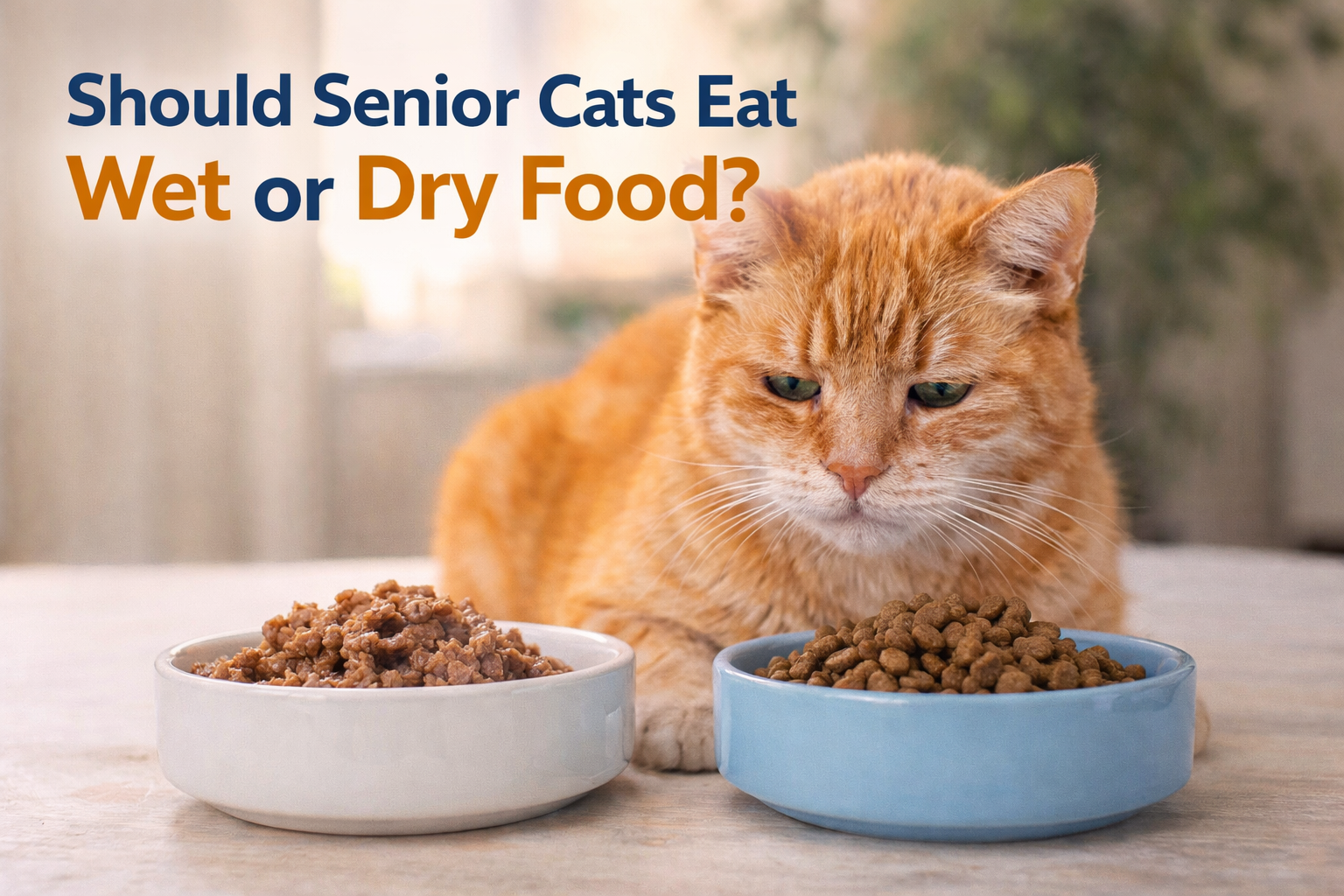
As your cat gets older, choosing the right food becomes more important. Senior cats can experience changes in appetite, body weight, muscle condition, dental health, thirst, and organ function. Some older cats need more calories to maintain their weight, while others become less active and need fewer calories. Cats with conditions such as chronic kidney disease, diabetes, dental disease, or gastrointestinal problems may also need a diet that is different from that of a healthy senior cat. That makes one question especially common: Should you feed your senior cat wet or dry food?
The answer is not simply “wet” or “dry.”
Both can provide complete and balanced nutrition when properly formulated. Wet food has a major advantage in moisture content, while dry food offers convenience, easy storage, and can work well for cats that prefer kibble.
For many senior cats, a combination of wet and dry food can be a practical option, but the right choice depends on the individual cat.
Quick Answer
Neither wet nor dry food is automatically best for every senior cat.
Wet food provides substantially more moisture and may be easier for cats with dental problems or reduced appetite to eat. Dry food is convenient, calorie-dense, easy to measure, and can be appropriate for healthy senior cats that eat it comfortably.
A combination of wet and dry food can also work well, provided the total daily calories are appropriate and both foods are nutritionally complete and balanced.
If your senior cat has kidney disease, dental disease, unexplained weight loss, diabetes, or another medical condition, ask your veterinarian which diet and feeding method are appropriate.
Why Do Senior Cats Have Different Nutritional Needs?
Getting older does not automatically mean a cat needs a completely different type of food.
However, aging is associated with changes that can affect nutrition and feeding.
Older cats may experience:
- Changes in activity level
- Loss of muscle mass
- Weight gain or weight loss
- Dental disease
- Reduced appetite
- Changes in smell and taste
- Changes in thirst
- Chronic kidney disease
- Hyperthyroidism
- Diabetes
- Gastrointestinal problems
Not every senior cat develops these problems.
In fact, healthy senior cats can have very different nutritional needs from one another.
A healthy 11-year-old cat that maintains an ideal body condition may not need the same diet as an 11-year-old cat with chronic kidney disease or painful dental disease.
Veterinary guidance therefore emphasizes evaluating senior cats individually rather than assuming that every older cat needs the same nutrient profile.
Wet Food for Senior Cats: What Are the Benefits?
Wet food has several characteristics that can make it useful for older cats.
1. Wet Food Provides More Moisture
This is one of its biggest advantages.
Dry cat food generally contains around 6% to 10% moisture, while canned food commonly contains around 70% to 80% water.
That means a cat eating wet food can obtain a substantial amount of its daily water intake directly from its meals.
Cats eating only dry food generally need to obtain more of their water by drinking.
Good hydration is important for cats of all ages, and it can become particularly important in older cats because diseases that increase water loss, including chronic kidney disease, diabetes, and hyperthyroidism, become more common with age.
Wet food does not “protect” the kidneys or prevent kidney disease by itself. Its advantage is that it can increase water intake as part of an overall feeding plan.
2. Wet Food Can Be Easier to Eat
Soft food can be easier for cats with painful or missing teeth to eat.
This can be especially useful when a senior cat begins showing signs such as:
- Dropping kibble
- Chewing differently
- Eating more slowly
- Avoiding dry food
- Drooling
- Bad breath
- Pawing at the mouth
However, switching to wet food should not be used to hide dental disease.
If your senior cat suddenly has difficulty chewing, a veterinary dental examination is important.
Cornell specifically notes that cats with periodontal disease may have difficulty chewing dry food and may benefit from wet food, smaller kibble, or water added to food.
3. Wet Food May Be More Appealing to Some Older Cats
Wet food often has a stronger smell and different texture than dry kibble.
That can make it appealing to cats whose appetite or sense of smell has changed with age.
But this is not universal.
Some senior cats strongly prefer dry food, while others prefer wet food.
The most important thing is that your cat eats enough of a nutritionally complete diet.
If an older cat suddenly loses interest in food, do not assume the problem is simply that they need tastier food. Appetite loss can be an important sign of illness.
4. Wet Food Can Help With Portion Control
Wet food often contains fewer calories per gram than dry food because of its high water content.
This can make it easier to feed a larger-looking portion for the same number of calories.
However, wet food is not automatically a weight-loss food.
A cat can still gain weight if it receives more calories than it needs.
Always consider the calorie content of the specific product and your cat’s individual calorie requirements.
What Are the Benefits of Dry Food for Senior Cats?
Dry food also has legitimate advantages.
It should not be described as an inappropriate food simply because a cat is old.
1. Dry Food Is Convenient
Dry food can be:
- Easy to store
- Easy to measure
- Convenient for busy households
- Less messy than some wet foods
- Available in many formulas
Once opened, dry food generally does not require refrigeration in the same way canned food does.
However, it should still be stored properly and protected from excessive heat, humidity, air, and contamination.
2. Dry Food Is Usually More Calorie-Dense
Because dry food contains much less water, it generally provides more calories in a smaller amount of food.
This can be useful for some cats that need to maintain or gain weight.
But it also makes portion control important for cats that are overweight or becoming less active.
A senior cat that continues eating the same amount of calorie-dense dry food while becoming less active may gradually gain excess weight.
3. Dry Food Can Be Easier to Measure
Measuring a specific amount of kibble can make calorie control straightforward.
This can be particularly useful if your veterinarian has recommended a specific daily calorie intake.
Do not rely blindly on the feeding chart on the package, though.
AAFCO notes that feeding directions are guidelines and may need to be adjusted based on an individual animal’s activity and condition.
4. Some Cats Simply Prefer Dry Food
Preference matters.
If a healthy senior cat eats a complete and balanced dry diet comfortably, maintains a healthy body condition, and drinks adequately, there is not automatically a reason to eliminate dry food.
The goal is appropriate nutrition, not choosing a particular food format simply because it is popular.
Does Dry Food Clean a Senior Cat’s Teeth?
This is one of the most common misconceptions about cat food.
Ordinary dry food should not be considered a substitute for dental care.
Although chewing some foods can have mechanical effects in the mouth, clinical evidence does not support the idea that simply feeding ordinary kibble prevents dental disease.
VCA notes that dry food alone does not improve feline oral health. Some specially designed dental diets may provide dental benefits because they are formulated specifically to affect plaque and the tooth surface.
The 2025 FelineVMA Feline Oral Health and Dental Care Guidelines also emphasize individualized dental care and active preventive oral health care for cats.
So:
Regular kibble ≠ dental treatment.
If dental health is a major concern, talk to your veterinarian about appropriate dental care and products with evidence supporting their dental claims.
Is Wet Food Better for Senior Cats Than Dry Food?
Not automatically.
Wet food has an important advantage because it provides substantially more moisture.
It may also be easier for a cat with dental discomfort to eat.
Dry food, however, can still be nutritionally appropriate and offers advantages in convenience, storage, calorie density, and portion measurement.
Cornell states that both high-quality wet and dry foods can provide complete and balanced nutrition, while wet food typically provides much more water.
So the better question is:
Which feeding format works best for this particular senior cat?
What About Feeding Both Wet and Dry Food?
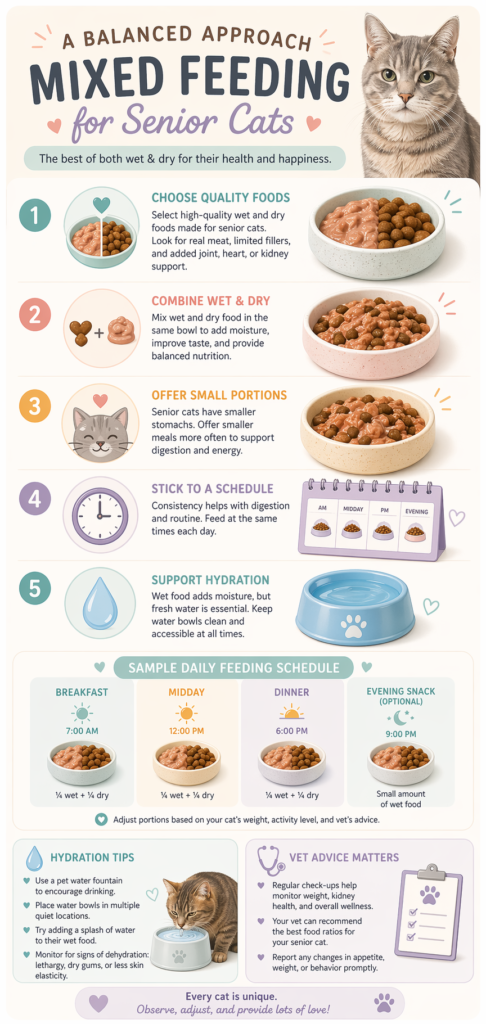
For many cats, mixed feeding is a practical option.
For example, you might feed a measured amount of dry food during one meal and wet food during another.
This can provide:
- Additional moisture from wet food
- The convenience of dry food
- Different textures
- Greater variety
- A feeding routine your cat enjoys
But mixed feeding does not automatically mean better nutrition.
The two foods should be nutritionally appropriate, and their calories need to be counted together.
For example, adding a full serving of wet food on top of the cat’s normal dry-food portion can result in overfeeding.
If your veterinarian has prescribed a therapeutic diet, do not mix foods without asking whether the combination is appropriate.
Cats with chronic kidney disease, for example, may need a specific therapeutic diet, and maintaining adequate food intake during dietary changes is particularly important.
Wet vs. Dry Food for Senior Cats
| Factor | Wet Food | Dry Food |
|---|---|---|
| Moisture | High | Low |
| Hydration support | Strong advantage | Requires more drinking |
| Ease of chewing | Usually easier | Can be difficult with dental pain |
| Calorie density | Usually lower | Usually higher |
| Storage | Refrigeration after opening usually needed | Easier to store |
| Convenience | Moderate | High |
| Palatability | Often appealing, but varies | Varies |
| Portion measurement | Possible | Usually very easy |
| Dental benefit | Not automatically | Ordinary kibble does not provide reliable dental care |
| Cost | Often higher | Often lower |
Neither column automatically wins. The appropriate choice depends on your cat.
How to Choose the Best Food for Senior Cat
Choosing food depends on your cat’s health and preferences. Here are some questions to ask:
| Question | Why It Matters |
|---|---|
| Does my cat have dental problems? | If yes, wet food is easier to eat. |
| Is my cat drinking enough water? | If no, wet food helps with hydration. |
| Does my cat like dry or wet food better? | Preference affects how much they eat. |
| Does my cat have any health issues? | Some diseases need special diets prescribed by vets. |
| What is my budget for cat food? | Dry food is usually less expensive. |
How Much Wet Food Should a Senior Cat Eat?
There is no universal amount such as “3 to 6 ounces per day” that applies to every senior cat.
The correct amount depends on:
- Your cat’s body weight
- Ideal body condition
- Activity level
- Age
- The calorie density of the specific food
- Whether other food is being fed
- Medical conditions
Two cans of different wet foods can contain very different amounts of calories. Instead of measuring food only by ounces or cans, look at the product’s calorie content and your veterinarian’s recommended daily intake.
If you feed both wet and dry food, count the calories from both.
How Often Should You Feed a Senior Cat?
Senior cats do not automatically need to eat three, four, or six meals a day. Cornell notes that cats 10 years and older can generally maintain the same feeding schedule as adult cats unless their veterinarian recommends otherwise.
Many cats do well with two measured meals per day. Some senior cats may do better with smaller, more frequent meals, particularly if they have a reduced appetite or other individual needs.
The important thing is to make sure your cat is eating enough and to monitor changes in appetite.
Should You Free-Feed Dry Food to a Senior Cat?
Free-feeding is not automatically harmful. Some cats can maintain an appropriate body condition while grazing.
However, it can make it harder to monitor how much a senior cat eats and may contribute to weight gain in cats that consume more calories than they need.
Measured feeding can make it easier to:
- Control calories
- Monitor appetite
- Track changes in food intake
- Adjust portions
- Identify possible health problems sooner
This is especially useful for senior cats because a noticeable change in appetite can be an early clue that something is wrong.
Tips for Feeding Your Senior Cat
1. Choose Complete and Balanced Food: Look for a nutritional adequacy statement showing that the food is complete and balanced for the appropriate life stage.
AAFCO identifies this statement as a key part of evaluating whether a pet food is nutritionally appropriate.
2. Monitor Your Cat’s Body Condition: Do not judge feeding only by the number on the scale. Muscle condition and body condition are both important in older cats. A senior cat can lose muscle while maintaining a similar body weight, so regular veterinary assessments are useful.
3. Keep Fresh Water Available: Provide clean, fresh water every day. Consider placing water in locations your cat can easily access. Some cats prefer fountains, while others prefer still water.
4. Consider Warming Wet Food Slightly: If your cat is reluctant to eat wet food, gently warming it can increase its aroma and may make it more appealing. Do not serve food hot. Test the temperature before offering it.
5. Do Not Ignore Appetite Changes: A senior cat that suddenly eats much less should not simply be assumed to be “getting picky.” Changes in appetite can accompany dental disease, kidney disease, hyperthyroidism, diabetes, gastrointestinal disease, and other conditions. Contact your veterinarian if the change persists or is accompanied by other symptoms.
6. Transition Food Gradually: Unless your veterinarian tells you otherwise, introduce a new food gradually. A sudden change can cause digestive upset and may make it difficult to determine whether your cat tolerates the new food. Some cats need a slower transition than others.
Signs Your Senior Cat May Need a Veterinary Checkup
Food changes should not be used to manage unexplained symptoms indefinitely.
Contact your veterinarian if your senior cat develops:
- Unexplained weight loss
- Sudden weight gain
- Reduced appetite
- Increased thirst
- Increased urination
- Repeated vomiting
- Persistent diarrhea
- Difficulty chewing
- Drooling
- Bad breath
- Reduced activity
- Difficulty jumping
- Muscle loss
- Sudden changes in behavior
These signs can have many possible causes.
For senior cats, finding the underlying problem is more important than repeatedly switching between food brands.
Wet or Dry Food for Senior Cats: What About Kidney Health?
This deserves special attention because it is often misunderstood. Wet food can help increase water intake, which is useful for cats that need better hydration. However, saying that wet food prevents kidney disease or automatically “protects the kidneys” would be too strong. Cats with chronic kidney disease have specific nutritional needs, and therapeutic kidney diets may help manage the disease. Both wet and dry therapeutic renal diets are available.
The priority is not simply choosing wet food. It is selecting an appropriate diet and maintaining adequate food and water intake under veterinary guidance.
What If My Senior Cat Refuses Wet Food?
Do not force a sudden switch simply because wet food is often recommended for older cats. Some cats strongly prefer dry food.
You can try:
- Different textures
- Different flavors
- Smaller portions
- Slightly warming the food
- Adding a small amount of water
- Offering wet food separately from dry food
If your cat continues eating their normal food but refuses wet food, this may simply be preference.
However, if your cat is refusing food altogether, that is different and deserves veterinary attention.
What If My Senior Cat Refuses Dry Food?
If your cat suddenly refuses dry food, do not automatically assume they have become picky. Dental pain is one possible reason. Other illnesses can also reduce appetite. If your cat is otherwise eating wet food comfortably, the immediate problem may be less about the food format and more about why they no longer want to chew kibble.
A veterinary examination is appropriate if the change is sudden or persistent.
Can Senior Cats Eat Both Wet and Dry Food Every Day?
Yes, provided the overall diet is nutritionally appropriate and the total amount of food is controlled. Many cats can eat a combination of wet and dry food successfully. The key is to account for the calories from both foods rather than treating one as an “extra.” If your cat is on a prescription diet, ask your veterinarian before combining different foods.
Frequently Asked Questions
Is wet food better for senior cats?
Not necessarily. Wet food provides more moisture and may be easier to eat, while dry food can also provide complete and balanced nutrition.
Should an older cat eat wet food or dry food?
Either can be appropriate if the food is complete and balanced. Some cats also do well with a combination of both.
Is wet food better for a senior cat’s kidneys?
Wet food can help increase water intake, but it does not prevent or treat kidney disease. Cats with kidney disease may need a therapeutic renal diet recommended by a veterinarian.
Does dry food cause dehydration in senior cats?
Not automatically, but dry food contains much less moisture than wet food. Always provide fresh water, especially for cats with increased hydration needs.
Does dry food help clean a senior cat’s teeth?
Ordinary dry food is not a reliable dental treatment. Special dental diets may provide dental benefits, but veterinary dental care is still important.
How much wet food should I feed my senior cat?
There is no universal amount. The right portion depends on the food’s calories, your cat’s weight, activity, and any other food they eat.
Can I feed my senior cat wet and dry food together?
Yes. Combining both can provide moisture while keeping the convenience of dry food, as long as total calories are controlled.
Should I switch my senior cat to wet food at age 10 or 11?
No, age alone does not require a switch to wet food. Choose the food format based on your cat’s health, appetite, dental condition, and preferences.
Is wet food better for an overweight senior cat?
Wet food can make calorie control easier because it is usually less calorie-dense than dry food. However, total daily calorie intake and portion size still matter most.
What is the best food for a senior cat with dental problems?
Soft wet food may be easier to eat, but it does not treat dental disease. A veterinary dental examination is important if your cat has trouble chewing or eating.
Can senior cats eat regular adult cat food?
Yes, if it is complete and balanced and suits the individual cat. A “senior” label is not automatically required at a specific age.
How often should I feed my senior cat?
Many senior cats can continue eating once or twice daily. Some may benefit from smaller, more frequent meals depending on their health and appetite.
Should I warm wet food for my senior cat?
Slightly warming wet food can make it more appealing by increasing its aroma. Make sure it is comfortably warm, not hot.
Finally
There is no universal winner between wet and dry food for senior cats. Wet food’s biggest advantage is moisture. It can also be easier for cats with dental problems to eat and may be more appealing to some cats.
Dry food’s biggest advantages are convenience, storage, calorie density, and easy portion measurement. It can be a perfectly appropriate part of a senior cat’s diet when the cat eats it comfortably and receives adequate water.
Mixed feeding is another reasonable option for many healthy cats.
The most important factors are not simply whether the food comes in a can or a bag. Look at:
- Whether the food is complete and balanced
- Your cat’s calorie needs
- Body condition and muscle condition
- Hydration
- Dental health
- Appetite
- Medical conditions
- Your cat’s individual preference
And remember one important rule:
If your senior cat suddenly stops eating, loses weight, drinks much more, urinates more, has trouble chewing, vomits repeatedly, or shows another significant change, do not assume the food format is the problem. Talk to your veterinarian.
For an aging cat, the best diet is the one that provides appropriate nutrition, supports the cat’s individual health needs, and is something they can comfortably and consistently eat.
References
- Cornell University College of Veterinary Medicine. Hydration in Cats
- Cornell University College of Veterinary Medicine. How Often Should You Feed Your Cat?
- VCA Animal Hospitals. Feeding Mature, Senior, and Geriatric Cats
- Feline Veterinary Medical Association. 2025 FelineVMA Feline Oral Health and Dental Care Guidelines
- AAFCO. Selecting the Right Pet Food