
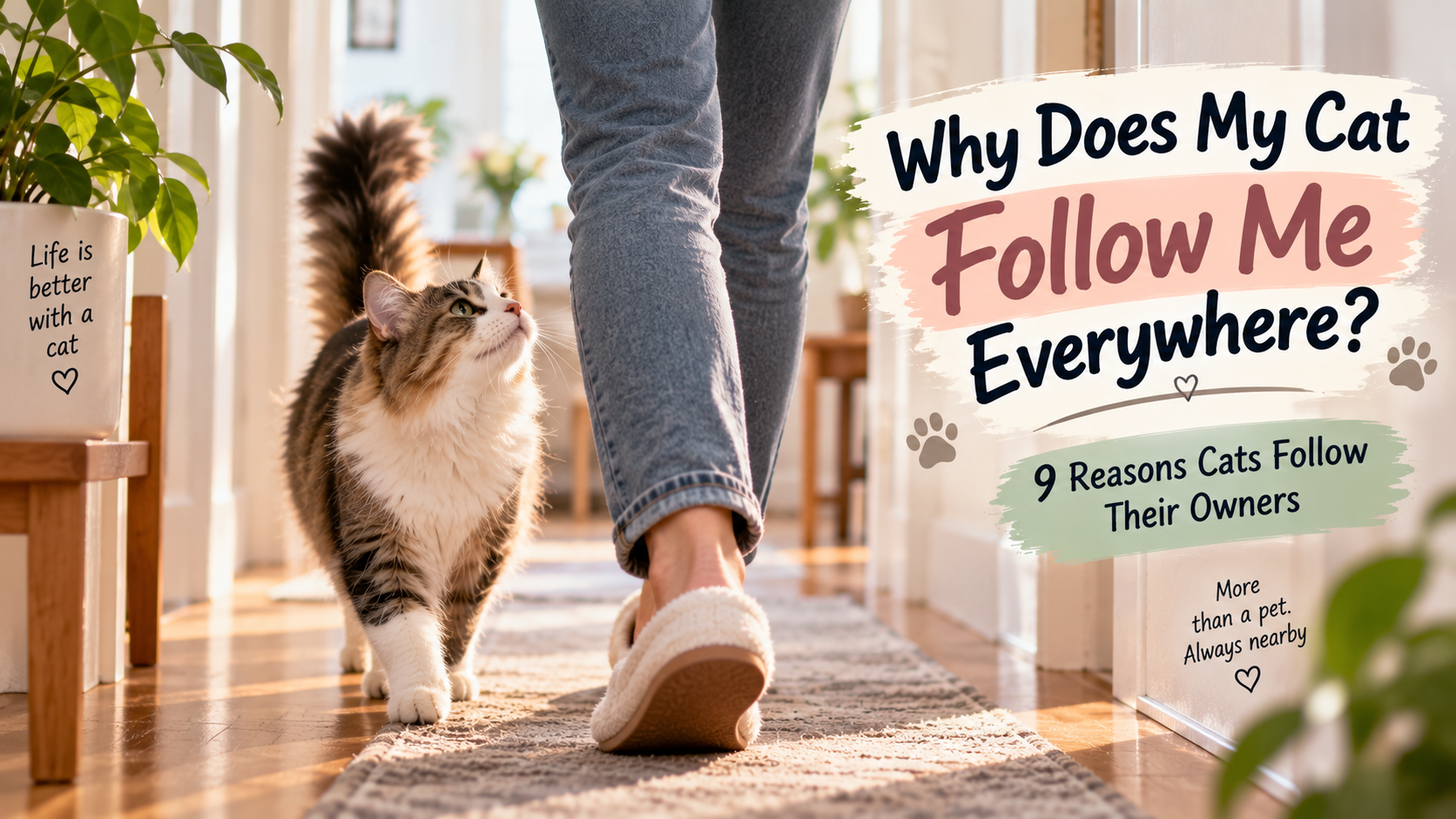
If your cat follows you from room to room, the most likely explanation is that your cat has learned that being near you is rewarding, interesting, or reassuring. Your cat may want attention, expect food, enjoy your company, be curious about what you’re doing, or simply have learned your daily routine.
Following you around the house does not automatically mean your cat is anxious or overly dependent. Cats develop different relationships with their owners, and individual personalities matter. Research on cat-owner relationships has found substantial variation in how cats relate to people, including differences in how much proximity to an owner they seek.
The clues are in what happens before, during, and after your cat follows you.
Why Does My Cat Follow Me Everywhere?
Your cat may follow you because you are associated with things your cat values: food, play, attention, warmth, safety, access to interesting places, or simple companionship.
Sometimes the reason is almost comically ordinary. You get up from the couch, and your cat gets up too. You walk into the kitchen, and your cat is suddenly right behind you. You head to the bathroom, and your cat appears at the door.
That pattern can become part of your cat’s routine.
The behavior becomes more meaningful when you look at the rest of your cat’s body language and what it does once it catches up with you.
A relaxed cat that follows you, settles nearby, and goes about its business is very different from a cat that becomes distressed whenever you leave its sight.
Here are nine common explanations.
Your Cat Feels Safe With You
Your cat may simply prefer being close to someone it knows well.
Cats can form individual relationships with people, and those relationships are influenced by the history of interactions between the cat and each person. Some cats actively seek more proximity to particular people.
If your cat follows you but seems relaxed, it may be choosing to stay near you because your presence is familiar and predictable.
You might notice your cat:
- Walking behind you without vocalizing
- Resting in the same room as you
- Sitting nearby while you work
- Following you and then settling down
- Choosing your bedroom or workspace as a resting area
This doesn’t necessarily mean your cat is thinking about you in human terms. It simply means that being near you may be part of what makes its environment comfortable and rewarding.
Your Cat Wants Attention
Sometimes your cat is following you because it wants you to interact with it.
The behavior can be especially obvious if your cat follows you and then:
- Rubs against your legs
- Meows
- Nudges your hand
- Brings you a toy
- Jumps beside you
- Looks at you expectantly
- Leads you toward a particular room
Cats can learn from experience that certain behaviors produce a response from their owners.
If following you reliably leads to petting, play, talking, or another form of interaction, your cat may keep doing it.
That doesn’t make the behavior manipulative in some sinister sense. It is simply learned behavior. The cat does something, something interesting happens, and the behavior may become more likely to occur again.
Your Cat Is Curious
Sometimes the answer is simply: you’re doing something interesting.
Cats are naturally attentive to changes in their surroundings. If you move from one room to another, open a cabinet, carry something unfamiliar, or start preparing food, your cat may want to investigate.
That’s particularly true for cats that enjoy exploring.
Your cat may follow you into the:
- Kitchen
- Bedroom
- Laundry room
- Bathroom
- Office
- Closet
- Garage or another accessible area
In this situation, your cat may not be following you as much as following the activity.
A useful clue is what happens once you stop moving. If your cat immediately starts sniffing, looking around, watching an object, or exploring the room, curiosity may be the main explanation.
Your Cat Associates You With Food
If your cat becomes your shadow whenever you walk toward the kitchen, food may be involved.
Cats are excellent at learning routines. If you usually prepare their meals at a particular time, your cat may begin following you when it recognizes the sequence of events that normally comes before feeding.
You may notice a predictable pattern:
You stand up → cat follows → you enter kitchen → cat heads toward food area.
Your cat may also follow you around meal times because you are associated with treats or other rewarding experiences.
If following you has repeatedly resulted in food, the behavior can become part of your cat’s learned routine.
That doesn’t necessarily mean your cat is hungry every time it follows you. Look at the timing and what your cat does next.
Your Cat Wants Companionship
Not every cat wants to spend all day on someone’s lap.
Some cats prefer a quieter form of companionship: simply being in the same room.
Your cat may follow you into the bedroom and sleep on the floor. It may sit nearby while you work. It may follow you into the bathroom and wait outside the shower.
That is still social contact.
Research on cat-human interactions shows that relationships between cats and their owners can take different forms, and individual cats vary in how much proximity they seek.
So if your cat follows you but doesn’t constantly demand petting, don’t assume it is uninterested in you.
For some cats, being near you is the interaction.
Your Cat Has Learned Your Routine
Cats are creatures of habit, and your daily movements can become predictable cues.
Your cat may learn that:
- You go to the kitchen after waking up
- You sit at your desk during certain hours
- You prepare dinner in the evening
- You go to bed at roughly the same time
- You leave the house at predictable times
- You return through the same door
Once your cat recognizes these patterns, following you can become part of its own daily schedule.
This also explains why some cats seem to know exactly where you’re going before you’ve done anything obvious.
Your cat may have learned the small signals that come before familiar activities.
The behavior doesn’t necessarily require a complicated explanation. Sometimes your cat has simply become very good at predicting what happens next.
Your Cat Is Bored
Following can also be a sign that your cat needs something more interesting to do.
This is especially worth considering if your cat follows you constantly but doesn’t seem particularly interested in food, affection, or resting nearby.
A cat that lacks enough environmental stimulation may look for activity wherever it can find it.
Signs that boredom may be contributing include:
- Excessive attention-seeking
- Repeatedly initiating play
- Knocking objects over
- Scratching inappropriate surfaces
- Restlessness
- Chasing people or feet
- Becoming unusually vocal
Cornell notes that behaviors such as scratching and other destructive activities can be normal feline behaviors related to investigation, play, and marking, rather than deliberate misbehavior. Providing appropriate outlets can help cats express these behaviors in acceptable ways.
If your cat seems bored, try increasing opportunities for independent activity.
A cat tree, scratching post, window perch, rotating selection of toys, puzzle feeder, or short interactive play sessions can make the home more engaging.
Your Cat May Be Anxious
Following is not always about affection or curiosity.
Some cats become unusually dependent on their owner’s presence when they are stressed or anxious.
The key is to look for other signs of anxiety.
A potentially anxious cat may also:
- Vocalize more than usual
- Hide when left alone
- Become restless
- Have changes in appetite
- Groom excessively
- Become destructive
- Show changes in litter-box behavior
- Appear tense or easily startled
A cat that simply likes staying near you is not necessarily anxious.
The difference is often in the cat’s emotional state. A relaxed cat can follow you and then happily settle somewhere nearby. An anxious cat may appear unable to settle when you move away or may show distress when you leave.
Sudden behavior changes also deserve more attention than a long-standing habit.
Cornell’s feline behavior guidance emphasizes that behavior problems can have multiple causes and that identifying the underlying trigger is important when a behavior becomes problematic.
When Following Behavior May Signal a Problem
Following you around the house is usually not a problem by itself.
What matters is whether the behavior is new, extreme, or accompanied by other changes.
For example, suppose your cat has always followed you from room to room. That is probably just part of its normal personality and routine.
But if a previously independent cat suddenly becomes intensely attached to you while also becoming vocal, restless, withdrawn, unusually hungry or thirsty, or different around the litter box, that deserves a closer look.
A sudden change in behavior can sometimes accompany stress or an underlying health problem.
You should consider talking with your veterinarian if following behavior appears alongside:
- Sudden changes in appetite or drinking
- Weight loss or gain
- Significant changes in vocalization
- Confusion or disorientation
- Changes in litter-box habits
- Persistent restlessness
- Excessive grooming
- Hiding
- Signs of pain
- Major changes in sleep or activity
Cats can show behavioral changes for both environmental and medical reasons, so it is risky to assume that a sudden personality change is purely emotional. Cornell’s veterinary guidance similarly recommends considering underlying medical causes when a cat develops significant behavior changes.
Why Does My Cat Follow Me Everywhere in the House?
If your cat follows you from room to room, the behavior may simply reflect a combination of curiosity, routine, attention, and companionship.
Think about what happens when you stop.
If your cat follows you into the bedroom and then curls up on the bed, that’s different from following you while repeatedly crying, pacing, or becoming distressed when you close a door.
The location can also provide clues.
Why does my cat follow me to the bathroom?
Bathrooms are interesting places from a cat’s perspective. You may spend several minutes there, the room contains unusual smells and sounds, and the door may sometimes be closed.
If your cat follows you into the bathroom, it may simply be curious or seeking company.
Some cats also learn that following their owner into the bathroom gets them attention.
You can learn more about this specific behavior in our guide to why cats follow their owners to the bathroom.
Why Does My Cat Follow Me but Not My Partner?
This is a common situation, and it doesn’t necessarily mean your cat dislikes your partner.
Cats can develop different relationships with different people.
Your cat may prefer you because you:
- Feed it more often
- Play with it more
- Spend more time at home
- Respond more consistently to its signals
- Give it treats
- Provide more opportunities for interaction
- Have a quieter or more predictable interaction style
Research on cat-owner relationships suggests that individual relationships can differ substantially and that both cat personality and human interaction patterns contribute to the relationship.
So if your cat follows you but not your partner, don’t automatically interpret that as a popularity contest.
Your cat may simply have learned that you are the person most closely associated with the things it values.
How to Respond When Your Cat Follows You Everywhere
If the behavior is relaxed and isn’t causing a problem, you don’t necessarily need to stop it.
Instead, make sure your cat has enough opportunities to choose what it wants to do.
Give your cat appropriate attention
If your cat wants interaction, offer short periods of play or petting when appropriate.
You don’t need to respond every single time your cat follows you.
Add more enrichment
If boredom appears to be part of the problem, increase independent activities.
Try:
- Puzzle feeders
- Interactive toys
- Scratching posts
- Cat trees
- Window perches
- Rotating toys
- Short hunting-style play sessions
Let your cat have a safe place to settle
Your cat should have comfortable places where it can rest without being disturbed.
A cat that follows you doesn’t need to be beside you every second.
Avoid punishing the behavior
Following is normal feline behavior in many households.
Scolding, pushing, or frightening your cat is unlikely to teach it what you actually want. If the behavior is becoming disruptive, focus instead on providing appropriate alternatives and understanding what is maintaining the behavior.
If the behavior is sudden or accompanied by other concerning changes, investigate the underlying cause rather than simply trying to suppress it.
Questions Cat Owners Often Ask
Why does my cat always follow me?
Your cat may follow you because it enjoys your company, wants attention, expects food, is curious about what you’re doing, or has learned your daily routine. If the behavior is relaxed and long-standing, it is often simply part of your cat’s normal personality.
Why does my cat follow me around but not my partner?
Cats can develop different relationships with different household members. Your cat may follow you more because you feed it, play with it, spend more time with it, or interact with it in a way the cat prefers.
Why does my cat follow me everywhere in the house?
Your movements may be interesting to your cat, or your cat may associate you with food, attention, play, and companionship. Following can also become a learned part of your cat’s daily routine.
Why does my cat follow me to the bathroom?
Your cat may be curious about what you’re doing, want company, or have learned that the bathroom is a place where it can interact with you. Some cats also dislike closed doors and want to know what is happening on the other side.
Does my cat follow me because it loves me?
Following can be part of a close relationship, but the behavior alone doesn’t prove affection. Look at the bigger picture. A relaxed cat that voluntarily stays near you, seeks interaction, and appears comfortable around you may simply enjoy your company.
Should I worry if my cat suddenly starts following me everywhere?
A sudden change is more worth investigating than a long-standing habit. If increased following occurs alongside changes in appetite, drinking, litter-box use, grooming, vocalization, activity, or general behavior, contact your veterinarian.
Final Thoughts
When your cat follows you from the bedroom to the kitchen, then waits outside the bathroom while you wonder why you can’t have five minutes alone, there’s usually no mysterious explanation.
Your cat may be interested in what you’re doing, expecting food, looking for attention, enjoying your company, or simply following a routine it has learned.
The important part is context.
A relaxed cat that follows you and then settles nearby is behaving very differently from a cat that becomes distressed whenever you disappear. And a sudden change in following behavior deserves more attention than a habit your cat has had for years.
If your cat is otherwise healthy, relaxed, eating normally, and behaving as usual, you can generally treat the following as one more part of its individual personality.
Sometimes your cat just wants to know where you’re going.