
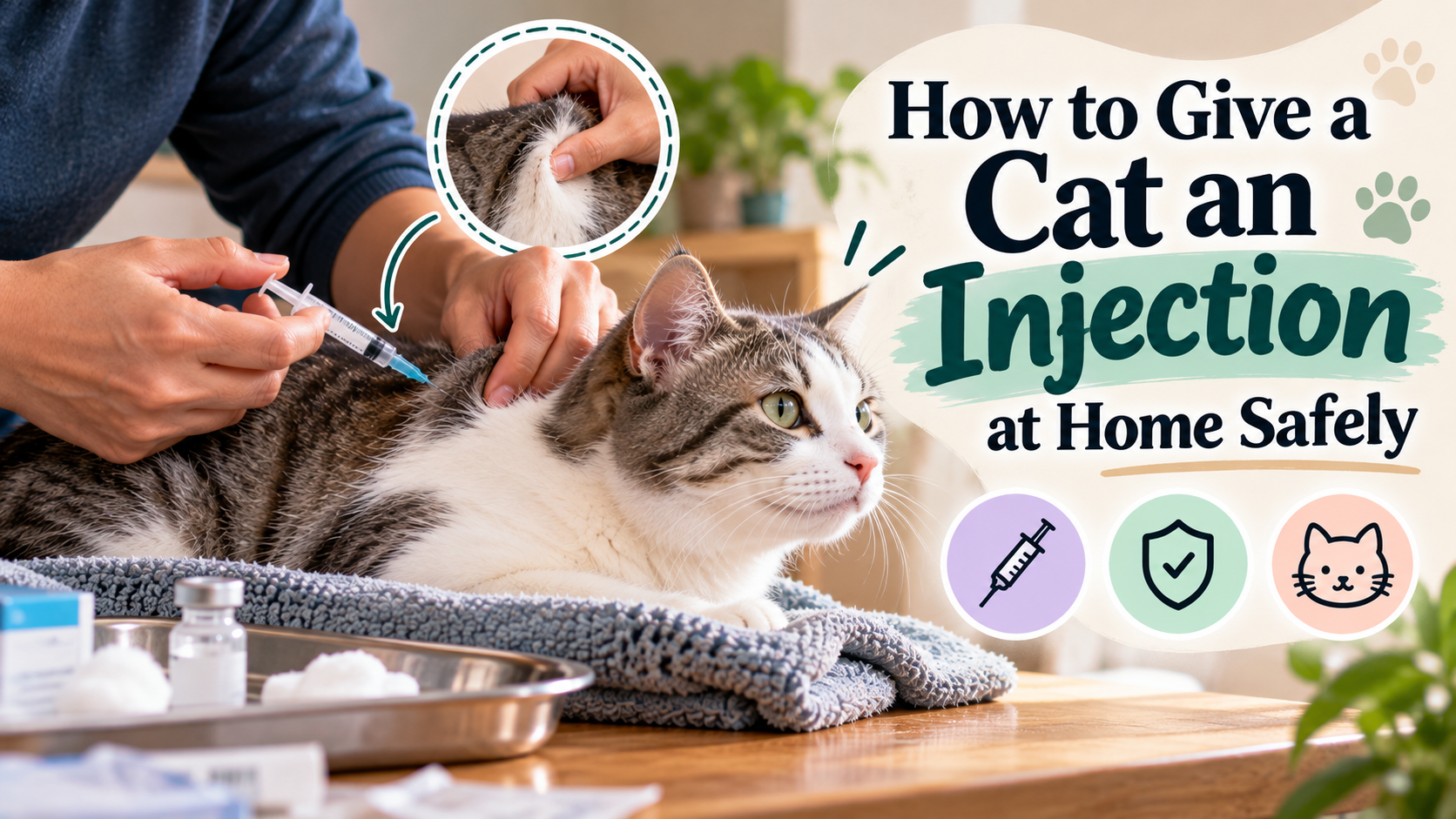
Giving your cat an injection at home can feel intimidating, especially the first time. The good news is that many cats can receive certain subcutaneous injections—injections given under the skin—at home with practice and calm handling.
Only give an injection after your veterinarian has shown you exactly what to do and has prescribed the medication for your cat. The correct needle, dose, injection site, storage method, and schedule depend on the medicine. Never guess at any of these details.
This guide explains how to give a cat an injection at home, mainly for prescribed subcutaneous medications such as some insulin, fluids, and other treatments. It does not replace hands-on veterinary instruction. Do not use these steps to give an intravenous, intramuscular, or any other injection unless your veterinary team has specifically trained you to do so.
Before you give your cat an injection
The safest injection is one you have prepared for carefully. Ask your veterinarian or veterinary technician to demonstrate the process and watch you do it once before you try it alone.
Make sure you know:
- The medication’s name and purpose
- The exact dose and how often to give it
- Whether the injection goes under the skin, into a muscle, or somewhere else
- Which syringe and needle size to use
- Where on your cat’s body to inject
- How to store and handle the medication
- What to do if you miss a dose, spill medication, or inject the wrong amount
- How to dispose of used needles and syringes
If anything about the instructions is unclear, stop and call the veterinary clinic. A quick question is safer than making an assumption.
When you should not give the injection yet
Pause and contact your veterinarian if:
- The medication looks different from usual, unless your veterinarian told you to expect that change
- The vial is expired, damaged, contaminated, or has particles that should not be there
- You are unsure whether the medication was already given
- Your cat is vomiting, extremely weak, collapsed, having trouble breathing, or acting seriously ill
- The prescribed dose or instructions do not match what you were told
- The injection site is swollen, bruised, infected, or unusually painful
For insulin or other medicines that affect blood sugar, ask your veterinarian what to do if your cat refuses food, vomits, or seems unwell. Do not automatically give the usual dose in these situations.
Supplies you’ll need
Gather everything before bringing your cat over. This helps keep the process short and prevents you from leaving a needle or open medication unattended.
You may need:
- The prescribed medication
- The correct syringe and needle
- A clean, stable surface
- A treat or small amount of your cat’s favorite food
- A towel, if your cat needs gentle support
- A sharps container approved for used needles and syringes
- Good lighting
Check the label and expiration date. Confirm the medication, dose, and cat before drawing it up. If your veterinarian told you to mix, roll, or shake the medication, follow those directions exactly. Some medications should not be shaken.
Do not reuse needles or share syringes between cats unless your veterinary team has given you specific instructions. A used needle is duller and can make the next injection more uncomfortable. Never throw loose needles into a household trash can.
How to give a cat an injection at home: step by step
The following steps describe a typical subcutaneous injection. Your veterinarian’s instructions always take priority.
1. Choose a calm time and place
Pick a quiet room where your cat usually feels comfortable. Turn off loud appliances and keep other pets and children away for a few minutes.
Many cats do better when the injection is part of a familiar routine. Speak normally, move slowly, and avoid chasing your cat around the home. Chasing can make future injections harder because your cat may start to associate you with fear.
If your cat is already frightened or struggling, take a short break if it is safe to do so. Forcing the procedure can lead to scratches, bites, or a damaged relationship with your cat. Ask the veterinary clinic for a different handling plan if injections are becoming a daily battle.
2. Prepare and check the medication
Wash your hands. Prepare the medication and syringe exactly as your veterinarian demonstrated.
Before injecting, check:
- The medication name
- The dose in the syringe
- The appearance of the medication
- The correct needle and syringe
- The injection schedule
Hold the syringe with the needle pointed safely away from yourself and your cat. Keep the needle sterile. Do not let it touch the table, your hands, your cat’s fur, or another surface.
If you are giving insulin, use the syringe made for that insulin. Insulin syringes can have different markings, and using the wrong type can cause a serious dosing error.
3. Position your cat comfortably
Your cat may sit, stand, or lie down, depending on what is most relaxed. Some cats will stay still for a quick injection while eating a treat. Others need a second person to gently steady them.
Use only the amount of restraint needed to keep everyone safe. A towel can help contain paws, but it should never make your cat overheat or interfere with breathing. Never pin a cat down by force or hold the scruff tightly as your main restraint method.
If your cat becomes increasingly agitated, stop and contact your veterinarian for help. A trained technician may be able to show you a safer position or suggest ways to make the procedure easier.
4. Pick the site your veterinarian recommended
For a subcutaneous injection, the needle goes into the loose layer of tissue beneath the skin. Your veterinarian may recommend an area along the back or sides, but the exact site depends on the medication and your cat’s treatment plan.
Do not inject into skin that is:
- Red, swollen, bruised, scabbed, or infected
- Wet or dirty
- Firm, thickened, or painful
- Already irritated from recent injections
If you have been told to rotate injection sites, keep a simple record of where and when you gave each dose. Rotating sites can help prevent repeated irritation in one area.
5. Lift a small tent of skin
With your free hand, gently pinch a fold of loose skin to form a small tent. Do not grab muscle, pull hard, or pinch so tightly that your cat reacts in pain.
The amount of loose skin varies from cat to cat. Your veterinarian should show you how much to lift and where to place your fingers. If you have trouble identifying the right area, ask for another demonstration rather than trying to work it out alone.
6. Insert the needle as you were taught
Hold the syringe as your veterinary professional demonstrated. Insert the needle into the base or side of the skin tent at the recommended angle. Use a smooth, confident motion rather than slowly poking at the skin.
The needle should enter the space under the skin—not straight through the skin fold and out the other side, and not deeply into muscle. Never aim toward your cat’s spine or push the needle farther than instructed.
If your cat suddenly cries out, jerks away, or you feel unusual resistance, stop. Do not force the needle. Your veterinarian can explain what to do if the needle slips, bends, or does not enter properly.
7. Inject the medication slowly
Once the needle is in the correct position, press the plunger steadily as you were shown. Keep the syringe stable. A slow, controlled injection is usually less startling than quickly forcing the medication in.
Do not pull back on the plunger or change the technique unless your veterinarian specifically instructed you to do so. Different medications and injection methods have different requirements.
8. Remove the needle and reward your cat
Remove the needle smoothly, then release the skin. A tiny drop of blood can happen occasionally. If you see a small spot, apply gentle pressure with clean gauze for a moment.
Do not rub the injection site unless your veterinary team told you to. Offer a treat, praise, playtime, or another reward your cat enjoys. The reward should come immediately so your cat begins to connect the routine with something positive.
Place the used needle and syringe directly into the sharps container. Never recap a needle unless your veterinarian has specifically taught you a safe method for doing so. If the needle falls onto the floor, keep people and pets away while you pick it up safely.
What if some medication leaks out?
A small wet spot on the fur may mean that part of the medication leaked or that the needle passed through the skin tent. Do not automatically give another full dose. You may accidentally give too much.
Write down what happened and call your veterinarian. Tell them the medication, prescribed dose, approximate amount that may have leaked, and when the injection occurred. They can tell you whether to repeat the dose or wait until the next scheduled time.
The same rule applies if you are unsure whether the injection was given, the syringe was empty, or your cat moved during the procedure: do not guess.
What to do if your cat won’t cooperate
Some cats accept injections after a few calm practice sessions. Others become more upset over time. You can often improve the experience by:
- Practicing touch near the injection area without using a needle
- Giving treats after calm behavior
- Preparing the syringe out of your cat’s sight
- Using a consistent location and routine
- Keeping sessions brief
- Having a helper offer food while you give the injection
- Asking your veterinarian whether a different needle or technique is appropriate
Never punish, yell at, or chase your cat for resisting. That can make fear worse and may cause defensive biting or scratching.
If you cannot safely give the injection, contact your veterinary clinic. The team may administer it for you, provide more training, adjust the treatment plan, or recommend a different form of medication when one is available.
After the injection: what is normal and what is not?
Your cat may briefly twitch, turn around, lick the area, or act mildly annoyed. A small amount of tenderness can occur. Keep watching your cat for changes, especially when giving a new medication.
Contact your veterinarian promptly if you notice:
- Increasing swelling, heat, redness, or pain at the injection site
- Persistent bleeding
- Hives, facial swelling, severe itching, or sudden vomiting
- Weakness, collapse, confusion, tremors, or seizures
- Trouble breathing
- Severe lethargy or behavior that is very different from normal
Trouble breathing, collapse, seizures, or rapidly worsening swelling can be an emergency. Seek urgent veterinary care rather than waiting for a routine callback.
If your cat receives insulin, learn the warning signs of low blood sugar from your veterinarian. These may include unusual weakness, wobbliness, confusion, tremors, seizures, or collapse. Your veterinarian should give you a specific emergency plan, including what to do and where to go.
Common mistakes to avoid
A few simple errors can create unnecessary risk. Avoid these common problems:
- Giving a medication that was not prescribed for this cat
- Guessing the dose or using a household measuring device
- Using the wrong syringe type
- Injecting into muscle when you were taught a subcutaneous technique
- Repeating a dose after a leak without veterinary advice
- Injecting through dirty, irritated, or infected skin
- Reusing needles
- Leaving medication or sharps where children or pets can reach them
- Skipping a dose and then doubling the next one
- Continuing to wrestle with a cat that is panicking
Keep a written log with the date, time, medication, dose, injection site, and any unusual reaction. This is especially helpful when several people care for the cat.
A quick safety checklist
Before each injection, ask yourself:
- Is this the correct medication for the correct cat?
- Is the dose and schedule clear?
- Am I using the correct syringe and needle?
- Does the medication look and smell as expected?
- Is the injection site healthy?
- Can I complete the injection without unsafe restraint?
- Do I know what to do if the dose leaks or I make a mistake?
- Is the sharps container ready?
If the answer to any question is no, pause and contact your veterinary team.
Final takeaways
Learning how to give a cat an injection at home is possible for many owners, but it should begin with hands-on instruction from a veterinarian or veterinary technician. Use the prescribed medication and dose, follow the recommended injection site and technique, keep your cat calm, and dispose of the needle safely.
The most important safety rule is simple: don’t guess. If you are unsure whether the entire dose went in, your cat seems ill, or the injection becomes unsafe, call your veterinarian for instructions. A short delay and a professional answer are much safer than giving an extra dose or continuing a stressful struggle.