
The most important fact about the early signs of heart disease in cats is that there may be no visible signs at all.
A cat can have significant changes in the heart muscle while continuing to eat, sleep, play, and behave normally. The first clue may be a heart murmur, an unusual rhythm, or an abnormal blood test found during a routine veterinary visit. Some cats are not diagnosed until they develop rapid breathing, congestive heart failure, a painful blood clot, or sudden collapse.
When outward changes do appear, the most useful early clues include:
- a consistently faster sleeping or resting breathing rate
- more effort required to breathe
- less interest in play or jumping
- unusual tiredness or hiding
- reduced appetite
- weakness or brief collapse
- an abnormal heart sound found during an examination
These changes do not confirm heart disease. Asthma, pneumonia, pain, anemia, hyperthyroidism, high blood pressure, fever, cancer, and other conditions can produce similar symptoms. Veterinary testing is necessary to determine whether the heart is responsible.
Two signs should never be watched at home to “see whether they improve”: difficulty breathing and sudden loss of normal leg function. Both require emergency veterinary care.
A cat’s heart can change long before behavior does
The most common feline heart disorder is hypertrophic cardiomyopathy, usually shortened to HCM. In HCM, the muscular wall of the left ventricle becomes abnormally thick. The ventricle may then have difficulty relaxing and filling normally between beats, even when its ability to contract still appears strong.
A large prospective screening study found HCM in 14.7% of apparently healthy cats. This estimate is often summarized as roughly one in seven cats, although prevalence can differ according to the population studied and the diagnostic criteria used.
Many affected cats remain in a subclinical stage, meaning that structural disease is present but the cat has no outward symptoms. Some remain stable for years. Others eventually develop one or more serious complications:
- congestive heart failure
- a blood clot that blocks an artery
- an abnormal heart rhythm
- fainting or collapse
- sudden cardiac death
The REVEAL study followed cats with preclinical HCM over many years and confirmed that a meaningful proportion eventually developed congestive heart failure, arterial thromboembolism, or both. The course remained highly variable, which is why an HCM diagnosis does not predict the same future for every cat.
Breathing is the most useful change an owner can monitor
Heart disease itself may be silent, but fluid accumulation caused by congestive heart failure often changes how a cat breathes.
When pressure rises in the vessels associated with the lungs, fluid may leak into the lung tissue, known as pulmonary edema, or collect in the space surrounding the lungs, known as pleural effusion. Either problem limits comfortable breathing.
A cat may respond by:
- breathing faster while asleep
- using the abdominal muscles more forcefully
- sitting upright instead of lying comfortably
- extending the head or neck
- holding the elbows away from the body
- appearing restless or unable to settle
- breathing with the mouth open
Open-mouth breathing in a resting cat is an emergency. Unlike dogs, cats do not normally pant after mild activity or because the room is slightly warm. A cat struggling to breathe should be transported to an emergency veterinary facility with as little handling and stress as possible.
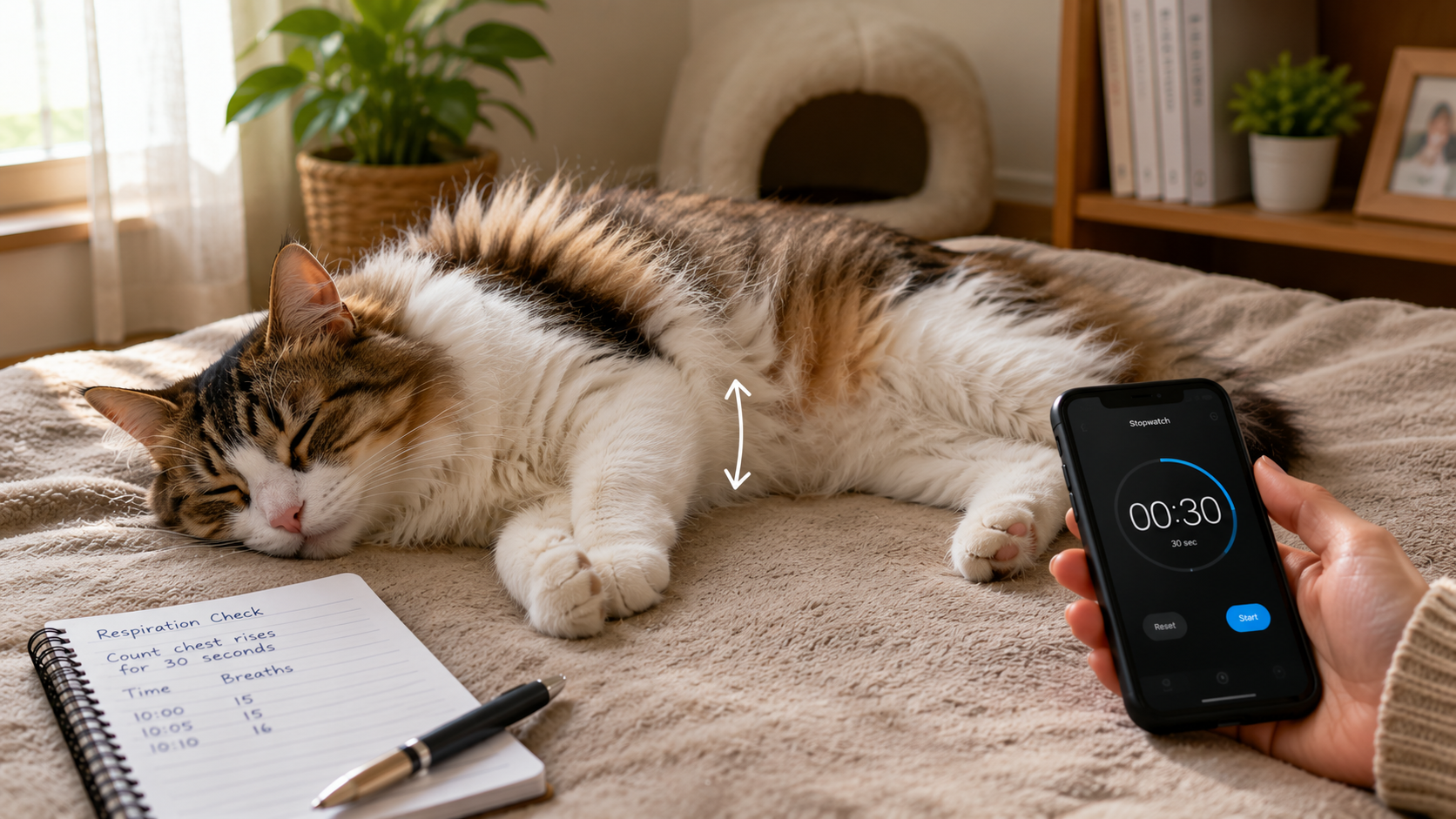
How to count a cat’s sleeping respiratory rate
Choose a time when your cat is fully asleep or resting quietly. Do not count while the cat is purring, grooming, dreaming actively, or recovering from play.
Watch the chest or side of the abdomen. One rise and fall is one breath.
Count for 30 seconds and multiply the number by two. You can also count for a full minute if the breathing pattern is difficult to follow. Record the result so that you can identify your cat’s usual range rather than relying on memory.
Cornell describes a normal resting respiratory rate as approximately 15 to 30 breaths per minute and advises veterinary consultation when the resting rate is above 35. Research involving healthy cats and cats with subclinical heart disease also found that sleeping rates were generally below 30 breaths per minute.
A number is not the only concern.
A cat breathing 28 times per minute with obvious abdominal effort may need help more urgently than a relaxed cat with a one-time count of 34 after changing position. Contact a veterinarian when the rate is repeatedly higher than your cat’s normal baseline, rises over several days, or is accompanied by effort, weakness, appetite loss, or restlessness.
Quiet lifestyle changes can be easy to misread
A cat with early or progressing heart disease may conserve energy without appearing dramatically ill.
Instead of showing obvious “exercise intolerance,” the cat may stop initiating play, take a lower route onto furniture, pause during activity, or choose sleeping places that are easier to reach. In a multi-cat household, an affected cat may no longer chase or wrestle with the other cats.
Other possible changes include:
- sleeping more than usual
- hiding in quiet areas
- interacting less with people
- grooming less effectively
- eating smaller meals
- appearing weak after activity
- briefly losing balance or collapsing
These signs have many possible causes. Arthritis, kidney disease, anemia, pain, diabetes, dental disease, thyroid disease, and normal changes in routine may produce similar behavior.
The value comes from the pattern. A cat that is less active and breathing faster while asleep deserves more urgent attention than a cat that skips one play session but otherwise acts normally.
Coughing is not the classic feline heart symptom.
Many people associate heart disease with coughing because cough is common in dogs and people with certain cardiac conditions.
Cats are different.
Cornell notes that cats very rarely cough because of heart disease. A coughing cat is more likely to have an airway or lung disorder, such as feline asthma. However, a full veterinary evaluation may still be needed to distinguish respiratory disease from heart failure.
Do not wait for a cough before considering the heart. Rapid breathing, increased breathing effort, low energy, and sudden weakness are more useful feline warning signs.
A heart murmur is a clue, not a diagnosis.
A murmur is an abnormal sound created by turbulent blood flow. A veterinarian may hear it with a stethoscope during a routine examination.
Murmurs matter, but they do not provide a simple yes-or-no answer.
Some cats with significant cardiomyopathy have no detectable murmur. Other cats have murmurs caused by stress, high heart rate, anemia, hyperthyroidism, or blood-flow patterns that are not associated with structural heart disease. In the CatScan study, many murmurs detected in apparently healthy cats were considered functional rather than evidence of HCM.
Other examination findings that may increase concern include:
- a gallop rhythm
- an irregular heartbeat
- a heart rate that remains unusually fast
- weak pulses
- abnormal lung sounds
- high blood pressure
- muffled heart or lung sounds
- visible breathing difficulty
A normal stethoscope examination cannot exclude every form of cardiomyopathy. Echocardiography may still be appropriate when a cat has symptoms, belongs to a higher-risk family, has an abnormal cardiac biomarker result, or needs additional assessment before anesthesia or breeding.
“Can’t breathe” and “can’t walk” are the two critical emergencies.
Advanced feline cardiomyopathy often becomes visible through one of two crises.
The cat cannot breathe normally.
Congestive heart failure may cause fluid to accumulate in or around the lungs. The cat may breathe rapidly, use the abdominal muscles, sit with the neck extended, or breathe through an open mouth.
Do not force food, water, or oral medication into a cat that is struggling to breathe. Avoid unnecessary restraint. Call the emergency clinic while preparing to leave so the veterinary team can be ready to provide oxygen and stabilize the cat before performing stressful diagnostic procedures.
The cat suddenly cannot use one or more legs.
Cardiomyopathy can allow blood to stagnate within an enlarged left atrium, increasing the risk that a clot will form. A fragment may travel through the arteries and block blood flow, most commonly near the point where the aorta divides to supply the rear legs. This is called feline arterial thromboembolism or aortic thromboembolism.
Possible signs include:
- sudden rear-leg weakness or paralysis
- dragging one or both hind legs
- severe pain or vocalizing
- cold paws or legs
- pale, blue, or gray paw pads
- rapid breathing
- extreme distress
A clot may occasionally affect a front leg or another organ instead. Any sudden limb paralysis or severe unexplained limb pain is an emergency.
Do not massage or warm the affected limb aggressively. Place the cat in a secure carrier, minimize movement, and seek immediate veterinary care.
Heart disease is a category, not one diagnosis.
“Heart disease” includes disorders with different causes, structures, risks, and treatment needs.
Hypertrophic cardiomyopathy
HCM causes abnormal thickening of the left ventricular muscle and is the most common feline cardiomyopathy. The underlying cause is unknown in many cats, but inherited variants have been identified in some family lines and breeds.
Restrictive cardiomyopathy
Restrictive cardiomyopathy involves abnormal stiffness or scar tissue that prevents the ventricles from relaxing and filling properly. Significant enlargement of the atria and congestive heart failure may develop.
Dilated cardiomyopathy
In dilated cardiomyopathy, the heart chambers enlarge and the ventricular muscle contracts weakly. Taurine deficiency was once an important cause in cats, but the condition became much less common after commercial cat foods were routinely supplemented with adequate taurine. Other causes remain possible.
Giving taurine supplements to a cat eating a complete and balanced commercial diet does not prevent HCM. Supplements should be used only when a veterinarian identifies a reason for them.
Arrhythmogenic and nonspecific cardiomyopathies
Some cats develop structural patterns that do not fit neatly into the more familiar categories. Others have important electrical abnormalities or inflammation of the heart muscle. Echocardiography, electrocardiography, clinical history, and other testing help the veterinary team classify the problem.
Congenital heart disease
Some kittens are born with abnormal valves, openings between heart chambers, or blood vessels that fail to close normally. Congenital disabilities are less common than acquired cardiomyopathy but may cause a murmur, poor growth, weakness, breathing trouble, or heart failure.
Not every thickened heart is primary HCM.
A thickened left ventricular wall does not automatically establish primary hypertrophic cardiomyopathy.
Systemic high blood pressure forces the heart to pump against greater resistance and can cause the ventricular walls to thicken. Hyperthyroidism increases heart rate and contractile force and can produce similar cardiac changes. Treating the underlying thyroid disorder or hypertension may allow some of those changes to improve.
Veterinarians may also consider dehydration, congenital disease, growth-hormone excess, inflammation, and other less common explanations.
That distinction matters because the treatment plan depends on the cause. A cat with primary HCM, a cat with uncontrolled hyperthyroidism, and a cat with systemic hypertension may have similar-looking heart measurements but different medical needs.
Which cats have a higher risk?
Heart disease can affect any cat, including young mixed-breed cats with no known family history.
Risk is higher in some situations:
- a close relative has HCM
- the cat belongs to a breed with increased HCM prevalence
- a murmur, gallop sound, or arrhythmia has been detected
- the cat has systemic hypertension
- the cat has hyperthyroidism
- the cat has unexplained fainting, weakness, or respiratory changes
- an abnormal cardiac biomarker has been found
- imaging suggests an enlarged heart or left atrium
HCM has been reported more frequently in Maine Coons, Ragdolls, British Shorthairs, Persians, Sphynx, Bengals, Norwegian Forest Cats, Siberians, and several other breeds. Breed association does not mean that every cat from those breeds will develop HCM, and mixed-breed cats remain commonly affected.
Genetic tests are available for particular HCM-associated variants in certain breeds, most notably Maine Coons and Ragdolls. A negative test does not rule out all forms of HCM because it evaluates specific known variants rather than every possible genetic or nongenetic cause. Echocardiographic screening remains important when risk is elevated.
How veterinarians investigate suspected heart disease
The diagnostic process answers several separate questions:
- Is heart disease present?
- What structural or electrical abnormality is involved?
- Is the cat in congestive heart failure?
- Is the risk of a blood clot elevated?
- Could another disease be causing or worsening the heart changes?
No single test answers every question.
| Diagnostic tool | Main question it helps answer | What it cannot establish alone |
| Physical examination | Are a murmur, gallop, abnormal rhythm, weak pulse, or breathing changes present? | A normal examination cannot exclude cardiomyopathy |
| Echocardiogram | How are the chambers, walls, valves, blood flow, and heart function structured? | It does not replace tests for thyroid disease, hypertension, or other causes |
| Chest X-rays | Is fluid present in or around the lungs, and is the heart silhouette enlarged? | A normal heart silhouette does not exclude HCM |
| Electrocardiogram | Is the rhythm or electrical conduction abnormal? | It cannot fully define the heart’s structure |
| Blood pressure | Is systemic hypertension contributing to cardiac changes? | One stressed reading may not represent the cat’s usual pressure |
| NT-proBNP | Is heart-muscle stretch or stress significant enough to support further cardiac investigation? | A normal result does not reliably exclude mild disease |
| Blood and urine testing | Are hyperthyroidism, anemia, kidney disease, electrolyte changes, or other illnesses present? | General laboratory testing does not classify cardiomyopathy |
Echocardiography provides the clearest structural answer.
An echocardiogram is an ultrasound examination of the heart. It shows ventricular wall thickness, chamber size, valve movement, blood-flow patterns, pumping function, and left atrial enlargement.
The ACVIM consensus statement and Cornell identify echocardiography as the key or gold-standard test for diagnosing and classifying feline cardiomyopathy. The examination is often performed by a veterinary cardiologist or another veterinarian with advanced cardiac-ultrasound training.
Chest X-rays focus on heart failure and the lungs.
X-rays help determine whether fluid has accumulated within the lungs or chest cavity. They can also identify airway disease, pneumonia, cancer, trauma, or other noncardiac explanations for breathing difficulty.
A cat in severe respiratory distress may need oxygen and stabilization before X-rays or other testing. Minimizing stress takes priority because struggling and restraint can worsen the crisis.
NT-proBNP is useful but not definitive.
NT-proBNP is released when the heart muscle is stretched or placed under increased stress. Blood testing can help identify cats that may benefit from an echocardiogram and may help distinguish cardiac from noncardiac causes of respiratory distress.
A positive screening result supports further investigation. A negative result does not reliably exclude mild cardiomyopathy, and kidney disease, hypertension, hyperthyroidism, severe respiratory illness, and other factors may affect interpretation.
Staging helps match treatment to actual risk.
The ACVIM system separates cats according to their disease status and risk of complications.
- Stage A: The cat is at increased risk but has no current evidence of cardiomyopathy.
- Stage B: Cardiomyopathy is present, but there have been no signs of congestive heart failure or arterial thromboembolism.
- Stage C: The cat currently has, or previously experienced, congestive heart failure or arterial thromboembolism.
- Stage D: Advanced disease remains difficult to control despite standard treatment.
Stage B is further divided according to the predicted risk of congestive heart failure or a blood clot. Left atrial enlargement and other echocardiographic findings can move a cat into a higher-risk group even when the cat looks healthy.
Staging prevents two common mistakes: assuming that every asymptomatic cat needs the same medication and assuming that a cat without symptoms has no meaningful risk.
Treatment depends on what the heart is doing now.
There is no universal “heart medicine” for cats.
A mildly affected cat with no atrial enlargement may need scheduled monitoring rather than immediate medication. A cat with substantial left atrial enlargement may need a strategy to reduce thromboembolism risk. A cat in congestive heart failure requires treatment to remove fluid and stabilize breathing. A cat with an arrhythmia may need a different drug or monitoring plan.
Monitoring subclinical disease
Monitoring may include repeat examinations, echocardiograms, blood pressure checks, thyroid testing, cardiac biomarkers, and home respiratory-rate records.
The interval depends on the cat’s age, measurements, risk category, rate of change, and other health conditions. A cat with stable mild disease should not automatically receive the same follow-up schedule as a cat whose left atrium is enlarging.
A conditionally approved treatment for selected subclinical HCM
In March 2025, the FDA conditionally approved Felycin-CA1, a delayed-release formulation of sirolimus, for managing ventricular hypertrophy in a specifically defined group of cats with subclinical HCM. It was the first product approved for any HCM indication in cats.
Conditional approval means the product met FDA safety and manufacturing requirements and demonstrated a reasonable expectation of effectiveness. Still, it had not yet met the substantial-evidence standard required for full approval.
It is not appropriate for every cat with a thickened heart. The labeled population excludes cats with current or previous congestive heart failure or arterial thromboembolism and includes other specific diagnostic requirements. Cats must also be screened for liver disease, and the medication should not be used in cats with pre-existing liver disease or diabetes mellitus. Only a veterinarian can determine whether a cat meets the label criteria.
Managing congestive heart failure
Emergency treatment may involve:
- oxygen support
- medication to remove excess fluid
- drainage of fluid around the lungs when needed
- careful handling and stress reduction
- treatment of an abnormal rhythm
- support for blood pressure, temperature, or circulation
After stabilization, many cats continue medication at home and undergo regular monitoring. Owners are often asked to record sleeping respiratory rate, appetite, body weight, activity, and medication administration.
Never give an extra diuretic or change a heart medication unless the veterinary team has provided a specific plan for that cat. Too much medication can cause dehydration, low blood pressure, electrolyte disturbances, or kidney problems.
Reducing blood-clot risk
Cats with substantial left atrial enlargement, evidence of blood stagnation, or a previous arterial thromboembolism may receive antithrombotic medication.
The FAT CAT clinical trial found that clopidogrel was more effective than aspirin for reducing recurrent cardiogenic arterial thromboembolism in cats that had survived a previous event. More recent research continues to evaluate alternative antithrombotic strategies.
This evidence does not mean that every cat with a murmur or mild HCM should receive a blood thinner. The decision depends on echocardiographic risk findings and the individual cat’s health.
Treating underlying disease
Heart-muscle thickening associated with hyperthyroidism or hypertension may improve when the underlying disorder is controlled. Treatment plans must also account for kidney disease, asthma, diabetes, anemia, and other conditions that affect medication safety or breathing.
A simple home monitoring plan
Owners cannot listen for a reliable murmur or diagnose cardiomyopathy at home. They can identify meaningful changes between veterinary visits.
Record the following:
- sleeping respiratory rate
- breathing effort
- appetite
- body weight
- activity and jumping
- hiding or restlessness
- fainting or weakness
- medication doses
- vomiting or diarrhea
- changes in leg movement
Use the same method and similar conditions each time. A trend is more useful than an isolated number.
A video can help document rapid breathing, abdominal effort, an unusual sleeping posture, collapse, or difficulty walking. Do not delay emergency care to record a video when the cat is visibly struggling.
Actions that can make the situation worse
Avoid the following when heart disease is suspected or diagnosed:
- restricting water without veterinary instructions
- giving human heart medication
- using another animal’s prescription
- starting aspirin or another blood thinner independently
- changing medication based on one breathing count
- forcing pills into a cat in respiratory distress
- abruptly stopping prescribed medication
- adding salt, taurine, potassium, or herbal supplements without guidance
- assuming a cough must be heart failure
- assuming the absence of a murmur means the heart is normal
Human medications and supplements can be toxic, interact with prescribed treatment, or worsen kidney function and blood pressure.
Can heart disease in cats be prevented?
Primary HCM cannot currently be prevented in every cat. Many cases have an unknown or complex genetic cause, and no diet, supplement, or lifestyle routine has been proven to eliminate that risk.
Practical risk-reduction and early-detection steps include:
- feeding a complete and balanced feline diet
- maintaining a healthy body condition
- arranging routine veterinary examinations
- checking blood pressure in appropriate adult and senior cats
- screening for hyperthyroidism as cats age
- investigating murmurs, gallop sounds, or arrhythmias
- discussing echocardiographic screening for higher-risk breeds or families
- using responsible breeding programs that combine genetic information with cardiac imaging
- providing year-round heartworm prevention when recommended for the cat’s location and lifestyle
- learning the cat’s normal sleeping respiratory rate
These actions cannot guarantee prevention. Their purpose is to reduce avoidable cardiac stress and identify disease before a crisis develops.
Questions owners often ask before cardiac testing.
Can a cat have serious heart disease with no symptoms?
Yes. Many cats with cardiomyopathy appear healthy during the subclinical stage. Some are diagnosed through a murmur, gallop rhythm, biomarker test, screening echocardiogram, or unrelated veterinary evaluation.
Can a cat have HCM without a heart murmur?
Yes. A normal stethoscope examination does not rule out cardiomyopathy. Echocardiography is needed to assess the heart’s structure directly.
Does a murmur always mean heart disease?
No. Stress and functional blood-flow changes can create murmurs in cats without structural heart disease. A murmur still deserves veterinary interpretation, especially when it is persistent, loud, accompanied by a gallop sound, or found in a cat with symptoms or elevated risk.
Is a fast heartbeat at the veterinary clinic proof of heart disease?
No. Stress can substantially increase a cat’s heart rate and may alter other examination findings. The veterinarian considers whether the rate remains abnormal, whether the rhythm is regular, and whether other findings support cardiac disease.
What sleeping breathing rate is too high?
Many healthy cats breathe fewer than 30 times per minute while asleep. Cornell advises contacting a veterinarian when a resting rate is above 35 breaths per minute. Repeated elevation, a rising trend, or any visible breathing effort is more concerning than one isolated count.
Can a cat live a long time with HCM?
Some cats with subclinical HCM remain stable for years and never develop major complications. Others progress to congestive heart failure, arterial thromboembolism, or sudden death. Left atrial size, disease severity, clinical stage, concurrent illness, and response to treatment all influence prognosis.
Does heart disease always require medication?
No. Some low-risk cats are monitored without medication. Treatment is selected according to the type of cardiomyopathy, obstruction, atrial size, rhythm, clot risk, and whether heart failure has occurred.
Is sudden rear-leg paralysis always caused by the heart?
No, but aortic thromboembolism related to cardiomyopathy is an important and painful cause. Spinal injury, neurologic disease, trauma, and other disorders are also possible. Sudden paralysis requires emergency evaluation regardless of the suspected cause.
What to do today if you are concerned
Start by observing your cat while fully asleep. Count the breathing rate and note whether each breath looks easy or requires abdominal effort.
Then review the past few weeks:
- Has play decreased?
- Is your cat choosing lower sleeping places?
- Has appetite changed?
- Have you seen weakness, collapse, or restlessness?
- Has a veterinarian previously mentioned a murmur or irregular rhythm?
- Is your cat from a higher-risk breed or family?
A persistent change deserves an appointment even when the cat still appears comfortable. Bring respiratory-rate records and videos when available.
Go directly to an emergency veterinary facility when your cat has open-mouth breathing, obvious respiratory effort, blue or gray gums, sudden collapse, severe pain, or sudden weakness or paralysis in one or more legs.
Early recognition cannot make every form of feline heart disease preventable or curable. It can give the veterinary team more time to identify the cause, assess the risk of heart failure or blood clots, select appropriate monitoring, and protect the cat’s quality of life before a hidden problem becomes a crisis.
Refferences
- Luis Fuentes V, Abbott J, Chetboul V, et al. ACVIM consensus statement guidelines for the classification, diagnosis, and management of cardiomyopathies in cats. Journal of Veterinary Internal Medicine. 2020;34(3):1062–1077. DOI: 10.1111/jvim.15745. This is the central consensus source for classifying, staging, diagnosing, and managing feline cardiomyopathy.
- Payne JR, Brodbelt DC, Luis Fuentes V. Cardiomyopathy prevalence in 780 apparently healthy cats in rehoming centers: the CatScan study. Journal of Veterinary Cardiology. 2015;17 Suppl 1:S244–S257. DOI: 10.1016/j.jvc.2015.03.008. This prospective screening study examined HCM prevalence and the limitations of relying on heart murmurs alone.
- Fox PR, Keene BW, Lamb K, et al. International collaborative study to assess cardiovascular risk and evaluate long-term health in cats with preclinical hypertrophic cardiomyopathy and apparently healthy cats: the REVEAL Study. Journal of Veterinary Internal Medicine. 2018;32(3):930–943. DOI: 10.1111/jvim.15122. This large international study examined long-term outcomes in cats with preclinical HCM.
- Cornell Feline Health Center — Cardiomyopathy and Hypertrophic Cardiomyopathy Owner-focused veterinary information covering hidden disease, breathing changes, congestive heart failure, thromboembolism, diagnosis, and treatment goals.
- Feline Veterinary Medical Association — Feline Hypertrophic Cardiomyopathy Client Handout A current 2026 caregiver resource on risk, symptoms, diagnosis, emergency signs, monitoring, and treatment.
- Borgeat K, Connolly DJ, Luis Fuentes V. Point-of-care NT-proBNP testing in apparently healthy cats. The research supports NT-proBNP as a useful screening tool while showing that a negative result cannot reliably exclude all heart disease.
- Ljungvall I, Rishniw M, Porciello F, Häggström J, Ohad D. Sleeping and resting respiratory rates in healthy adult cats and cats with subclinical heart disease. Journal of Feline Medicine and Surgery. 2014. DOI: 10.1177/1098612X13508940. The study supports home respiratory-rate monitoring and found generally low sleeping rates in healthy cats and cats with subclinical disease.
- U.S. Food and Drug Administration — Conditional approval of Felycin-CA1 The FDA conditionally approved sirolimus delayed-release tablets in 2025 for a narrowly defined group of cats with subclinical HCM and ventricular hypertrophy.