
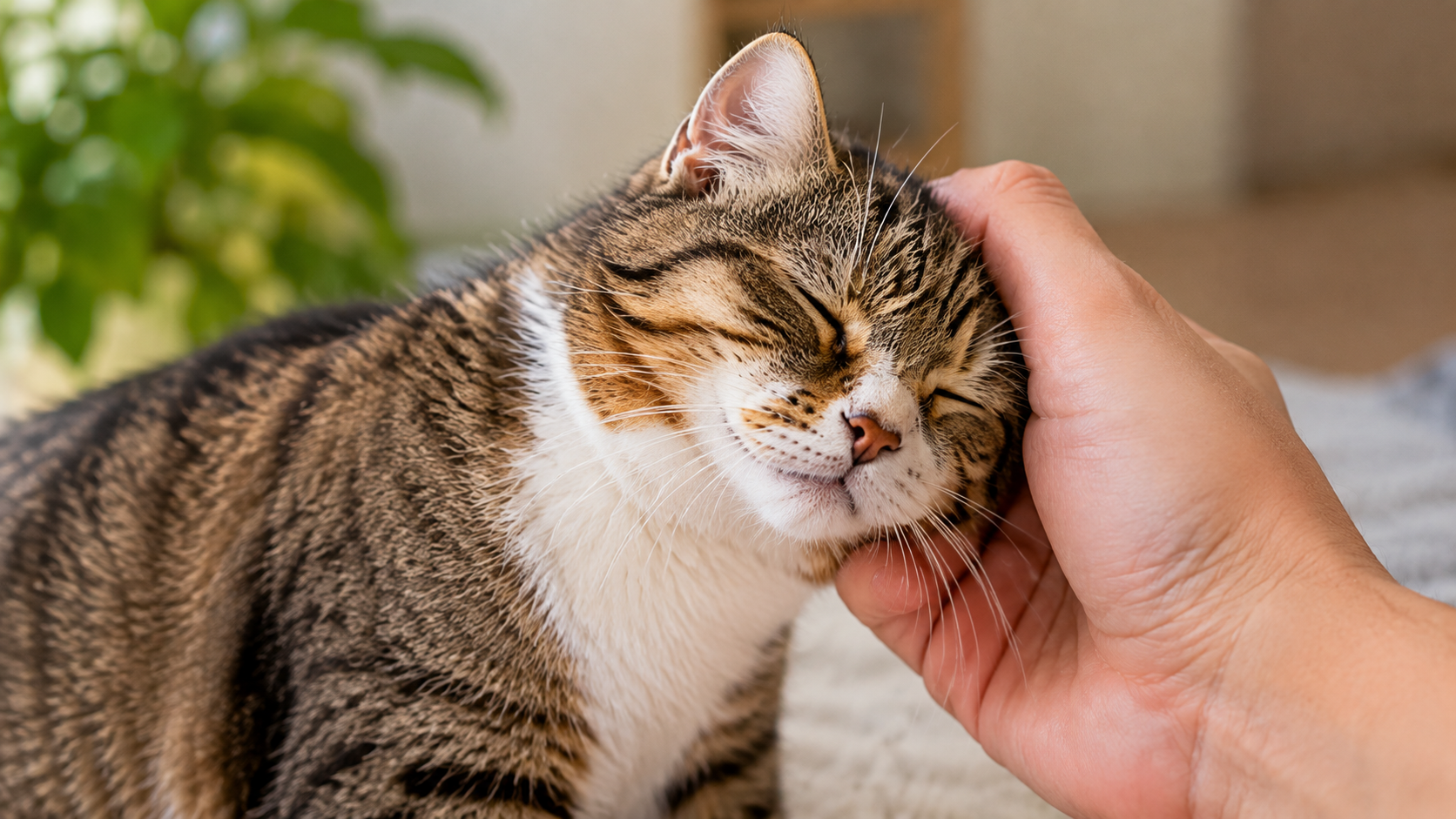
When your cat headbutts you, it usually means they feel comfortable approaching you and are engaging in normal feline social behavior. This action, also called head bunting, can help cats exchange familiar scents, greet people they know, or ask for attention.
If your cat keeps headbutting you, they may be repeating a familiar greeting or asking for something they enjoy, such as petting, food, or interaction. The exact meaning depends on what happens before and after the headbutt.
Most headbutting is normal. However, repeatedly pressing the head against a wall or another surface without an apparent reason is different and can indicate a medical problem.
What Does It Mean When a Cat Headbutts You?
When a cat deliberately presses their forehead, cheek, or side of their head against you, they are usually engaging in a behavior called head bunting.
There are several possible explanations:
- Social greeting: Your cat may be welcoming you home or approaching you after you have been away.
- Scent communication: Cats have scent-producing glands around their face and head. Rubbing these areas against you can deposit scent-related chemical signals.
- Attention-seeking: Your cat may have learned that headbutting your hand gets you to pet them or interact with them.
- Social comfort: Voluntarily approaching you and initiating contact can be consistent with a comfortable relationship.
These explanations can overlap. A cat may greet you, exchange scents, and ask for attention during the same interaction.
Headbutting is often associated with affection, but it is better to interpret it alongside your cat’s overall body language rather than assuming that every headbutt has exactly the same meaning.
Why Does My Cat Headbutt Me?
Cats use a combination of scent, body language, and physical contact to communicate. Head bunting is one way they interact with familiar people, other cats, and their environment.
1. Your Cat Is Greeting You
Some cats approach their owners as soon as they enter a room or return home.
Your cat might walk toward you with their tail upright, bump your leg, rub their cheek against you, and follow you around the house.
This sequence is consistent with a friendly social greeting. The headbutt is one part of the interaction rather than a message with only one possible meaning.
2. Your Cat Is Sharing Familiar Scents
Cats have scent-producing glands around their cheeks, chin, forehead, and other parts of their body.
When your cat rubs their face against you, they can deposit scent-related chemical signals on your skin or clothing. Cats also rub against furniture, doorways, and other familiar objects.
This behavior is part of feline scent communication. It may help create a familiar scent environment, but it does not necessarily mean your cat is claiming ownership of you in the human sense.
Veterinary sources describe head bunting and facial rubbing as normal behaviors associated with scent communication and social interaction. See PetMD’s veterinary-reviewed explanation of cat headbutting.
3. Your Cat Wants Attention
Sometimes, the reason is straightforward.
Your cat bumps your hand, you respond by petting them, and they enjoy the interaction. Over time, your cat may learn that headbutting is an effective way to get your attention.
Your cat might want a cheek scratch, a short play session, or simply a moment of contact.
However, initiating contact does not automatically mean your cat wants to be petted continuously. Watch how they respond and allow them to move away when they have had enough.
4. Your Cat Feels Comfortable Around You
Cats have different personalities and preferences for physical contact.
Some frequently rub against their owners, while others prefer sitting nearby or following them around without touching them very often.
When your cat voluntarily approaches you, rubs against you, and remains relaxed, the overall behavior is consistent with social comfort.
Still, headbutting is not the only way a cat can show a positive relationship with a person.
Why Does My Cat Keep Headbutting Me?
If your cat keeps headbutting you repeatedly, consider the situation in which it happens.
Repeated head bunting is not automatically a problem. Your cat may be greeting you, asking for attention, or repeating a behavior that has worked well in the past.
Here are some common patterns to look for.
Your Cat Keeps Headbutting You While You Work
If your cat repeatedly bumps your hand, arm, laptop, or phone while you work, they may be seeking interaction.
Your cat may also have learned that interrupting you causes you to look at them, speak to them, or offer a pet.
If you want to encourage calmer behavior, schedule regular play and attention breaks. Reward relaxed behavior when your cat settles nearby rather than responding only when they interrupt you.
Your Cat Keeps Headbutting You Before Meals
If your cat headbutts you around mealtime, they may have learned to associate approaching you with getting food.
Watch what happens next. If your cat walks toward the feeding area, looks back at you, or waits beside their bowl, the behavior may be part of a learned feeding routine.
Maintain consistent meal times and measure portions appropriately. Avoid giving extra food every time your cat asks if doing so would exceed their daily allowance.
Your Cat Keeps Headbutting You at Night
Some cats become more active when their owners are relaxing or getting ready for bed.
If your cat repeatedly bumps your face or hand at night, they may want attention, play, or access to something they need.
Try providing an appropriate play session and keeping food, water, litter, and resting areas accessible. If the behavior suddenly becomes much more frequent or is accompanied by other changes, consider discussing it with your veterinarian.
Your Cat Keeps Headbutting You More Than Usual
A naturally affectionate cat may headbutt frequently without any underlying problem.
However, a sudden change from your cat’s normal behavior deserves attention, particularly if you also notice reduced appetite, unusual irritability, excessive rubbing, ear discharge, or sensitivity around the face.
Do not assume that every new or unusually intense behavior is simply affection. Contact your veterinarian if the change persists or comes with other concerning signs.
Why Does My Cat Headbutt Me and Then Bite Me?
This can seem confusing, but the two behaviors are not necessarily contradictory.
Your cat may initiate friendly contact and then decide they have had enough petting. Some cats become uncomfortable with prolonged touching or with being handled in certain areas.
Watch for warning signs such as:
- A rapidly flicking tail
- Ears turning sideways or backward
- A tense body
- Skin twitching
- Turning the head toward your hand
- Trying to move away
- Swatting, grabbing, or biting
If you notice these signs, pause the interaction and give your cat space.
A bite that occurs repeatedly when a particular area is touched, especially if the behavior is new, may indicate pain or discomfort. Arrange a veterinary examination rather than assuming your cat is simply being moody.
Why Does My Cat Headbutt My Face or Hand?
Why Does My Cat Headbutt My Face?
Your face may be accessible when you are sitting or lying down, making it an easy target for close social contact.
If your cat gently bumps your face, rubs their cheek against you, and remains relaxed, this is generally consistent with normal head bunting.
Avoid forcing your face toward your cat or holding them in place. Let your cat decide how close they want to get.
Why Does My Cat Headbutt My Hand?
Your hand may be associated with petting, feeding, or play.
If your cat bumps your hand and then leans into your fingers, they may be inviting you to continue interacting. Try a gentle cheek or chin scratch, then pause to see whether your cat asks for more.
If your cat moves away, respect that choice.
Why Does My Cat Headbutt Me in the Morning?
Your cat may be greeting you after waking up or asking for breakfast.
If headbutting regularly happens just before meals, your cat may have learned that the behavior gets your attention. If it happens when you first wake up and your cat then settles nearby, it may be part of a familiar greeting routine.
The timing and the behavior that follows can help you understand what is happening.
Why Does My Cat Headbutt Me and Purr?
A cat may purr while headbutting you during a relaxed social interaction.
If your cat also approaches voluntarily, rubs against you, and maintains a relaxed posture, the overall pattern is consistent with a comfortable interaction.
However, purring alone does not prove that a cat is happy. Cats can also purr in other circumstances, including when stressed or uncomfortable.
Consider the whole picture rather than using one behavior to determine your cat’s emotional state.
Does My Cat Headbutt Me to Mark Me as Their Territory?
There is a biological basis for the idea that headbutting involves scent marking, but the explanation is more complicated than ownership.
Cats have scent-producing glands around their face. When they rub their cheeks or forehead against a person or object, they can leave scent-related chemical signals behind.
This is a normal part of feline communication. It can occur when cats interact with familiar people, other cats, and objects in their environment.
However, you cannot determine from one headbutt that your cat is claiming ownership of you. Social contact and scent communication can occur together.
Should I Let My Cat Headbutt Me?
Yes, if you are comfortable with the contact and your cat is behaving normally.
You generally do not need to discourage ordinary head bunting. Instead, let your cat initiate and end the interaction.
You can respond by:
- Offering a gentle cheek or chin scratch.
- Pausing after a few seconds.
- Watching whether your cat leans in or returns for more.
- Stopping if your cat moves away or shows discomfort.
You do not need to headbutt your cat back. A calm voice, gentle touch, or simply allowing your cat to rub against you is enough.
Respecting your cat’s preferences can help make everyday interactions more comfortable for both of you.
Cat Headbutting vs. Head Pressing: When Should You Worry?
It is important to distinguish normal head bunting from abnormal head pressing.
Head bunting is a deliberate social behavior. Your cat approaches you or an object, briefly makes contact with the forehead or cheek, rubs, and then continues behaving normally.
Head pressing involves persistently pushing the head against a wall, floor, corner, or other surface without an apparent reason. A cat may appear confused, disoriented, or unable to stop the behavior normally.
Persistent head pressing can indicate a serious neurological or metabolic problem and requires urgent veterinary assessment.
Other concerning signs can include:
- Circling or difficulty walking
- Loss of coordination
- Disorientation
- Changes in vision
- Seizures
- Sudden changes in awareness or responsiveness
Do not wait to see whether persistent head pressing resolves on its own. Seek urgent veterinary care, especially if other neurological signs are present.
For more information, read PetMD’s guide to head pressing in cats.
What If My Cat Suddenly Stops Headbutting Me?
A cat may change its social habits for many reasons, and stopping headbutting alone does not necessarily indicate illness.
However, a noticeable change becomes more concerning if it occurs alongside other symptoms.
For example, your cat may suddenly stop approaching you and also begin hiding, eating less, avoiding jumps, resisting touch, grooming differently, or using the litter box differently.
Cats can hide pain, and behavioral changes may be among the first signs that something is wrong.
If the change is sudden, persistent, or accompanied by physical symptoms, contact your veterinarian.
Frequently Asked Questions
What does it mean when a cat headbutts you?
It usually means your cat is engaging in normal social behavior. Head bunting can involve greeting, scent communication, seeking attention, or comfortable physical contact. The exact meaning depends on the situation and your cat’s body language.
Why does my cat keep headbutting me?
Your cat may be repeating a familiar greeting, asking for attention, seeking petting, or following a learned routine. Repeated headbutting is generally normal when your cat remains relaxed and otherwise behaves normally. A sudden change in frequency or intensity deserves closer attention.
Is headbutting a sign that my cat loves me?
Headbutting can be consistent with a positive social relationship and familiarity. However, one behavior cannot tell you exactly what a cat feels. Consider the overall relationship, body language, and willingness to interact.
Why does my cat headbutt me but not other people?
Cats can develop different relationships with different people. Your cat may be more comfortable with your interaction style or may associate you with familiar routines such as feeding or petting. This does not automatically mean your cat dislikes other people.
Why does my cat headbutt me and then walk away?
Your cat may simply be greeting you or engaging in brief social contact. Some cats enjoy a short interaction without wanting to remain beside someone or continue being petted.
Why does my cat headbutt me and then bite me?
Your cat may initially welcome contact but become uncomfortable with prolonged petting. Watch for tension, tail flicking, ears turning backward, or attempts to move away. If biting is new or happens when you touch a particular area, consult a veterinarian.
Why does my cat headbutt furniture after headbutting me?
Cats commonly rub their faces against familiar objects as part of scent communication. The same behavior can occur during social interactions with people and other cats.
Is it normal for a cat to headbutt a wall?
A brief rub against a wall or doorway can be normal. However, a cat that persistently presses its head against a wall or corner without an apparent reason may be showing a medical warning sign. Seek urgent veterinary care if this happens, particularly if the cat appears confused or uncoordinated.
Why doesn’t my cat headbutt me?
Not all cats use head bunting frequently. Your cat may show social comfort by sitting nearby, following you, greeting you, sleeping in the same room, or relaxing in your presence. The absence of headbutting does not mean your cat dislikes you.
Final Thoughts
When a cat headbutts you, the behavior usually reflects normal feline social interaction and scent communication. Your cat may be greeting you, seeking attention, or engaging in a familiar routine.
If your cat keeps headbutting you, look at the timing and what happens next. A relaxed cat that voluntarily approaches, rubs against you, and continues behaving normally is generally displaying ordinary head bunting.
The important distinction is between a brief, deliberate head bump and persistent, abnormal head pressing. The latter can indicate a serious medical problem and requires urgent veterinary attention.
Rather than trying to translate every headbutt into one specific human emotion, pay attention to your cat’s overall behavior. That will give you a more reliable understanding of what your cat may be communicating.