

Your cat presses one front paw into the blanket, then the other. The claws may stretch out. A purr starts. A minute later, the kneading stops and your cat curls into a ball.
That sequence is usually completely normal.
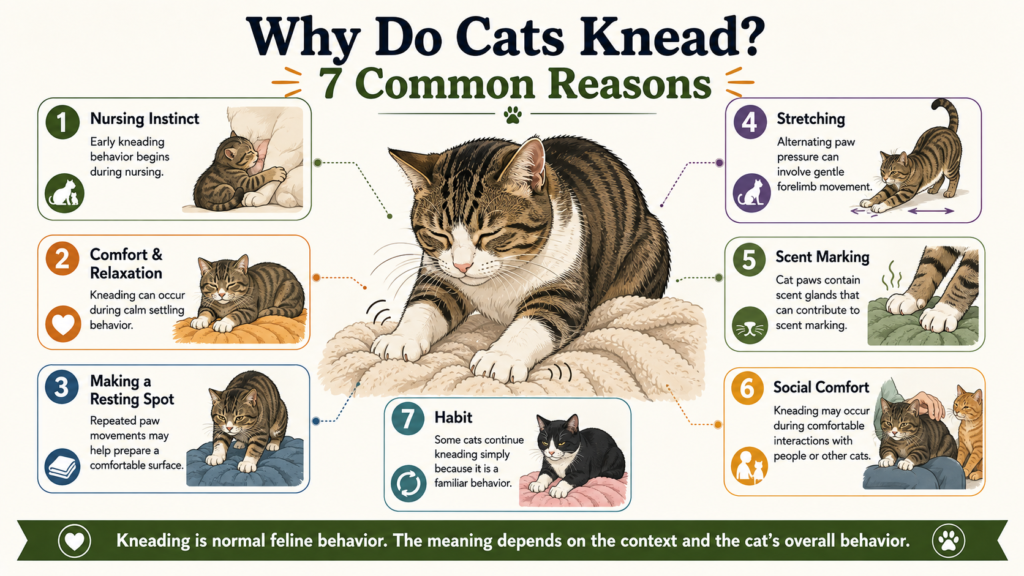
Cats often knead before sleeping because kneading appears to be part of a comfortable settling routine. The behavior has a clear origin in kittenhood: nursing kittens knead their mother’s abdomen with alternating front paws during feeding. Many cats continue the movement into adulthood, particularly around soft surfaces, rest, and other comfortable situations.
Why adult cats retain the behavior is less certain. Comfort, scent communication, stretching, and preparing a resting surface are all reasonable explanations discussed in veterinary behavior resources. Still, we cannot translate every kneading session into one precise emotion or motivation.
For an owner, that uncertainty isn’t much of a problem. The timing and the rest of your cat’s behavior usually tell you what you need to know.
Kneading Starts Long Before a Cat Has a Bedtime Routine
The strongest explanation for kneading begins with nursing.
Young kittens rhythmically press their paws against their mother while feeding. International Cat Care describes kittens kneading the mother’s abdomen as they nurse, helping maintain milk flow.
That part of the behavior is well established.
What happens later is more interesting. Many cats continue kneading long after they are weaned. Adult cats may knead blankets, pillows, beds, people, or other soft surfaces even though milk is obviously no longer involved. Veterinary behavior sources generally interpret this as persistence of an early-life behavior that has become associated with comfortable or rewarding circumstances.
This helps explain why kneading fits so naturally into bedtime.
Sleep follows a period of decreasing activity. A familiar blanket, warm lap, soft bed, or quiet couch may provide exactly the sort of comfortable context in which an adult cat performs a behavior that has been present since kittenhood.
Why It Happens Right Before Sleep
There isn’t one universal reason.
Instead, several functions can overlap during the same kneading session.
It may be part of your cat’s settling ritual.
Some cats circle. Some turn several times. Some paw at a blanket. Others knead intensely for a minute and then collapse into their preferred sleeping position.
AAHA specifically notes that domestic cats commonly knead soft objects before lying down.
That makes the timing meaningful. When kneading happens consistently between “I have chosen this spot” and “I am now asleep,” it is reasonable to interpret the behavior as part of that individual cat’s bedtime sequence.
The ritual itself can become highly predictable.
A cat may jump onto the same corner of the bed every night, knead the same blanket, turn around, tuck in the paws, and sleep. In that situation, there is little reason to search for a hidden problem unless something about the pattern changes.
Soft surfaces may encourage the behavior.
Blankets, fleece, pillows, comforters, and human laps are common kneading targets. Veterinary resources frequently describe kneading on pliable surfaces, particularly when cats are settling down.
Texture may matter because the movement originated during nursing against the mother’s body. However, it would be too strong to claim that an adult cat consciously thinks a blanket is its mother.
A simpler interpretation works better: soft surfaces provide an appropriate context for a deeply established pawing behavior.
Kneading may help prepare a resting spot.
You may encounter the explanation that cats knead because their wild ancestors flattened grass and other vegetation before sleeping.
Veterinary resources do discuss this as an explanation for pre-sleep kneading.
It is best treated as a plausible evolutionary interpretation rather than a proven explanation for what a particular house cat is thinking. We have much clearer evidence that kittens knead during nursing than we do for reconstructing the exact ancestral function of bedtime kneading in modern domestic cats.
The distinction matters because cat behavior is often presented online with more certainty than the evidence allows.
What Your Cat Does After Kneading Is an Important Clue
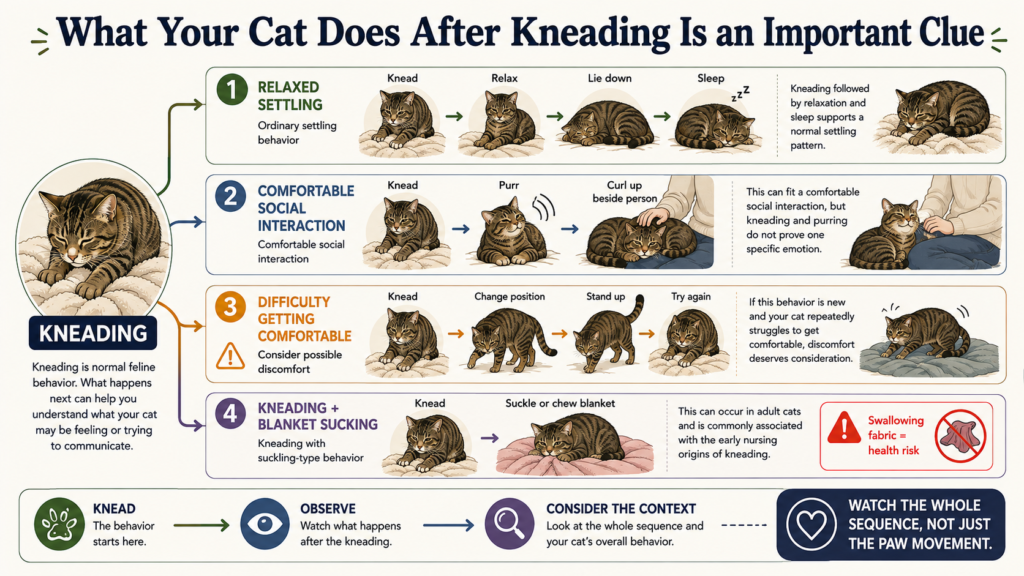
Rather than trying to decode every paw movement, watch the entire sequence.
Knead → relax → lie down → sleep
That pattern strongly supports an ordinary settling behavior.
Knead → purr → curl up beside you.
This can fit a comfortable social interaction, although purring and kneading should not automatically be translated as proof of one specific emotion.
Knead → repeatedly change position → stand up → try again.
Now the question changes. If your cat seems unable to get comfortable, particularly if the behavior is new, discomfort deserves consideration. Behavioral changes can be an important sign of feline pain because cats don’t always display obvious symptoms such as limping or crying.
Knead → suck or chew a blanket.
Some adult cats combine kneading with suckling-type behavior on soft materials. This is commonly associated with the early nursing origins of kneading.
If the cat is actually tearing off and swallowing fabric, however, the concern is no longer simply kneading. Eating non-food material can create a separate health risk and should be discussed with a veterinarian.
The sequence often tells you more than the kneading alone.

Does Kneading Mean My Cat Feels Safe?
Often, the surrounding behavior is consistent with comfort—but avoid treating kneading as a guaranteed emotional decoder.
AAHA describes kneading as a normal behavior associated with getting comfortable and contentment, while VCA notes possible links between kneading and the security associated with early nursing.
A cat about to sleep may also show other relaxed signals:
- a loose rather than rigid posture
- ears resting in a neutral position
- relaxed facial muscles
- paws gradually becoming still
- normal interaction with familiar people
- comfortable resting rather than repeated repositioning
Feline body language should always be read as a combination of signals. Current Feline Veterinary Medical Association guidance similarly emphasizes looking at posture, ears, pupils, activity, and the wider situation when interpreting a cat’s emotional state.
So a better interpretation is:
“My cat is kneading while appearing relaxed and preparing to sleep.”
That’s much more informative than simply:
“Kneading means happiness.”
The “Making Biscuits on Me” Version Has an Extra Layer
Some cats don’t merely knead before sleeping. They knead you before sleeping.
Your stomach, thigh, chest, or lap may become the mattress.
This can be uncomfortable when claws are involved, but it doesn’t mean your cat is trying to hurt you. Kneading is a natural behavior, and veterinary guidance recommends redirecting it rather than punishing the cat.
There may also be a scent component. Cats have scent-producing structures associated with their paws, and veterinary sources describe kneading and other paw-related behaviors as possible ways of depositing scent on frequently used places or social partners.
That doesn’t justify the exaggerated claim that your cat is literally “claiming ownership” of you. Scent is an important part of feline communication, but assigning a human-like ownership motive goes beyond what we can know from the behavior alone.
For practical purposes, your lap may be warm, soft, familiar, socially safe, and conveniently located at bedtime.
That’s enough to make it an excellent kneading target.
When the Claws Make Bedtime Less Relaxing for You
You don’t have to choose between tolerating painful claws and preventing your cat from kneading altogether.
Create a better target.
Place a thick folded blanket between your cat’s paws and your skin. If your cat has a favorite kneading location, keep an appropriate soft surface there. AAHA recommends redirecting kneading toward acceptable materials rather than yelling at or punishing the cat.
Regular nail care can also reduce sharp claw tips, although trimming should be done safely and only to the appropriate part of the nail.
Avoid pushing your cat off roughly once kneading begins. If you need to move them, interrupt gently and offer the preferred blanket or another comfortable resting place.
Punishment is unnecessary for normal behavior and may add fear or stress to a previously calm interaction. Contemporary feline behavior guidance favors predictable interactions, appropriate outlets for natural behavior, and positive reinforcement over punishment.
What About Kneading and Purring at the Same Time?
Kneading and purring often appear together, particularly during quiet social or resting situations. Because both behaviors occur early in life around nursing, the combination is commonly associated with comfort in adult cats.
Still, don’t use purring as a medical all-clear.
Cats can purr in more than one emotional or physical context. The safest interpretation comes from the whole picture: a normally eating, normally moving cat who settles comfortably after kneading is different from a cat who purrs while repeatedly shifting position, hiding, eating less, or resisting touch.
Behavior has context. Context carries the meaning.
Is Kneading Before Sleeping Ever a Stress Signal?
Ordinary pre-sleep kneading is not, by itself, a reason to conclude that a cat is stressed.
The picture becomes less straightforward when kneading changes dramatically.
AAHA notes that unusually increased kneading—or a sudden decrease in a cat’s established kneading behavior—can justify investigation because changes may accompany stress, discomfort, or other health or behavioral problems.
Look beyond the paws for signs that your cat isn’t settling normally.
A distressed cat may show combinations of behaviors such as:
- persistent hypervigilance
- crouching
- hiding or repeated avoidance
- ears turned back or sideways
- unusual pupil dilation
- difficulty resting
- increased irritability
- reduced interest in normal activities
The Feline Veterinary Medical Association advises considering multiple body-language signals and whether a cat’s physical and social environment is meeting its needs. Secure hiding and resting places, climbing opportunities, separated resources, scratching options, play, and predictable interactions all contribute to a more cat-friendly environment.
If your cat kneads normally and falls asleep peacefully, enrichment does not need to be used as a “treatment” for kneading.
Kneading itself isn’t the problem.
A New Bedtime Pattern Matters More Than an Old Quirk
A useful rule in feline health is to know what is normal for your cat.
One cat may knead for five minutes every night from kittenhood onward. Another may barely knead at all. Both can be normal.
The more meaningful question is whether something has changed.
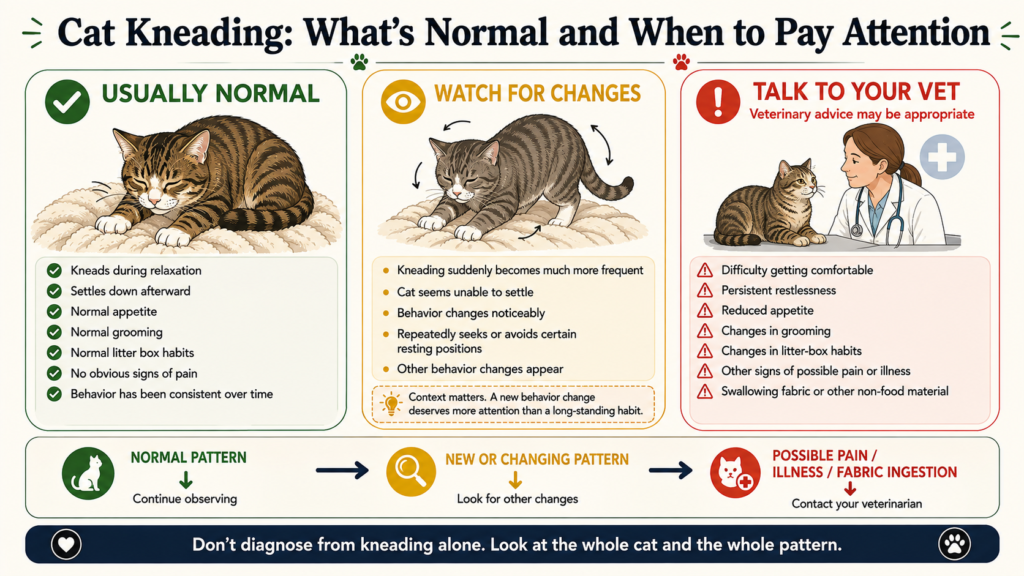
Consider veterinary advice if your cat suddenly starts kneading far more or far less than usual and you also notice:
- difficulty getting comfortable
- repeated standing and lying down
- reluctance to jump onto familiar furniture
- stiffness or altered walking
- unusual sensitivity to touch
- hiding
- irritability
- reduced appetite
- decreased activity
- changes in grooming
- changes in litter-box habits
- a noticeable change in sleeping location or sleep pattern
AAHA emphasizes that behavioral changes may be among the earliest observable signs of pain in cats, including when the underlying illness is not immediately obvious.
This becomes especially relevant as cats age. Cornell’s Feline Health Center advises owners of older cats to pay attention to changes in sleeping, eating, resting locations, and other established behaviors rather than automatically attributing them to aging.
Kneading is rarely the diagnostic clue by itself.
The change around it is what matters.
One Bedtime Myth Worth Retiring
You may hear that a cat kneading before sleep definitely means:
“They think you’re their mother.”
That goes too far.
The behavior unquestionably has an early association with nursing: kittens knead while feeding from their mother.
Adult kneading may preserve elements of that juvenile behavioral pattern, and comfortable conditions may help bring it out. But an adult cat kneading a fleece blanket is not evidence that the cat literally misidentifies the blanket—or its human—as its mother.
Likewise, claims that every kneading cat is “showing love,” “marking ownership,” or “remembering kittenhood” turn plausible interpretations into certainties that the behavior itself cannot support.
A more evidence-aware explanation is also the simpler one:
Kneading begins as a functional kitten behavior and commonly persists into adulthood in comfortable, resting, and social contexts. The exact motivation of any individual adult cat can’t be known from kneading alone.
Should You Let Your Cat Knead Before Bed?
Usually, yes.
If your cat kneads a blanket or bed, settles comfortably, and otherwise behaves normally, there is generally nothing that needs to be corrected. AAHA describes kneading as normal feline behavior and recommends giving cats appropriate outlets for it.
A simple owner response works well:
Leave it alone when the behavior is harmless.
Add a thick blanket if claws are uncomfortable.
Redirect gently if the cat is damaging a surface.
Watch for changes if kneading suddenly becomes excessive, disappears, or is paired with difficulty settling.
Call your veterinarian when the changed behavior comes with possible pain, reduced appetite, altered movement, significant lethargy, unusual hiding, or other departures from your cat’s normal routine.
There is no need to stop a healthy cat from making biscuits simply because bedtime has become bakery time.
Quick Answers About Pre-Sleep Kneading
Why does my cat knead the blanket before sleeping?
Soft bedding provides a common context for kneading, and many cats incorporate the behavior into their settling routine before lying down.
Why does my cat knead me and then fall asleep on me?
Your body offers warmth, softness, familiarity, and social contact. Kneading you before settling may occur for the same reasons a cat kneads other comfortable resting surfaces, with social familiarity potentially adding another layer.
Why does my cat knead and purr before bed?
Both behaviors commonly occur in comfortable resting contexts and have roots in early kitten behavior around nursing. Their appearance together often fits relaxation, but neither should be interpreted in isolation if the cat otherwise seems uncomfortable or unwell.
Why does my cat use its claws while kneading?
The kneading motion can naturally involve flexing the toes and extending the claws. If kneading hurts when your cat does it on you, place a thick blanket between the paws and your skin rather than punishing the behavior.
Do all cats knead before sleeping?
No. Cats vary considerably in their individual behavior. Some knead regularly, some only in particular situations, and others rarely appear to knead. The most useful reference point is your own cat’s established pattern rather than whether they match another cat.
Why has my senior cat suddenly started kneading more before sleeping?
A behavioral change in an older cat deserves more attention than a long-standing habit. Increased kneading does not diagnose pain or disease, but if it appears alongside difficulty settling, mobility changes, appetite changes, altered sleep, hiding, or other unusual behavior, discuss it with your veterinarian.
Let the Bedtime Ritual Tell the Story
The next time your cat starts kneading before sleep, watch what follows.
If the paws slow down, the muscles relax, and your cat settles comfortably into a familiar sleeping spot, you’re probably watching an ordinary piece of feline bedtime behavior rather than a problem that needs solving.
What science and veterinary guidance can say confidently is that kneading begins during nursing and is commonly retained into adulthood. What we should be more cautious about is claiming to know the single emotional reason an adult cat performs it. Comfort, settling, scent communication, and preparing a resting surface may all contribute in different situations.
So enjoy the biscuit-making.
Just keep an eye on the larger routine. A familiar knead-and-sleep sequence is usually normal; a meaningful change in how your cat moves, rests, eats, interacts, or settles is the part worth investigating.
Refferences
- International Cat Care — Cat Pregnancy: Confirms that nursing kittens knead their mother’s abdomen with their paws as part of feeding and maintaining milk flow.
- American Animal Hospital Association (AAHA) — “Is My Cat’s Kneading Normal?”: Describes kneading as generally normal feline behavior, discusses kneading before lying down, and advises veterinary assessment when the behavior changes significantly.
- VCA Animal Hospitals — “Why Do Cats Knead? (Or, the Art of Biscuit Making!)”: Provides veterinary-reviewed context on kitten nursing behavior and possible scent-marking functions of adult kneading.
- Feline Veterinary Medical Association — Setting Up the Environment for Success: Provides current guidance on feline environmental needs, safe resting places, predictable interactions, enrichment, and recognizing distress through body language.
- AAHA — “Recognizing Pain in Cats”: Explains why changes in normal behavior can be an important clue to pain or illness, even when obvious physical signs are absent.
- Cornell Feline Health Center — Loving Care for Older Cats: Highlights changes in sleeping, eating, and other established behaviors as reasons to discuss a senior cat’s health with a veterinarian.