
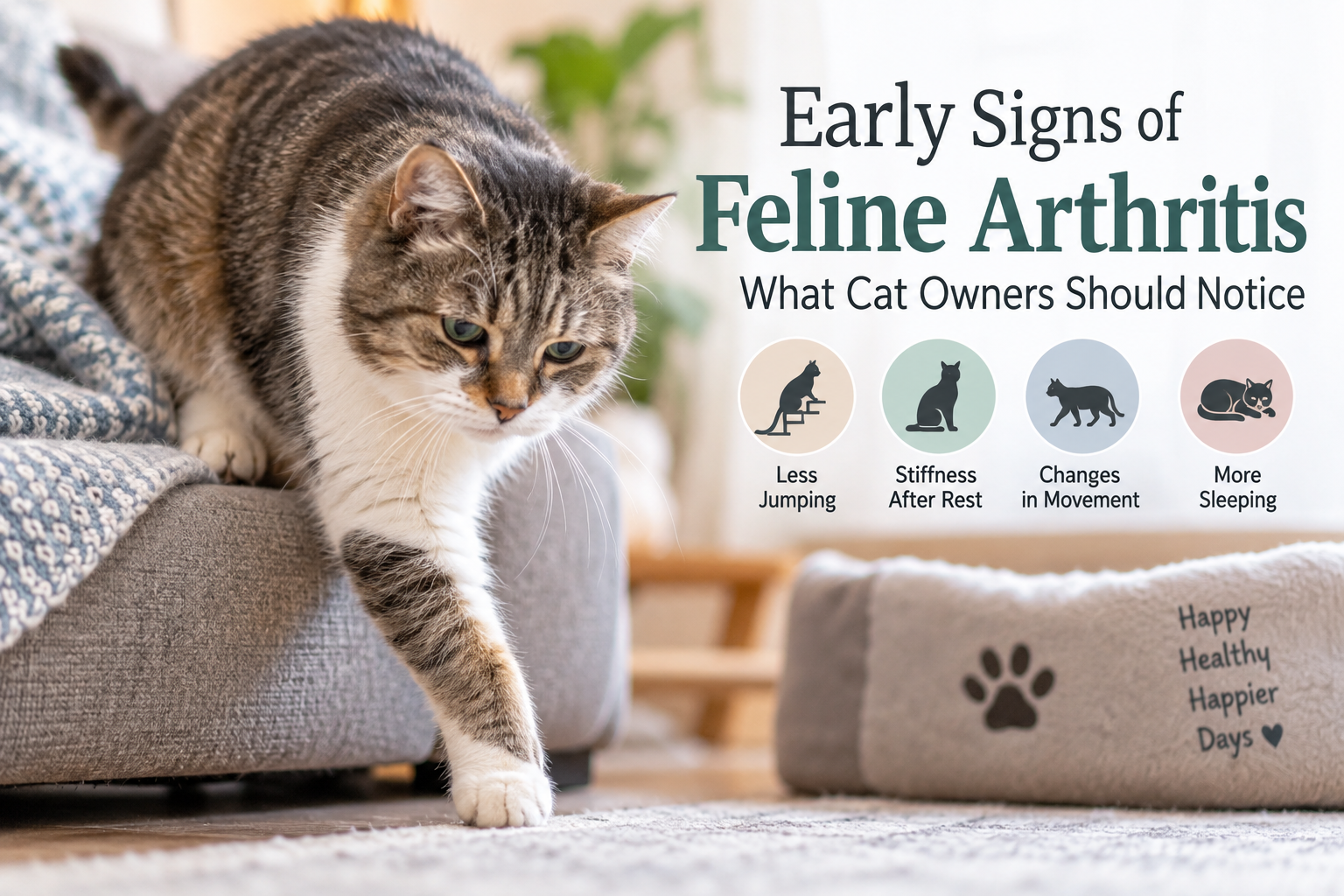
Cats are very good at hiding pain. That’s why the early signs of feline arthritis can be easy to miss. Your cat may not limp or cry out. Instead, you might notice that they no longer jump onto the sofa, spend more time sleeping, or seem unusually irritable when you touch their back or legs.
Feline arthritis, also called osteoarthritis or degenerative joint disease, happens when the tissues in a joint become damaged and movement becomes painful. It can affect older cats, but age is not the only factor. Previous injuries, abnormal joint development, excess weight, and other health problems can also play a part.
The earlier you notice a change, the sooner your veterinarian can look for the cause and help manage your cat’s comfort. Arthritis cannot usually be reversed, but treatment and home adjustments can make daily life much easier.
What are the early signs of feline arthritis?
The most common early signs are small changes in movement, jumping, grooming, sleeping habits, litter box use, and mood. A cat with early arthritis may still walk normally and appear healthy at first.
Watch for changes such as:
- Jumping less often or choosing lower surfaces
- Hesitating before using stairs
- Stiffness after sleeping
- Walking more slowly or carefully
- Avoiding play or stopping sooner than usual
- Difficulty getting into or out of the litter box
- Grooming less, especially around painful joints
- Licking or overgrooming one area
- Hiding more or acting irritable when handled
- Sleeping in easier-to-reach places
One isolated change does not prove that your cat has arthritis. But a pattern that lasts, gets worse, or affects normal activities deserves a veterinary checkup.
1. Your cat stops jumping as high
A cat that used to leap onto a bed, windowsill, or kitchen counter may begin using a chair, nearby step, or another lower route instead. Some cats still jump but hesitate first, pull themselves up with their front legs, or land awkwardly.
This is one of the easiest signs to overlook. Owners sometimes assume their cat is simply becoming less playful or more cautious with age. In fact, jumping puts a lot of pressure on the hips, knees, elbows, shoulders, and spine.
You may notice that your cat:
- No longer jumps to a favorite resting place
- Misses a jump they used to make easily
- Jumps down and immediately walks away
- Uses furniture as a series of steps
- Cries, flinches, or appears tense after landing
Don’t encourage a painful jump to “test” your cat. Put a stable step, ramp, or low piece of furniture near favorite spots instead. This helps your cat keep access to the places they enjoy while you arrange a veterinary appointment.
2. Stiffness after resting
Arthritic cats may look stiff when they first get up after a nap. The stiffness can be most noticeable in the morning or after a long period of sleep. Your cat may stretch for longer than usual, walk with short steps, or take a few minutes to move comfortably.
Some cats loosen up once they start walking. That does not mean the problem is harmless. Pain from arthritis can vary with activity, temperature, and how long the cat has been still.
Look at your cat’s first few steps after resting. Do they rise smoothly, or do they seem slow and careful? Do they avoid putting full weight on one leg? A short video of this movement at home can be useful because cats often move differently in a veterinary clinic.
3. Less play and a change in daily activity
A cat with joint pain may still seem interested in a toy but stop playing sooner. They may watch a feather toy instead of chasing it, avoid fast turns, or lie down during a game they once enjoyed.
You might also see less running, fewer trips around the house, or more time spent sleeping. Cats naturally sleep a lot, so the change is usually more meaningful than the total number of hours. Compare your cat with their own normal routine rather than with another cat.
Try shorter, gentler play sessions. Use toys that can be moved slowly along the floor, and avoid making your cat jump repeatedly. If your cat consistently loses interest in play or seems painful, ask your veterinarian for advice rather than assuming it is just aging.
4. Trouble with stairs and climbing
Stairs can reveal joint pain before a clear limp appears. Your cat may pause at the bottom, climb one step at a time, or avoid a staircase altogether. They may also stop climbing a cat tree or choose only the lowest platform.
Going down can be especially difficult because it creates impact through the front legs and shoulders. A cat that used to race up and down stairs may now move carefully or take a different route.
Keep food, water, a resting area, and a litter box on the same floor when possible. This is particularly helpful if your cat has to use stairs to reach essential resources.
5. Changes in grooming
Pain and reduced flexibility can make grooming difficult. Cats with arthritis may stop cleaning hard-to-reach areas such as the lower back, hips, or hind legs. Their coat may become greasy, tangled, or clumped.
The opposite can also happen. A cat may repeatedly lick or chew a painful joint, leaving a thin patch of fur or irritated skin. Overgrooming can have other causes, including allergies, parasites, and stress, so it should not automatically be blamed on arthritis.
Brush your cat gently if they tolerate it, but don’t force grooming around a sore area. A veterinarian can help determine whether the problem is pain, skin disease, or something else.
6. Difficulty using the litter box
Litter box changes are an important early warning sign. A cat with painful hips, knees, or back may struggle to climb into a tall box, squat comfortably, or turn around inside it. They may urinate or defecate next to the box because getting in hurts.
This is not spite or bad behavior. If the box is painful to use, your cat may look for a more accessible location.
Helpful changes include:
- Offering a box with a low entrance
- Placing boxes on each floor of the home
- Keeping the box in a quiet, easy-to-reach location
- Cleaning it regularly so your cat does not need to step around waste
- Choosing a box large enough for your cat to turn comfortably
Sudden litter box problems still require veterinary attention. Painful joints are only one possible cause, and urinary or digestive problems can also lead to accidents.
7. Irritability or resistance to handling
A normally friendly cat may become less patient when lifted, brushed, or touched near the hips, back, legs, or tail. They may move away, growl, hiss, swat, or tense their body.
This does not mean your cat has suddenly become aggressive. Pain can make a cat protect a sensitive area. Even a gentle touch may feel threatening if the joint is sore.
Avoid repeatedly pressing or manipulating the suspected joint at home. You could make the pain worse, and a frightened cat may scratch or bite. Instead, tell your veterinarian exactly what you noticed and where your cat seems uncomfortable.
8. Hiding more or sleeping in different places
Cats often choose sleeping locations that reduce discomfort. An arthritic cat may stop using a tall cat tree and sleep on the floor, a low chair, or a warm blanket. They may also hide more because pain makes them feel vulnerable.
A change in favorite sleeping spots can be subtle. Look for a pattern: Is the new location easier to reach? Does your cat avoid jumping down? Are they spending more time alone?
Give your cat soft, warm resting areas that are easy to enter and leave. Keep them away from drafts and busy walkways, but don’t force your cat to use a bed they dislike.
9. A different walking pattern
Limping is possible, but it is not required. Cats may show joint pain through a shorter stride, a hunched posture, a lowered head, or a reluctance to turn quickly. Some move stiffly after rest but appear more normal later.
You may also see a cat shift weight from one leg to another or avoid slippery floors. Arthritis can affect more than one joint, so the movement may look generally cautious rather than like a clear limp.
Place nonslip rugs or runners on smooth floors if your cat struggles for traction. Do not give human pain medicine. Medications such as acetaminophen, ibuprofen, and naproxen can be dangerous or fatal to cats, even in amounts that may seem small.
Arthritis symptoms versus normal aging
Cats may naturally slow down as they get older, but aging itself is not a diagnosis. A gradual change in activity can still be caused by pain, dental disease, heart disease, kidney disease, vision problems, or another medical condition.
| What you notice | Possible concern | What to do |
|---|---|---|
| Less jumping | Joint pain, weakness, or vision changes | Record which heights your cat avoids and contact your veterinarian |
| Stiffness after sleep | Arthritis or another painful condition | Take a short video and arrange an examination |
| Litter box accidents | Joint pain, urinary disease, digestive problems, or stress | Schedule veterinary care, especially for sudden changes |
| Less grooming | Arthritis, obesity, dental pain, or illness | Check the coat and ask for a full health assessment |
| More hiding | Pain, stress, or illness | Look for other symptoms and seek advice |
| Less appetite or weight loss | Many possible health problems | Contact your veterinarian promptly |
The key question is not, “Is this normal for an old cat?” It is, “Is this different from my cat’s usual behavior?”
How is feline arthritis diagnosed?
A veterinarian usually starts with your cat’s history and a physical examination. They may watch your cat walk, assess joint movement, feel for swelling or discomfort, and look for muscle loss.
X-rays may be recommended, but the findings do not always perfectly match the amount of pain a cat feels. Some cats have obvious changes on imaging with few visible symptoms, while others show significant pain despite modest findings. Your observations at home are an important part of the diagnosis.
Before the appointment, write down:
- When you first noticed the change
- Which activities your cat avoids
- Whether symptoms are worse after rest or activity
- Changes in appetite, weight, grooming, or litter box use
- Any previous injury or known joint problem
- Videos of walking, jumping, using stairs, or getting into the litter box
A veterinary visit is especially important if the change is sudden, your cat cannot bear weight, a joint looks swollen, or your cat stops eating. Seek urgent care for severe pain, collapse, breathing trouble, inability to urinate, or a sudden inability to use a leg.
How can you help a cat with early arthritis at home?
Small changes can reduce the need to jump, climb, or walk across slippery surfaces. They do not replace veterinary treatment, but they can make everyday tasks less painful.
Make favorite areas easier to reach
Use low steps or a stable ramp to help your cat reach a sofa, bed, or window. Make sure anything your cat climbs is secure and cannot slide or tip over.
Improve traction
Hard floors can be difficult for painful joints. Non-slip rugs, runners, or yoga mats can create safer paths between food, water, litter boxes, and resting places. Keep nails trimmed if your cat allows it, since very long nails can make walking less comfortable.
Choose accessible litter boxes
A low-sided box may be easier to enter, while a larger box gives your cat room to turn. Some cats still need high sides or a covered box to prevent mess, so balance accessibility with your cat’s normal preferences.
Keep resources nearby
Put food, water, resting spots, and litter boxes where your cat can reach them without a long trip or a flight of stairs. Avoid moving everything suddenly; gradual changes are less stressful for many cats.
Support a healthy body weight
Extra weight puts more force on painful joints. If your cat is overweight, ask your veterinarian for a gradual weight-management plan. Do not sharply restrict food or start a new diet without guidance, because cats can become seriously ill if they stop eating.
Keep handling gentle
Support your cat’s chest and hindquarters when lifting them, and avoid squeezing painful areas. Better yet, allow your cat to choose low resting surfaces so they do not need to be picked up often.
What treatments might a veterinarian recommend?
Treatment depends on your cat’s age, overall health, affected joints, kidney and liver function, and other medications. A veterinarian may discuss prescription pain relief, weight management, physical rehabilitation, environmental changes, or other options.
Never use leftover medication from another pet or give an over-the-counter human pain reliever unless a veterinarian specifically tells you to do so. Cats process many drugs differently from people, and a product that is safe for humans may be toxic to cats.
Your veterinarian may also want follow-up visits to see whether your cat is moving more comfortably. Improvement can show up as better grooming, more interest in play, easier litter box use, or a return to favorite resting spots—not necessarily dramatic running or jumping.
How can you monitor your cat’s comfort?
Cats rarely give a simple verbal signal that treatment is working. Keep a short weekly note about the behaviors that changed. For example, record whether your cat:
- Uses the stairs
- Jumps onto a low surface
- Grooms normally
- Plays for a few minutes
- Gets into the litter box easily
- Tolerates gentle handling
- Eats and drinks normally
A phone video taken in the same part of the home can help you compare movement over time. Avoid judging your cat’s comfort by appetite alone. Some cats continue eating even when they are in pain.
The bottom line
The early signs of feline arthritis are often quiet: less jumping, stiffness after naps, slower play, grooming changes, litter box trouble, or increased irritability. Because cats hide pain, even a small change from normal is worth paying attention to.
Make your home easier to navigate, avoid human pain medication, and schedule a veterinary examination if the changes continue or affect daily life. With the right treatment and a few practical adjustments, many cats with arthritis can remain comfortable and engaged in their routines.
Frequently asked questions
At what age do cats start showing arthritis?
Arthritis becomes more common as cats get older, but there is no single age when it starts. Younger cats can also develop joint problems after injury, because of abnormal joint development, or for other medical reasons. Any persistent change in movement or behavior should be discussed with a veterinarian.
Can a cat have arthritis without limping?
Yes. Many cats with arthritis do not limp clearly. They may jump less, move stiffly after resting, groom less, avoid stairs, or become irritable when handled. Subtle changes are often more useful clues than limping alone.
Is sleeping more always a sign of arthritis?
No. Cats naturally sleep frequently, and extra sleep can have many causes. Sleeping more becomes more concerning when it happens along with stiffness, reduced jumping, less grooming, appetite changes, hiding, or difficulty using the litter box.
How can I tell whether my cat is in pain?
Look for changes from your cat’s normal behavior, including reduced activity, hiding, altered grooming, hunched posture, reluctance to jump, trouble with the litter box, or sensitivity to touch. Cats may not cry or limp, so a veterinary examination is the safest way to investigate ongoing signs.
Can feline arthritis be cured?
Arthritis usually cannot be reversed, but its effects can often be managed. Veterinary treatment, a healthy body weight, appropriate activity, and easier access to food, water, litter boxes, and resting places can improve comfort and quality of life.
Can I give my cat ibuprofen or acetaminophen for arthritis pain?
No. Do not give ibuprofen, acetaminophen, naproxen, aspirin, or another human pain reliever unless your veterinarian gives specific instructions. Several common human medicines can seriously poison cats. Contact a veterinarian or emergency animal clinic immediately if your cat may have swallowed one.