
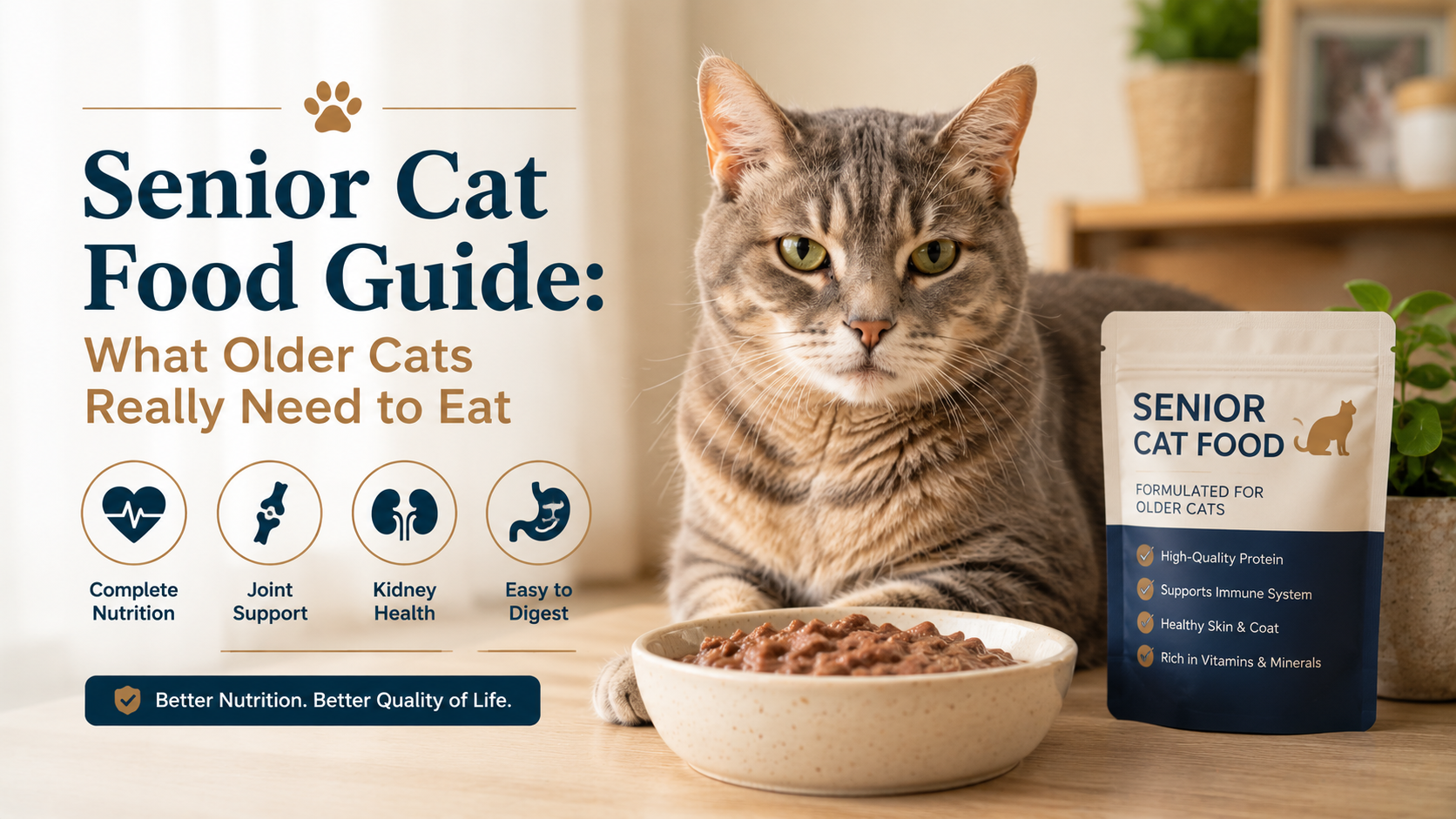
Feeding an older cat isn’t just about switching to a bag labeled “senior.” Cats age at different rates, and the right diet depends on your cat’s individual health, weight trend, and any conditions your vet has flagged; not just a birthday.
This guide walks through when senior nutrition needs typically start to shift, what actually matters in a senior cat’s diet, and how to tell the difference between normal aging and something that needs veterinary attention. None of this replaces a conversation with your vet, especially since so much of senior feeding depends on bloodwork and individual health history.
By the end, you’ll know what to look for on a label, how wet and dry food compare for older cats, how to handle weight loss or weight gain, and which changes in eating habits are worth a vet visit rather than a diet swap.
Quick Answer
Most healthy senior cats do well on a nutritionally complete diet that’s easy to digest, appropriately calorie-dense for their activity level, and higher in quality protein to help preserve muscle mass. There’s no single “best” senior food; the right choice depends on your cat’s weight trend, dental health, and any diagnosed conditions like kidney disease or diabetes, which is why a veterinary check-in matters more than the age printed on the bag. Senior Cat Food Guide
When Does a Cat Actually Become “Senior”?
There’s no exact birthday that flips a switch. According to the American Association of Feline Practitioners (AAFP), cats over 10 years of age are generally considered senior, though aging is highly individual from cat to cat.
A commonly used life-stage breakdown looks like this:
| Life Stage | Age Range |
|---|---|
| Mature/Middle-Aged | 7–10 years |
| Senior | 11–14 years |
| Geriatric | 15+ years |
Rather than fixating on the exact category, focus on what actually changes: metabolism, muscle mass, dental health, and organ function can all shift gradually starting around age 7–10, which is why many vets suggest starting more frequent wellness checks well before a cat reaches its early teens.
Why Senior Cat Nutrition Needs Change
Aging affects a cat’s body in ways that directly influence what and how much they should eat.
Muscle loss (sarcopenia). Even healthy senior cats tend to lose lean muscle mass over time. Adequate, high-quality protein helps slow this process, which is why very low-protein diets aren’t automatically the right choice for a healthy senior cat, despite being a common assumption.
Slower metabolism. Many senior cats become less active, which can lead to weight gain if calorie intake isn’t adjusted. Others lose weight due to reduced appetite, illness, or difficulty absorbing nutrients; so senior feeding isn’t automatically about cutting calories.
Dental changes. Periodontal disease is common in older cats and can make dry kibble uncomfortable to chew, sometimes leading a cat to eat less overall.
Digestive changes. Some senior cats absorb nutrients less efficiently, which is part of why highly digestible, nutrient-dense food is often recommended over simply feeding less of a regular diet.
Kidney function. According to Cornell’s Feline Health Center, kidney function frequently deteriorates in older cats, which is one reason easy access to fresh water becomes especially important with age.
Weight Loss vs. Weight Gain: Two Very Different Problems
Senior cats can trend in either direction, and the feeding approach is completely different depending on which one your cat is experiencing.
| Situation | What’s Often Happening | What Usually Helps |
|---|---|---|
| Gradual weight gain | Lower activity, same calorie intake | Portion control, weighing food, vet-guided calorie targets |
| Gradual weight loss | Muscle loss, illness, reduced appetite, or an underlying condition | Veterinary workup first, then calorie-dense or more palatable food if appropriate |
| Sudden weight loss | Often linked to an underlying medical issue | Prompt veterinary evaluation, not a diet change alone |
Unexplained weight loss in an older cat is one of the more important signs not to manage on your own with food alone. It’s frequently linked to conditions such as hyperthyroidism, kidney disease, or diabetes, all of which need veterinary diagnosis rather than trial-and-error feeding changes.
Wet Food vs. Dry Food for Senior Cats
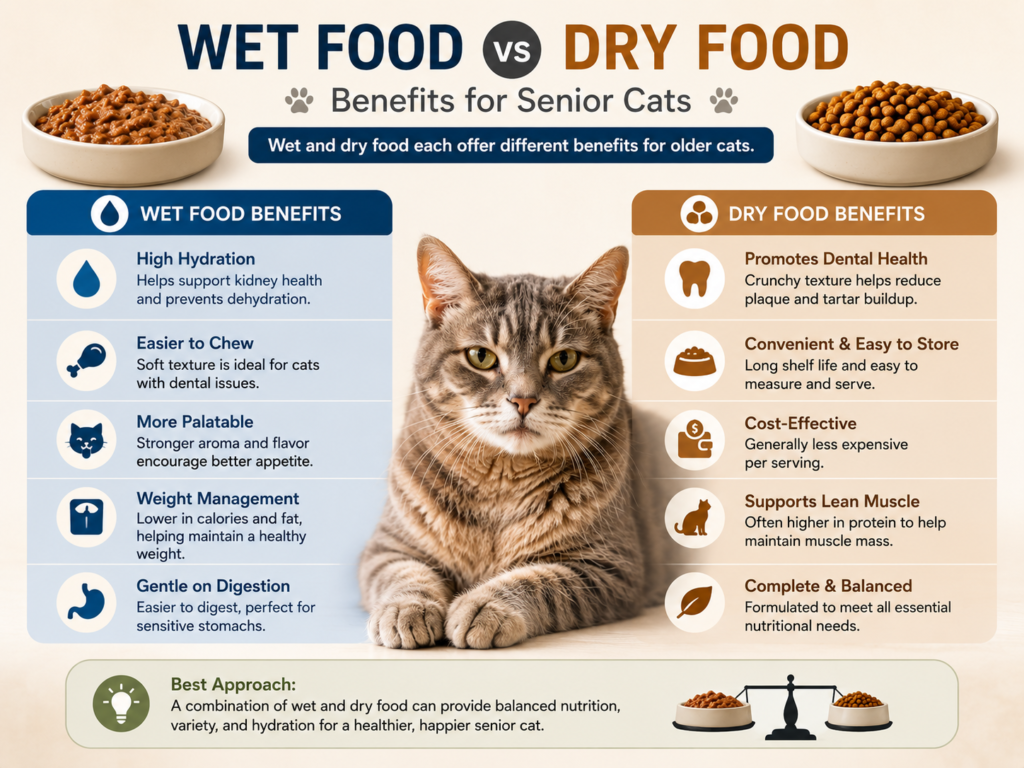
Both can be part of a healthy senior diet, and many vets recommend a mix rather than choosing strictly one or the other.
Wet food advantages for seniors:
- Higher moisture content, which supports hydration; especially helpful given how common reduced kidney function becomes with age
- Often easier to chew, which matters for cats with dental discomfort
- Tends to be more palatable for cats with a reduced appetite
Dry food advantages for seniors:
- Convenient for free-feeding schedules some cats are used to
- Can support dental health somewhat through chewing action, though it isn’t a substitute for dental care
- Typically more calorie-dense per volume, which can help cats who need to maintain weight
Cornell’s Feline Health Center specifically notes that for older cats, it can help to mix canned and dry food to let the cat absorb the extra water canned food offers, particularly given how common declining kidney function is in aging cats.
What to Look for on a Senior Cat Food Label
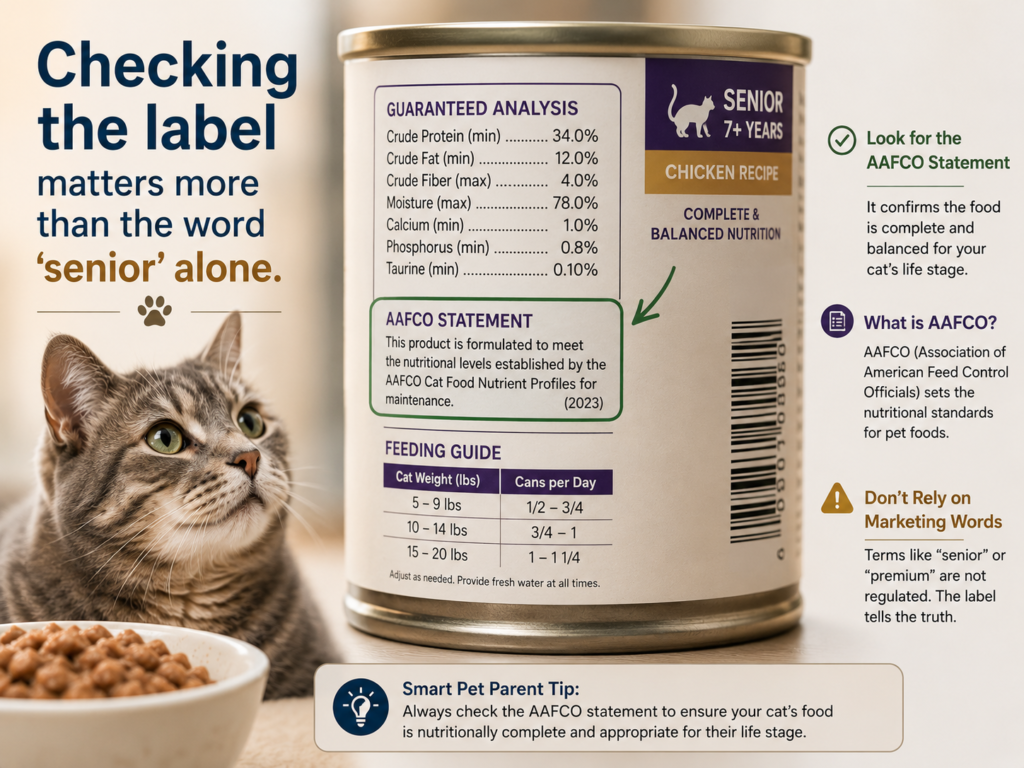
Not every “senior formula” is meaningfully different from an adult formula, and there’s currently no official regulatory definition of what a “senior” cat food must contain. Because of that, the label on its own doesn’t guarantee the food is right for your specific cat.
Here’s what’s actually worth checking:
| Label Element | Why It Matters |
|---|---|
| AAFCO nutritional adequacy statement | Confirms the food meets established minimum nutrient standards |
| Protein source and quality | Supports muscle maintenance, especially important with age-related muscle loss |
| Life stage listed | “Adult maintenance” and “all life stages” formulas can also be appropriate depending on your cat’s needs |
| Calorie density (kcal/cup or kcal/can) | Helps you adjust portions if your cat is gaining or losing weight |
| Added prescription-diet language | Signals the food is meant to be used under veterinary guidance for a specific condition |
Cornell notes that basic minimum nutritional requirements for cat food are established by the AAFCO’s Feline Nutrition Expert Subcommittee, and that reading the nutrition label is one of the most reliable ways to compare foods.
Common Health Conditions That Affect Senior Cat Diets
Several conditions become more common with age and often call for a specific, veterinarian-guided diet rather than a general “senior” formula.
| Condition | Typical Dietary Consideration |
|---|---|
| Chronic kidney disease (CKD) | Often managed with a protein- and phosphorus-restricted diet, prescribed by a vet |
| Diabetes mellitus | Often managed with a diet moderately restricted in carbohydrates |
| Hyperthyroidism | May require an iodine-restricted therapeutic diet in some cases, alongside other treatment |
| Dental disease | May call for softer textures or smaller kibble size rather than a full diet change |
| Arthritis | Not primarily diet-driven, but maintaining a healthy weight reduces joint stress |
Cornell’s veterinary guidance specifically notes that diabetic cats should ideally be fed a diet moderately restricted in carbohydrates, while cats with advanced chronic kidney disease should usually be fed a protein and phosphorus-restricted diet. These are exactly the kinds of changes that should be made with veterinary input, not guessed at from general online advice.
How Often Should You Feed a Senior Cat?
Feeding frequency doesn’t necessarily need to change just because a cat has reached senior status. Cornell’s feeding guidance states that senior cats should generally maintain the same feeding regimen as adult cats unless a veterinarian recommends otherwise.
That said, some practical adjustments are common as cats age:
- Smaller, more frequent meals can help cats with reduced appetite eat enough overall.
- Free-feeding dry food may need to shift to portioned meals if weight gain becomes an issue.
- Cats with dental discomfort may do better with several smaller wet food meals than one or two large ones.
Common Mistakes When Feeding Senior Cats
Assuming all senior formulas are equivalent. Since there’s no strict regulatory standard for what makes a food “senior,” formulas vary significantly between brands. Comparing actual nutrient content matters more than the word “senior” on the bag.
Cutting calories just because a cat is aging. Weight loss in seniors is often a red flag for illness, not something to encourage. Reducing food without veterinary guidance can worsen an underlying problem.
Switching to a low-protein diet without a medical reason. Restricting protein is appropriate for some diagnosed kidney conditions, but healthy senior cats generally benefit from adequate protein to help preserve muscle.
Ignoring gradual weight changes. Slow, steady weight loss or gain over several months is easy to miss day to day. Monthly weigh-ins (even on a kitchen scale, weighing yourself holding the cat) can catch trends early.
Not adjusting for dental pain. A cat that suddenly seems “picky” may actually be avoiding kibble because chewing hurts, not because they dislike the food.
Skipping veterinary checkups because the cat “seems fine.” Many senior conditions, including early kidney disease, don’t show obvious symptoms until they’ve progressed. The AAFP recommends a minimum of twice-yearly exams for senior cats aged 10 to 15, and exams every four months for healthy cats over 15, specifically to catch issues early through bloodwork rather than waiting for visible symptoms.
Warning Signs That Need a Vet Visit, Not Just a Diet Change
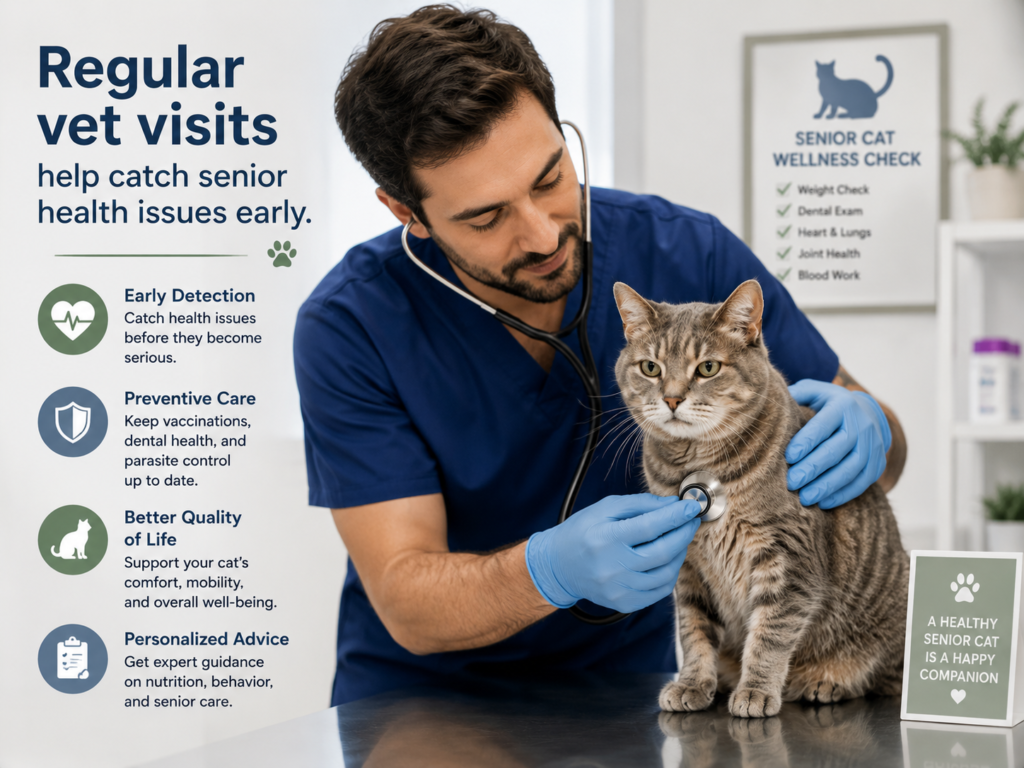
Contact your veterinarian if you notice any of the following in an older cat:
- Unexplained weight loss or gain over a few weeks to months
- Increased or decreased thirst
- Changes in litter box habits (more or less urine, straining, accidents outside the box)
- Vomiting or diarrhea that isn’t a one-off event
- Noticeable decrease in appetite or complete food refusal
- Bad breath, drooling, or apparent mouth pain
- Increased hiding, reduced grooming, or sudden behavior changes
A cat that refuses to eat for more than a day or two needs prompt veterinary attention, since prolonged appetite loss can lead to serious complications in cats regardless of age.
Frequently Asked Questions
What is the best food for senior cats?
There’s no single best food for every senior cat; the right choice depends on your cat’s weight trend, dental health, and any diagnosed medical conditions.
At what age should I switch my cat to senior food?
Many vets consider cats senior starting around 10–11 years old, but the right time to adjust diet depends more on individual health changes; like weight trends or new diagnoses; than a specific age.
Do senior cats need less protein?
Not usually. Healthy senior cats generally benefit from adequate, high-quality protein to help preserve muscle mass.
Is wet food better than dry food for senior cats?
Both can work well. Wet food supports hydration and is often easier to chew, which helps with dental discomfort and kidney health. Dry food is more calorie-dense and convenient. Many vets recommend a mix of both.
Key Takeaways
- There’s no single age or food that fits every senior cat; individual health, weight trend, and any diagnosed conditions matter more than the word “senior” on a label.
- Healthy older cats generally still need adequate protein; restriction is typically reserved for specific medical conditions and should be vet-guided.
- Unexplained weight loss is a common early sign of illness in senior cats and deserves veterinary attention rather than a diet change alone.
- Twice-yearly vet visits (or more often past 15) help catch age-related conditions early, often before symptoms are noticeable at home.
If you’re also noticing changes in your cat’s litter box habits alongside diet questions, our guide on senior cat kidney health and hydration goes deeper into how water intake and food moisture work together as cats age.
Resources:
Cornell University College of Veterinary Medicine, Feline Health Center — feeding and senior cat care guidance
American Association of Feline Practitioners (AAFP) — 2021 Feline Senior Care Guidelines
1 thought on “Senior Cat Food Guide: What Older Cats Really Need to Eat”
Comments are closed.