
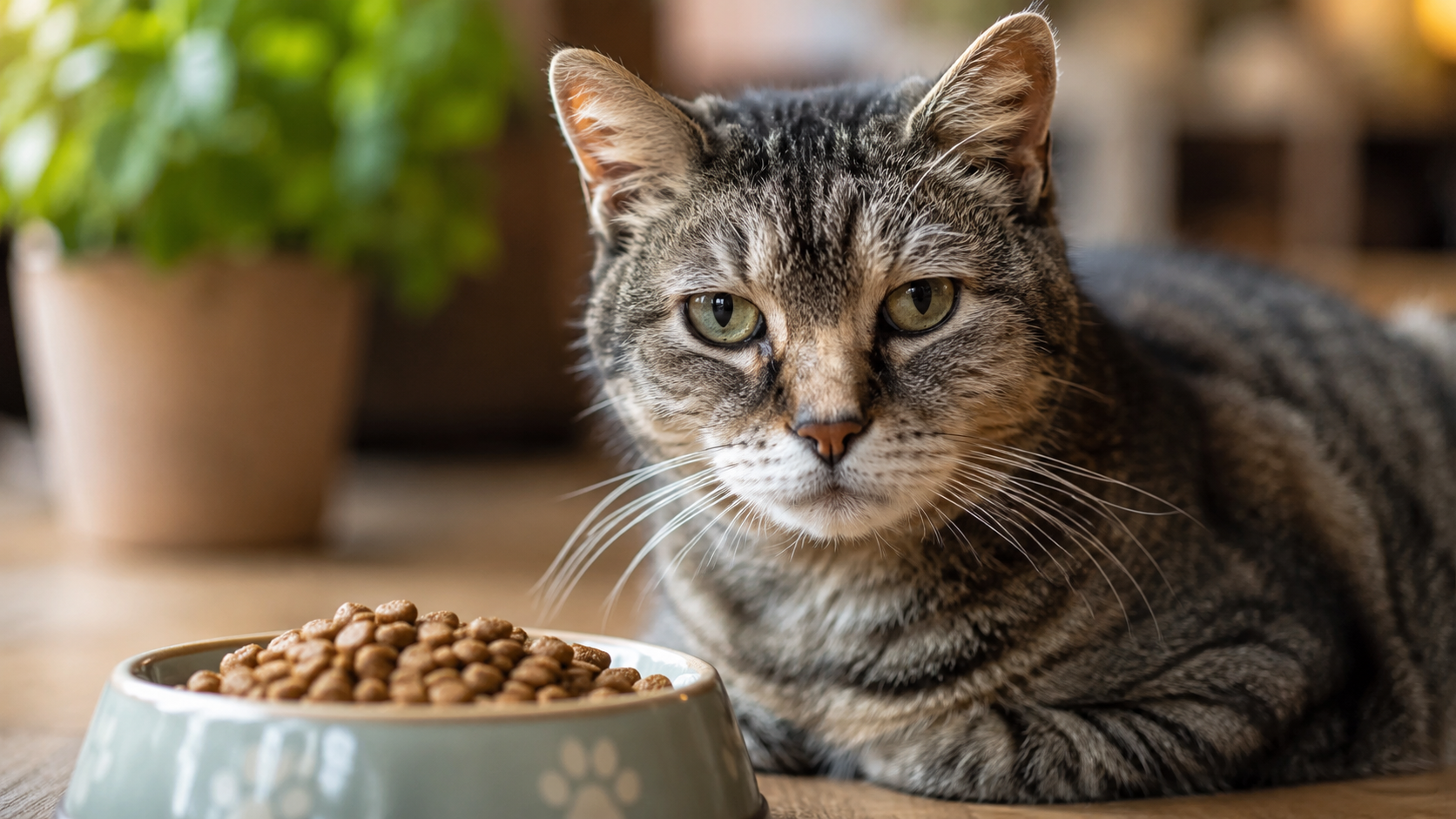
The right choice depends on your cat’s age, body condition, appetite, activity level, dental health, and any diagnosed medical conditions.
In this guide, we’ll look at 10 senior dry cat foods worth considering, explain what each one is best suited for, and show you how to evaluate a senior Choosing the best dry food for a senior cat is not simply about finding a bag labeled “Senior.”
As cats age, their nutritional needs can change. Some older cats become less active and gain weight. Others lose muscle or begin losing weight. Dental disease can make crunchy kibble uncomfortable, while conditions such as chronic kidney disease, diabetes, hyperthyroidism, and gastrointestinal problems can completely change what diet is acat food beyond the marketing claims on the front of the bag.
Important: This guide is for general education and does not replace veterinary advice. If your senior cat has kidney disease, diabetes, urinary disease, significant weight loss, or another diagnosed condition, ask your veterinarian before changing their diet.
Quick Picks: 10 Senior Dry Cat Foods to Consider
| Product | Best for |
|---|---|
| Purina Pro Plan Adult 7+ Complete Essentials Chicken & Rice | Everyday senior nutrition and digestive support |
| ORIJEN Guardian Senior | Owners looking for a high-animal-ingredient formula |
| Nulo Freestyle Senior Alaska Pollock & Sweet Potato | High-protein, grain-free diets |
| Hill’s Science Diet Adult 11+ Chicken Recipe | Cats 11+ |
| Hill’s Science Diet Adult 7+ Senior Vitality | Supporting activity, interaction, and healthy aging |
| IAMS ProActive Health Healthy Senior | Senior cats 11+ needing mainstream, balanced nutrition |
| NUTRO Wholesome Essentials Senior Chicken & Brown Rice | Chicken-and-rice diets with a straightforward ingredient profile |
| Wellness Complete Health Senior | Senior cats whose owners want added joint-support ingredients |
| BLUE Tastefuls Adult 7+ Chicken & Brown Rice | Cats that prefer a chicken-and-grain formula |
| NOW FRESH Senior | Owners who prefer fresh meat and fish ingredients |
These are not ranked from best to worst. A food that works very well for one senior cat may be a poor choice for another.
As an Amazon Associate, we earn from qualifying purchases. This post contains affiliate links – if you buy through them, we may earn a commission at no extra cost to you.
| # | Product | ||
|---|---|---|---|
| 1 |  | Purina Pro Plan Senior Best Overall | Check Price |
| 2 |  | Orijen Guardian Senior Most Nutrient Dense | Check Price |
| 3 |  | Nulo FreeStyle Senior Best Grain Free | Check Price |
| 4 |  | Hill's Science Diet 11+ Best for Advanced Age | Check Price |
| 5 |  | Hill's Science Diet Vitality Best for Vitality Support | Check Price |
| 6 |  | Iams Proactive Health Senior Best for Digestive Health | Check Price |
| 7 |  | Nutro Wholesome Essentials Senior Best Natural Ingredients | Check Price |
| 8 |  | Wellness Complete Health Senior Best Holistic Formula | Check Price |
| 9 |  | Blue Buffalo Tastefuls Senior Best Palatability | Check Price |
| 10 |  | Now Fresh Senior Best Protein Variety | Check Price |
What Makes a Good Dry Food for a Senior Cat?
Before looking at individual products, understand what actually matters.
The word “senior” on a bag is not enough.
A good choice should provide complete and balanced nutrition appropriate for your cat’s life stage, have an appropriate calorie density, provide adequate high-quality protein, and fit your cat’s individual health needs.
AAFCO explains that the nutritional adequacy statement is one of the most important parts of a pet food label. It tells you whether the food is complete and balanced for a particular life stage or purpose.
Look for the following.
1. A Complete and Balanced Diet
The first thing to check is the nutritional adequacy statement.
For an ordinary healthy senior cat, you will commonly see a statement indicating that the food provides complete and balanced nutrition for adult maintenance.
Some foods are also formulated for all life stages.
The important point is that “senior” itself should not be treated as a guarantee that the food is nutritionally appropriate.
AAFCO recognizes life-stage categories such as growth, reproduction, adult maintenance, and all life stages. The nutritional adequacy statement tells you what the food is actually intended to provide.
2. Adequate, High-Quality Protein
Protein becomes particularly important as cats age because maintaining lean muscle can become more difficult.
This does not mean every senior cat needs the highest protein number you can find.
Instead, look for a complete diet that provides appropriate amounts of high-quality protein and essential amino acids.
A healthy older cat should not automatically be placed on a low-protein diet simply because it is old.
Kidney disease is a different situation. Cats with diagnosed chronic kidney disease may benefit from a therapeutic renal diet with controlled phosphorus and other nutritional modifications. These diets should be selected with veterinary guidance rather than simply choosing any “low-protein” food. IRIS recommends consideration of renal diets in cats with appropriate stages of CKD.
3. Calories That Match Your Cat’s Body Condition
Senior cats do not all have the same calorie needs.
An overweight, sedentary 12-year-old cat needs a different feeding strategy from a thin, active 12-year-old cat.
Dry food is relatively calorie-dense, so measuring portions matters.
Check the package for:
- Calories per cup
- Calories per kilogram
- Feeding recommendations
- Your cat’s current body condition
AAFCO requires calorie information on complete pet foods, and feeding directions are intended as starting guidelines that may need adjustment based on the individual animal.
4. Appropriate Fat Levels
Fat provides concentrated calories and essential fatty acids.
A senior cat that is underweight may need a more calorie-dense diet, while an overweight cat may need fewer calories.
Do not automatically choose the lowest-fat food simply because your cat is old.
Body condition matters more than age alone.
5. Omega-3 Fatty Acids
Omega-3 fatty acids, particularly EPA and DHA, can be useful components of a senior cat’s diet.
They are commonly included in senior formulas intended to support areas such as skin, coat, joints, and general health.
However, the presence of an omega-3 claim on a package does not mean that the food will treat arthritis or another disease.
Think of it as nutritional support, not a replacement for veterinary treatment.
6. Fiber and Digestive Support
Some senior formulas contain prebiotic fibers, probiotics, or other sources of dietary fiber.
These ingredients may be useful for digestive health and stool quality.
But more fiber is not automatically better.
If your cat has chronic constipation, diarrhea, vomiting, or another gastrointestinal problem, the cause should be investigated instead of repeatedly changing foods.
7. A Kibble Your Cat Can Actually Eat
This is easy to overlook.
A nutritionally excellent dry food is useless if your cat cannot comfortably chew it.
Older cats are more likely to experience dental disease, missing teeth, gum problems, or oral pain.
If your senior cat suddenly starts dropping kibble, chewing differently, eating more slowly, refusing dry food, or showing other signs of mouth discomfort, do not assume the food has simply become boring.
A dental examination may be more appropriate.
Cornell notes that cats with periodontal disease may have difficulty chewing dry food and may benefit from wet food or smaller kibble depending on the situation.
Dry Food vs. Wet Food for Senior Cats
Dry food is not inherently bad for senior cats.
But it has one major nutritional disadvantage compared with wet food:
Moisture.
Dry kibble typically contains far less water than canned or pouch food.
That matters because hydration can become increasingly important as cats age, particularly when kidney or urinary problems are present.
Wet food can provide substantially more moisture while also making meals easier to eat for some cats with dental problems.
That does not mean every senior cat must stop eating dry food.
Many healthy senior cats do perfectly well on dry food, mixed feeding, or a combination of dry and wet food.
Dry food
Advantages:
- Convenient
- Easy to measure
- Usually less expensive per calorie
- Easy to store after opening
- Can be useful for cats that prefer kibble
Potential disadvantages:
- Very low moisture compared with wet food
- Calorie-dense
- Can be difficult for cats with dental pain
- Easy to overfeed when free-fed
Wet food
Advantages:
- High moisture content
- Often easier to eat
- Lower calorie density by weight
- Can be useful for cats that do not drink much
Potential disadvantages:
- Usually more expensive
- Requires refrigeration after opening
- Some cats strongly prefer dry food
- Not every wet food is nutritionally equivalent
The important question is not:
“Is dry food or wet food better?”
It is:
“Which feeding approach best meets this individual cat’s nutritional and medical needs?”
The 10 Best Dry Foods for Senior Cats
Again, these are not ranked from #1 to #10. They are options that fit different preferences and nutritional situations.
1. Purina Pro Plan Senior Dry Cat Food
Best for: Everyday senior nutrition with digestive support
Purina Pro Plan’s Adult 7+ Complete Essentials Chicken & Rice formula is designed for cats age 7 and older.
The current formula lists chicken as the first ingredient and includes prebiotic fiber and guaranteed live probiotics. It also provides omega-6 fatty acids and vitamin A for skin and coat support.
Purina states that the food provides complete and balanced nutrition for adult cats and lists approximately 470 kcal per cup for the current formula.
Why consider it
- Designed for cats 7+
- Chicken is the first ingredient
- Contains prebiotic fiber
- Contains guaranteed live probiotics
- Complete and balanced
- Widely available
Keep in mind
This is not a prescription kidney diet or treatment for a specific disease.
If your cat has CKD, diabetes, urinary disease, or another condition requiring therapeutic nutrition, ask your veterinarian whether this type of food is appropriate.
Best fit: A generally healthy senior cat whose owner wants a conventional, widely available dry diet.
2. ORIJEN Guardian Senior Grain Free WHOLEPREY Dry Cat Food 4lb
Best for: Owners who prefer a formula built around multiple animal ingredients
ORIJEN Guardian Senior is designed specifically for senior cats and emphasizes fresh or raw animal ingredients.
The manufacturer states that Guardian Senior is formulated to support areas including immune function, healthy weight, heart health, digestion, and muscle maintenance. It also emphasizes EPA and DHA from fish and animal-derived protein.
Why consider it
- Designed for senior cats
- Emphasizes animal ingredients
- Includes fish-derived omega-3 fatty acids
- Includes prebiotics and fiber
- Provides taurine
- Focuses on muscle and healthy body condition
Keep in mind
A longer or more exotic ingredient list does not automatically make a food nutritionally superior.
This formula may also be a poor choice for a cat with a medical condition requiring a therapeutic diet.
Best fit: A healthy senior cat whose owner specifically prefers an animal-ingredient-focused formula.
3. Nulo FreeStyle Senior Dry Cat Food
Best for: Owners looking for a high-protein, grain-free senior formula
Nulo’s current Freestyle Senior Alaska Pollock & Sweet Potato formula uses pollock, chicken meal, turkey meal, and duck among its primary ingredients.
The manufacturer lists 38% minimum crude protein, 14% minimum crude fat, 6% maximum crude fiber, and 416 kcal per cup. It also includes L-carnitine and a Bacillus coagulans probiotic. The food is formulated to meet AAFCO requirements for adult maintenance.
Why consider it
- Senior formula
- Grain-free
- High protein
- Multiple animal protein sources
- Contains L-carnitine
- Contains a probiotic
- Small-disk kibble
Keep in mind
Grain-free is not automatically healthier for senior cats.
This formula contains several animal protein sources, so it may not be the most appropriate choice for a cat that needs a limited-ingredient or novel-protein diet.
Best fit: A healthy senior cat that does well with fish and multiple protein sources.
4. Hill’s Science Diet Senior 11+ Dry Cat Food
Best for: Cats 11 years and older
Hill’s Science Diet Adult 11+ Chicken Recipe is specifically formulated for cats 11 and older.
Hill’s describes it as a senior diet designed to support healthy aging, including brain function and coat health. The current product is substantiated through AAFCO feeding tests for complete and balanced nutrition for adult maintenance.
Why consider it
- Specifically designed for cats 11+
- Complete and balanced
- Senior-focused nutrient profile
- Available from a major veterinary nutrition brand
- Useful option for cats entering later life
Keep in mind
Do not assume that every cat needs to switch foods immediately when turning 11.
Body condition, appetite, dental health, activity, and medical status are more important than a birthday alone.
Best fit: A generally healthy cat 11 years or older.
5. Hill’s Science Diet Adult 7+ Senior Vitality Dry Cat Food
Best for: Older cats showing reduced activity or interaction
Hill’s Science Diet Adult 7+ Senior Vitality is formulated for cats 7 years and older.
Hill’s describes the formula as supporting everyday ability to get up and go, with a proprietary blend intended to support brain health, interaction, energy, and vitality. The current formula is complete and balanced for adult maintenance.
Why consider it
- Designed for cats 7+
- Senior-specific nutritional profile
- Focuses on healthy aging
- Includes omega-6 fatty acids and vitamin E
- Complete and balanced
Keep in mind
A decline in activity should not automatically be treated as an ordinary effect of aging.
If your cat suddenly stops jumping, playing, grooming, or interacting, arthritis, dental disease, pain, or another medical condition may be involved.
Best fit: A healthy senior cat whose activity level has gradually changed with age.
6. IAMS Proactive Health Healthy Senior Dry Cat Food
Best for: A widely available senior formula for cats 11+
IAMS ProActive Health Healthy Senior is designed for cats 11 years and older.
The current formula uses chicken as the first ingredient and includes vitamin E and antioxidants, calcium and phosphorus, and L-carnitine. IAMS also states that the food is complete and balanced for adult maintenance.
Why consider it
- Designed for cats 11+
- Chicken is the first ingredient
- Contains L-carnitine
- Contains vitamin E and antioxidants
- Complete and balanced
- Widely available
Keep in mind
IAMS states that the crunchy texture helps reduce plaque buildup, but ordinary kibble should not be treated as a substitute for proper dental care.
For dental-specific benefits, look for products with evidence of dental efficacy, such as those carrying the Veterinary Oral Health Council (VOHC) seal. VOHC maintains a list of accepted feline dental diets and products.
Best fit: A generally healthy senior cat 11+ whose owner wants a conventional, accessible formula.
7. Nutro Wholesome Essentials Senior Dry Cat Food
Best for: Cats that do well with chicken-and-rice formulas
NUTRO Wholesome Essentials Senior Chicken & Brown Rice currently uses chicken as the first ingredient and includes vitamin E, selenium, taurine, and natural prebiotic fiber.
The current guaranteed analysis lists 36% minimum crude protein and 17% minimum crude fat.
Why consider it
- Chicken as the first ingredient
- Includes prebiotic fiber
- Contains taurine
- Contains vitamin E and selenium
- No corn, wheat, or soy in the current formula
- Complete senior nutrition
Keep in mind
There is no nutritional requirement for a senior cat to avoid grains.
If your cat does well with a grain-inclusive formula, there is no general reason to switch solely because another food is grain-free.
Best fit: A senior cat that does well with a chicken-and-brown-rice diet.
8. Wellness Complete Health Senior Dry Cat Food
Best for: Owners interested in a senior formula with added joint-support ingredients
Wellness Complete Health Senior is formulated specifically for older cats and uses deboned chicken as a primary ingredient.
The current product description highlights added glucosamine and chondroitin for hip and joint support.
Why consider it
- Designed for senior cats
- Chicken-based
- Includes added glucosamine and chondroitin
- Complete senior nutrition
- Useful option for owners specifically interested in joint-support ingredients
Keep in mind
Glucosamine or chondroitin in a food should not be considered a treatment for arthritis.
If your cat is reluctant to jump, walks stiffly, avoids stairs, or becomes uncomfortable when handled, speak with your veterinarian.
Best fit: A healthy senior cat whose owner wants a food that includes joint-support ingredients.
9. Blue Buffalo Tastefuls Chicken & Brown Rice Senior Dry Cat
Best for: Cats that prefer a chicken-and-grain formula
BLUE Tastefuls Adult 7+ Chicken & Brown Rice is formulated for mature cats 7 years and older.
The current formula starts with deboned chicken and includes whole grains and vegetables. Blue Buffalo describes it as providing a balance of protein and complex carbohydrates for mature cats.
Why consider it
- Designed for cats 7+
- Deboned chicken as the first ingredient
- Contains whole grains
- Includes taurine
- Senior-specific formula
Keep in mind
Do not choose or reject this food simply because it contains grains.
The presence of grains does not by itself make a cat food inferior.
Best fit: A senior cat that enjoys chicken-based, grain-inclusive food.
10. Now Fresh Senior Dry Cat Food
Best for: Owners who prefer fresh meat and fish ingredients
NOW FRESH Senior is marketed as a grain-free senior formula built around fresh meats and fish.
The manufacturer highlights fresh turkey, salmon, and duck, along with ingredients intended to provide protein, fiber, antioxidants, and omega-3 fatty acids.
Why consider it
- Senior-specific formula
- Fresh meat and fish ingredients
- Grain-free
- Contains omega-3 fatty acids
- Includes fiber sources
- No meat meals or by-products according to the manufacturer
Keep in mind
“Fresh,” “natural,” and “grain-free” are not nutritional guarantees.
Evaluate the complete and balanced statement, calorie content, guaranteed analysis, ingredient list, and your cat’s individual needs.
Best fit: A healthy senior cat whose owner prefers a fresh-meat-focused formula.
Where These Overlap
Many of the foods listed here share common goals for senior cats, such as high-quality protein, immune support, and digestive health. For example, Purina Pro Plan Senior, Iams Proactive Health Senior, and Nutro Wholesome Essentials Senior all use chicken as a primary ingredient and include rice or grains to provide steady energy. If your cat does well on a traditional diet, these three are quite similar in their general approach to nutrition.
On the other hand, Orijen Guardian Senior, Nulo FreeStyle Senior, Wellness Complete Health Senior, and Now Fresh Senior represent a different philosophy. These are grain-free and often emphasize fresh, raw, or multiple protein sources. Choosing between these often comes down to your cat’s specific protein preference—whether they like pollock, turkey, or deboned chicken—and whether they need extra help with joints or weight. The “best” choice is often the one your cat finds most palatable, as even the most nutrient-dense food provides no benefit if your cat refuses to eat it.
Which Senior Dry Food Should You Choose?
Instead of asking:
“Which brand is number one?”
ask:
“Which formula best fits my cat?”
Here is a simpler way to narrow your choices.
For a generally healthy senior cat
Look for:
- Complete and balanced nutrition
- Appropriate calories
- Adequate high-quality protein
- A formula your cat actually enjoys
- A calorie level that matches body condition
Purina Pro Plan, Hill’s Science Diet, IAMS, NUTRO, BLUE Tastefuls, and other established brands can all fit this general category depending on the specific formula.
For a cat that is gaining weight
Focus more on:
- Calorie density
- Portion control
- Body condition
- Activity level
- Measured meals
Do not assume that simply choosing a “senior” formula will prevent weight gain.
Dry food is easy to overfeed because it contains relatively concentrated calories.
For a cat that is losing weight
This requires more caution.
Progressive weight loss in an older cat can be caused by conditions such as:
- Chronic kidney disease
- Hyperthyroidism
- Diabetes
- Dental disease
- Gastrointestinal disease
- Cancer
- Other chronic conditions
Do not simply buy a higher-calorie senior food and assume the problem is solved.
A veterinary examination is more important.
For a cat with dental problems
Dry food may actually become harder to eat.
Watch for:
- Dropping kibble
- Chewing on one side
- Eating more slowly
- Pawing at the mouth
- Bad breath
- Drooling
- Refusing dry food
- Weight loss
A dental examination may be more useful than switching between five different kibble brands.
If dental support is a major priority, look for products with documented dental efficacy. VOHC maintains a current list of accepted feline dental diets and products.
For a cat with kidney disease
Do not choose a food simply because it says:
- Low protein
- Kidney support
- Renal support
- Low phosphorus
A cat with diagnosed CKD may need a therapeutic renal diet with carefully controlled phosphorus and other nutrients.
The correct diet depends on the stage and individual circumstances of the disease.
IRIS recommends considering renal diets for appropriate stages of feline CKD and emphasizes dietary management as a key part of treatment.
Talk to your veterinarian before selecting a kidney diet.
For a picky senior cat
Palatability matters.
A food cannot help your cat if they refuse to eat it.
If your cat has become selective, consider:
- Different protein flavors
- Smaller kibble
- Wet food
- Mixed feeding
- Warming wet food slightly
- Smaller, more frequent meals
But persistent appetite loss is not simply “pickiness” in an older cat.
A sustained reduction in appetite should be discussed with a veterinarian.
How Much Protein Does a Senior Cat Need?
This is one of the most misunderstood parts of senior-cat nutrition.
You will often see advice saying that senior cats need “30% to 45% protein.”
That is too simplistic to use as a universal rule.
The guaranteed analysis on a pet food label is not enough by itself to determine whether a food is appropriate for an individual cat.
Protein should be considered in relation to:
- Calories
- Dry matter
- Protein quality
- Amino acid profile
- The rest of the diet
- Body condition
- Kidney function
- Other medical conditions
A healthy senior cat generally should not be placed on a low-protein diet simply because of age.
On the other hand, a cat with CKD may need a veterinary therapeutic diet with controlled phosphorus and an appropriate amount and quality of protein.
So instead of asking:
“What is the highest protein senior cat food?”
ask:
“Does this food provide appropriate protein for my cat’s health status?”
That is a much more useful question.
Does a Senior Cat Need Grain-Free Food?
No.
There is no general reason that a healthy senior cat must eat grain-free food.
Grains such as rice, corn, wheat, and barley can be included in complete and balanced cat foods.
The presence of grains does not automatically make a food low quality.
Likewise, grain-free does not automatically mean healthier.
Compare the entire nutritional profile rather than focusing on one ingredient category.
If your cat has a diagnosed food allergy or intolerance, dietary selection becomes a different issue and should be handled with veterinary guidance.
Does Dry Food Clean a Senior Cat’s Teeth?
Usually, you should not rely on ordinary kibble to clean your cat’s teeth.
Some specially designed dental diets have demonstrated plaque or tartar control.
The Veterinary Oral Health Council maintains a list of products that have earned its Seal of Acceptance for dental claims. Current accepted feline products include specific dental diets from Hill’s, Purina, and Royal Canin, among others.
Ordinary senior kibble should not be considered a replacement for:
- Veterinary dental examinations
- Professional dental cleaning when recommended
- Appropriate home dental care
And if your senior cat has painful teeth, simply giving harder kibble is not a solution.
How to Switch a Senior Cat to a New Dry Food
Do not change foods overnight unless your veterinarian specifically tells you to.
A sudden change can cause digestive upset and may make it harder to determine whether your cat actually tolerates the new formula.
A simple transition can look like this:
Days 1 to 2: Mostly old food with a small amount of new food
Days 3 to 4: About half old and half new
Days 5 to 6: Mostly new food with a smaller amount of old food
Day 7: New food
Some cats need a slower transition.
If your cat develops significant vomiting, diarrhea, refuses food, or develops another concerning symptom, stop trying to force the transition and contact your veterinarian.
Hill’s currently recommends a seven-day transition for its senior formulas, while individual cats may need more time.
How Many Times a Day Should You Feed a Senior Cat?
There is no universal requirement that senior cats must eat three, four, or six meals per day.
Many adult and senior cats do well with measured meals once or twice daily, while some cats benefit from more frequent smaller meals.
The important thing is consistency and the ability to monitor how much your cat actually eats.
Cornell notes that senior cats can generally maintain the same feeding regimen as adult cats unless a veterinarian recommends otherwise.
For senior cats, measured feeding can have another advantage:
You can notice appetite changes more easily.
If you free-feed a large bowl of kibble, a gradual reduction in eating may go unnoticed.
Should You Free-Feed Dry Food to a Senior Cat?
Free-feeding is not automatically wrong.
Some cats maintain an ideal body condition while grazing throughout the day.
However, it can become problematic for senior cats that are gaining weight or whose activity has decreased.
Measured portions make it easier to:
- Control calorie intake
- Monitor appetite
- Track weight
- Notice changes in eating behavior
- Adjust food when necessary
If your cat is overweight, portion control is often more important than simply buying a different bag of senior food.
Signs Your Senior Cat’s Food May Not Be Working
No food is guaranteed to be right for every cat.
Pay attention to changes such as:
- Persistent vomiting
- Repeated diarrhea
- Ongoing soft stool
- Progressive weight loss
- Excessive weight gain
- Reduced appetite
- Difficulty chewing
- Poor coat condition
- Increased thirst
- Increased urination
- Reduced activity
- New food-related aggression or discomfort
These signs do not necessarily mean the food is the cause.
In older cats, they can also indicate an underlying medical condition.
For example, increased thirst and urination may occur with kidney disease, diabetes, or hyperthyroidism.
A food change should not delay veterinary evaluation.
Common Mistakes When Buying Senior Cat Food
Choosing a food because it says “Senior”
The word on the front of the bag is not enough.
Read the nutritional adequacy statement, calories, guaranteed analysis, ingredients, and feeding directions.
Automatically choosing the highest-protein food
More protein is not automatically better for every cat.
Consider protein quality and your cat’s health status.
Assuming older cats need low protein
Healthy senior cats do not automatically need a low-protein diet.
Kidney disease is a separate medical issue.
Assuming grain-free means healthier
There is no general nutritional requirement for a healthy senior cat to avoid grains.
Believing ordinary kibble cleans teeth
Most ordinary kibble should not be treated as a dental treatment.
Look for evidence-backed dental products when dental support is the goal.
Free-feeding without monitoring body condition
Dry food is calorie-dense.
A senior cat that becomes less active can gradually gain weight.
Changing foods every few weeks
Constantly switching foods can make digestive problems harder to identify and can create unnecessary stress for a picky cat.
Choosing a therapeutic diet without a diagnosis
Kidney, urinary, gastrointestinal, diabetic, and other veterinary diets are designed for specific medical situations.
Do not choose them simply because the marketing sounds healthier.
Frequently Asked Questions
What does it take to keep my senior cat happy on a new diet?
Transition to a new food slowly over 7 to 10 days by gradually increasing the new food ratio while decreasing the old. This method helps prevent digestive upset. According to the American Veterinary Medical Association, a gradual transition is vital for maintaining a healthy gut during dietary changes.
What do I need to look for as my cat enters their teenage years?
As cats reach 11 years and older, they often require more specialized support for their vital organs and energy levels. Keep a close eye on their weight, appetite, and coat condition. If you notice they’re struggling with mobility or seem less interested in play, you might need to move to a formula specifically for advanced seniors, such as Hill’s Science Diet 11+.
What happens if my cat stops eating their new food?
If your cat stops eating, first ensure the food is fresh and stored in a cool, dry place. Senior cats can sometimes have dental issues that make crunchy kibble difficult to chew. You might try adding a little warm water to soften the kibble, or consider if they prefer a different protein source. If the refusal continues for an extended period, consult your veterinarian to rule out underlying health issues.
Could a more capable food have suited my cat better?
The best food is one your cat eats consistently that supports their specific health needs. A nutrient-dense option like Orijen Guardian Senior works for many, though cats with sensitive stomachs may require specialized formulas like Iams Proactive Health Senior. Focus on results like energy levels and coat health rather than ingredient complexity.
Conclusion
There is no single best dry food for every senior cat.
The best choice is the food that:
- Provides complete and balanced nutrition
- Supplies appropriate protein and essential nutrients
- Provides an appropriate amount of calories
- Fits your cat’s body condition
- Is comfortable for your cat to eat
- Your cat actually likes
- Fits any medical or dietary requirements
- Can be fed consistently and measured appropriately
For a healthy senior cat, products such as Purina Pro Plan Adult 7+, Hill’s Science Diet 7+ or 11+, IAMS Healthy Senior, NUTRO Wholesome Essentials Senior, BLUE Tastefuls Adult 7+, ORIJEN Guardian Senior, Nulo Freestyle Senior, Wellness Complete Health Senior, and NOW FRESH Senior are all options worth comparing.
But the product name should be the beginning of your evaluation, not the end.
Look at the label.
Check the calories.
Consider your cat’s body condition.
Think about hydration.
Pay attention to dental health.
And if your older cat has unexplained weight loss, increased thirst, vomiting, appetite changes, difficulty eating, or another new symptom, talk to your veterinarian before assuming a different food is the answer.
For senior cats, the right food is not simply the one with the most impressive ingredient list. It is the one that provides appropriate nutrition for the individual cat in front of you.
References
- AAFCO. Selecting the Right Pet Food
Guidance on complete and balanced nutrition, life stages, feeding directions, and choosing pet food. - Cornell Feline Health Center. How Often Should You Feed Your Cat?
Veterinary guidance covering feeding frequency, dental disease, and dietary considerations for cats with medical conditions. - International Renal Interest Society (IRIS). Diets for Cats with Chronic Kidney Disease
Evidence-based guidance on nutritional management of feline chronic kidney disease. - Veterinary Oral Health Council (VOHC). Accepted Dental Products for Cats
Current information on feline dental diets and products that have earned the VOHC Seal of Acceptance.
1 thought on “Best Dry Food for Senior Cats: A Vet-Informed Buying Guide”
Comments are closed.