
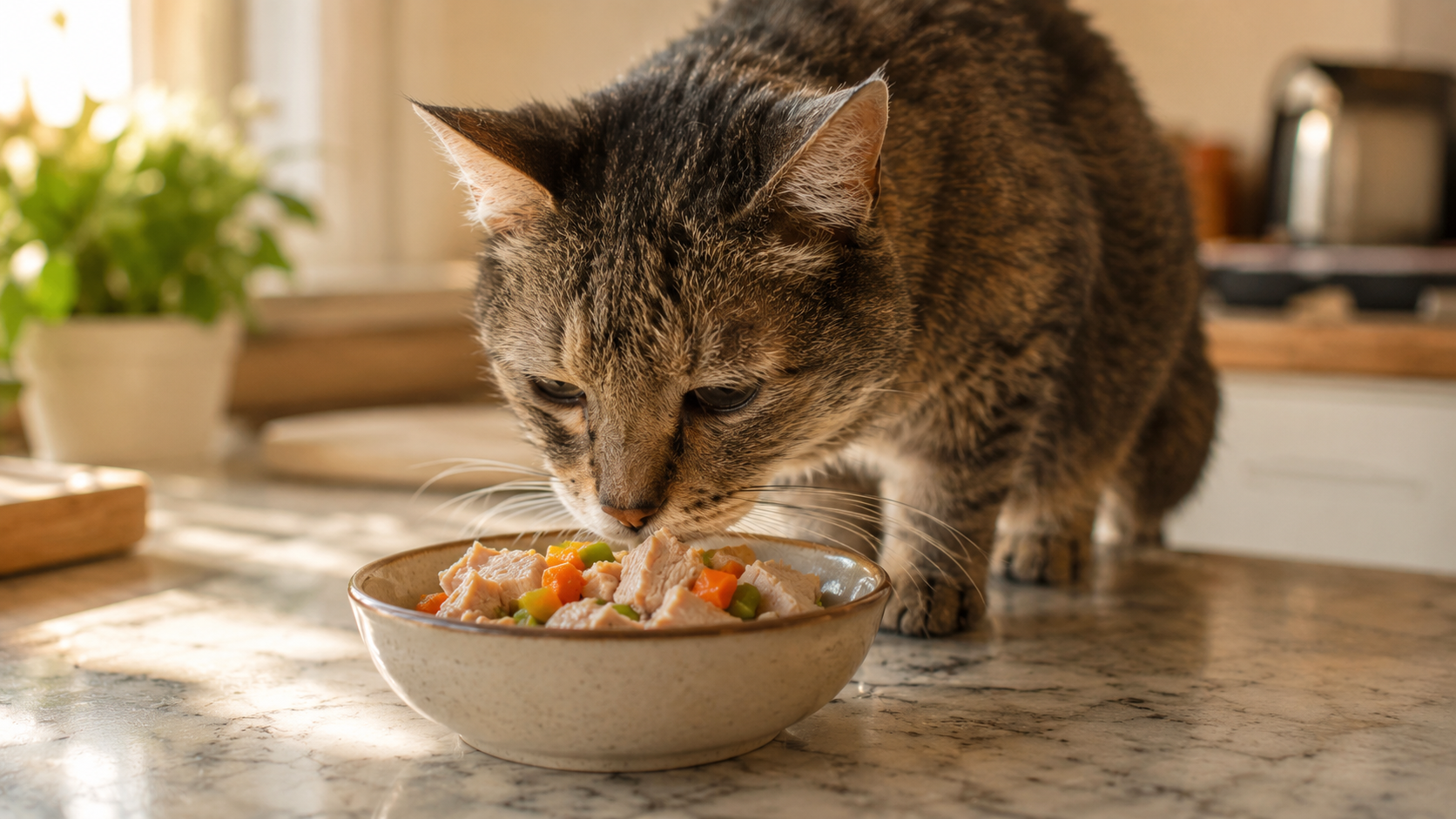
Homemade food can be part of a senior cat’s diet. Still, it should never be your cat’s only food unless the recipe was specifically formulated and balanced by a board-certified veterinary nutritionist. Cats have extremely precise nutritional requirements, including taurine, an amino acid they can’t produce in adequate amounts on their own, and homemade recipes found online frequently fall short of meeting them, sometimes seriously. This isn’t a reason to avoid homemade food altogether, but it is a reason to approach it carefully.
If you’re drawn to homemade cat food because you want more control over ingredients for your aging cat, that instinct makes sense. But feline nutrition is genuinely more complicated than it looks, and getting it wrong with a senior cat who may already be managing reduced kidney function, muscle loss, or other age-related changes carries more risk than doing it with a young, healthy cat.
Why Cats Are Different From Dogs (and Why This Matters for Homemade Food)
Cats are obligate carnivores, meaning their bodies are built to run almost entirely on animal-derived nutrients, unlike dogs, who can process a wider range of plant-based ingredients reasonably well. This isn’t a minor detail; it’s the reason so many well-intentioned homemade cat food recipes fail nutritionally, even when they look “healthy” on the surface.
A few things make feline nutrition especially unforgiving:
- Taurine is an amino acid cats must get from their diet because they can’t synthesize enough of it themselves. It’s found almost exclusively in animal tissue, and it’s easily reduced by cooking. A homemade diet without a proper taurine supplement is a common source of deficiency.
- Vitamin A in cats must come from animal sources; cats can’t convert plant-based beta-carotene into usable vitamin A the way humans and dogs can.
- Arachidonic acid, an essential fatty acid, must also come from animal fat, since cats can’t produce enough of it from plant-based fats.
- Calcium and phosphorus need to be balanced in a fairly specific ratio, which a simple “meat and vegetables” recipe usually doesn’t achieve without added bone meal or a calcium supplement.
None of this means homemade food is inherently bad; it means it has to be built correctly, the same way a commercial food does behind the scenes.
What the Research Actually Shows About Homemade Cat Food
This is worth being direct about, since a lot of homemade recipe content online glosses over it: multiple published evaluations of homemade cat food recipes have found that a large share fail to meet basic nutrient requirements, most commonly around taurine, but also calcium, certain vitamins, and trace minerals. Some recipes have even been found to exceed safe upper limits for certain nutrients, which can be just as harmful as a deficiency.
This is why organizations like AAFCO and veterinary nutrition researchers consistently recommend that any homemade diet fed long-term be formulated or at least reviewed by a board-certified veterinary nutritionist (credentialed through the American College of Veterinary Nutrition, or ACVN), rather than assembled from a recipe found online, however well-reviewed it looks.
Is Homemade Food Ever a Good Fit for a Senior Cat?
It can be, in a few specific situations:
| Supplementing a commercial diet occasionally | Small, cat-safe homemade additions can add variety without replacing balanced nutrition |
| A cat with a diagnosed condition requiring a custom diet | A veterinary nutritionist may design a homemade therapeutic recipe as part of treatment |
| An owner committed to working with a veterinary nutritionist for a fully balanced, ongoing homemade diet | This is the only scenario where homemade food safely becomes a cat’s sole diet |
| A picky senior cat who needs help finishing meals | Small, plain toppers can boost palatability without replacing the full diet |
What doesn’t tend to work well is assembling a recipe from a blog or video and feeding it as a complete, standalone diet without any professional nutrient review, especially for a senior cat, who has less physiological buffer for getting it wrong than a healthy young adult does.
A General Idea of What Cat-Safe Homemade Ingredients Look Like
To be clear about what this section is and isn’t: this is a general overview of ingredients commonly used as a base for homemade cat food, not a complete or nutritionally balanced recipe. Cooked plain meat, vegetables, and water, no matter how fresh, will almost always fall short of a cat’s full nutrient requirements (particularly calcium, taurine, and certain vitamins) without a properly dosed supplement premix added by a professional.
| Animal protein | Cooked chicken, turkey, or fish | Should be plain, boneless, fully cooked, no seasoning |
| Organ meat | Small amounts of cooked liver | Provides some nutrients not found in muscle meat, but excess can cause vitamin A toxicity |
| Cooked vegetables | Small amounts of pumpkin, peas, or carrots | Optional filler/fiber source, not a core nutrient source for cats |
| Water or unsalted broth | Added for moisture | Helps hydration, especially useful for senior cats |
| Taurine and calcium supplements | Added per a veterinary nutritionist’s formulation | Not optional for a complete homemade diet |
If you want to build a genuinely complete and balanced recipe, a board-certified veterinary nutritionist (or a vetted recipe-formulation service that provides one) can supply exact ratios and supplement dosing for your specific cat. That level of precision is outside what any general article, including this one, can responsibly provide, since it needs to account for your individual cat’s weight, health status, and any medical conditions.
Ingredients and Preparation Choices That Matter More for Senior Cats
Cooking, not raw, for most senior cats
Fully cooking meat reduces the risk of foodborne bacteria like Salmonella and E. coli, which is a bigger concern for older cats, whose immune systems may be less robust. The FDA and most veterinary food-safety guidance recommend cooking meat to a safe internal temperature rather than serving it raw, particularly for cats managing other health conditions.
Texture for dental comfort
Many senior cats have some degree of dental disease, so soft, finely chopped, or pureed textures are often easier to eat comfortably than large chunks.
No added salt, onion, garlic, or seasoning
Onion and garlic (including powdered forms) are toxic to cats and should never be included, even in small amounts. Salt and seasoning blends aren’t appropriate either; cats don’t need them, and excess sodium isn’t ideal for cats with certain heart or kidney conditions.
Adjusting for existing health conditions
A senior cat with chronic kidney disease, for example, may need a very specific, often lower, phosphorus and protein profile, which is precisely the kind of adjustment that requires professional formulation rather than a general recipe. The same goes for cats managing diabetes, urinary issues, or food sensitivities.
Common Mistakes With Homemade Senior Cat Food
- Treating “fresh” as automatically “balanced.” Fresh, high-quality ingredients don’t guarantee a nutritionally complete diet; balance depends on the full nutrient profile, not just ingredient quality.
- Skipping the taurine supplement. This is one of the most common and most serious gaps in homemade cat recipes found online.
- Feeding homemade food exclusively without any professional review, especially long-term.
- Adding bones without proper preparation guidance, which can pose a choking or internal injury risk.
- Assuming a recipe is safe because it’s popular or has good reviews online. Popularity isn’t the same as nutritional validation.
- Not adjusting for an existing health condition. A homemade diet appropriate for a healthy adult cat may not be appropriate for a senior cat with kidney disease or another condition.
- Switching a cat to homemade food abruptly. Any diet change should be introduced gradually to avoid digestive upset.
Myth vs. Fact
| “Homemade food is automatically healthier than commercial food.” | Quality depends on whether the recipe is nutritionally complete, not on whether it’s homemade. A poorly balanced homemade diet can be less healthy than a well-formulated commercial one. |
| “If I use fresh, human-grade ingredients, my cat will get everything she needs.” | Ingredient quality doesn’t guarantee nutrient completeness — cats need specific, precisely balanced nutrients that plain meat and vegetables alone usually don’t provide. |
| “A recipe I found online with lots of positive reviews must be nutritionally sound.” | Popularity and taste-testing by other owners don’t confirm nutritional adequacy — that requires actual nutrient analysis. |
| “Cats can get taurine from any meat, so supplementation isn’t necessary.” | Cooking reduces taurine content, and amounts vary by meat type, which is why homemade diets typically still need a dedicated taurine supplement. |
Warning Signs of a Nutritionally Inadequate Diet
If a senior cat has been eating an unbalanced homemade diet for a while, signs can be subtle at first and easy to miss. Contact your veterinarian if you notice:
- Reduced energy or lethargy
- Changes in coat quality or excessive shedding
- Weight loss or poor muscle condition
- Vision changes or unsteady movement
- Signs of heart trouble, like rapid breathing or reduced stamina
These signs are not exclusive to nutritional deficiency and can indicate other conditions, so a veterinary evaluation is the appropriate next step rather than self-diagnosing a dietary cause.
Practical Tips If You Want to Try Homemade Food
- Talk to your veterinarian first, especially if your senior cat has an existing health condition. Bloodwork can establish a useful baseline before you start.
- Work with a board-certified veterinary nutritionist (search the ACVN directory or ask your vet for a referral) for a truly complete and balanced recipe, rather than relying on an online recipe alone.
- Introduce any new food gradually over 7–10 days to avoid digestive upset.
- Start with homemade food as a supplement, not a full replacement, unless a professionally formulated recipe is in place.
- Recheck bloodwork periodically if your cat is eating homemade food long-term, to catch any developing imbalance early.
- Keep records of the exact recipe and supplement doses used, so any vet involved in your cat’s care has accurate information.
Frequently Asked Questions
Is homemade food safe for senior cats?
It can be, but only if it’s nutritionally complete and balanced, which typically requires formulation by a board-certified veterinary nutritionist. An unbalanced homemade diet can lead to serious deficiencies over time.
Can I feed my senior cat homemade food instead of commercial cat food?
Only if the homemade recipe has been properly formulated to meet a cat’s full nutrient needs, including taurine, calcium, and specific vitamins; without that, it shouldn’t replace a complete commercial diet.
What’s the biggest risk with homemade cat food?
Taurine deficiency is one of the most commonly reported issues, since taurine is easily lost during cooking and isn’t naturally abundant enough in many home-prepared recipes without supplementation.
Do I need to add supplements to homemade cat food?
Yes, in almost all cases. Plain meat and vegetables alone typically don’t provide adequate calcium, taurine, and certain vitamins for cats.
Can senior cats with kidney disease eat homemade food?
Only a recipe specifically formulated for their condition by a veterinarian or veterinary nutritionist, since kidney-friendly diets require a specific, carefully controlled protein and phosphorus balance.
Is raw homemade food better than cooked for senior cats?
Cooking is generally recommended for most senior cats to reduce the risk of foodborne illness, which matters more for older cats with potentially less robust immune systems.
How do I know if a homemade cat food recipe is nutritionally complete?
Look for a recipe that has been formulated or reviewed by a board-certified veterinary nutritionist and includes properly dosed supplements. Recipe popularity or positive reviews alone don’t confirm nutritional adequacy.
Can I mix homemade food with commercial cat food?
Yes, many owners use homemade food as a supplement or occasional addition to a complete commercial diet, which is generally lower-risk than replacing the diet entirely.
What ingredients should never go into homemade cat food?
Onion, garlic (including powdered forms), excess seasoning, added salt, and cooked bones (which can splinter) should all be avoided.
How often should I get bloodwork if my senior cat eats homemade food long-term?
There’s no universal schedule, but periodic rechecks, often alongside routine senior wellness visits, can help catch a developing nutrient imbalance early. Your veterinarian can recommend a specific timeline for your cat.
Final Takeaways
- Homemade food isn’t unsafe by nature, but it requires real nutritional precision that a typical online recipe usually doesn’t provide.
- Taurine, calcium, and certain vitamins are the most common gaps in homemade cat diets, and getting them wrong can cause serious, sometimes irreversible harm over time.
- Senior cats, especially those with existing health conditions, have less room for nutritional error than healthy young adults.
- If you want homemade food to be your cat’s main diet, working with a board-certified veterinary nutritionist is the safest path; using it as an occasional supplement to a complete commercial diet is a lower-risk alternative.
- If you’re looking for a fully balanced, ready-to-use option instead, see our guide on the best wet food for senior cats for commercially formulated alternatives.
Sources:
AAFCO — nutrient profiles and nutritional adequacy statements
Cornell Feline Health Center — feline nutrition and homemade diet considerations
WSAVA Global Nutrition Guidelines
FDA — pet food safety and homemade diet guidance
American College of Veterinary Nutrition (ACVN) — board-certified veterinary nutritionist directory
Peer-reviewed veterinary nutrition research on taurine adequacy in homemade cat diets