
Giving a cat liquid medicine can feel stressful, especially if your cat squirms, hides, or clamps their mouth shut. The good news is that the process usually gets easier when you prepare first and use calm, gentle movements.
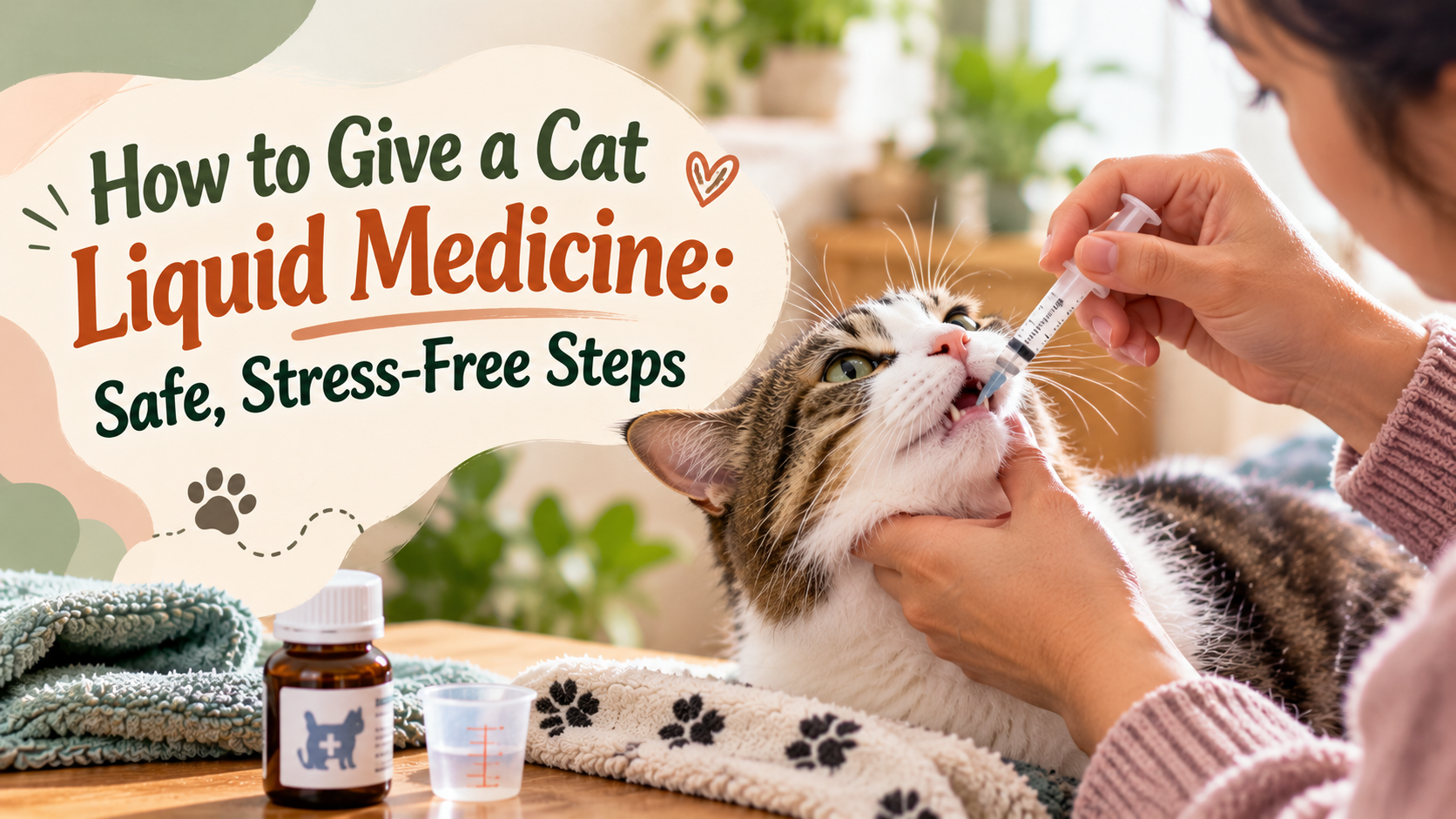
To give a cat liquid medicine, draw the prescribed amount into an oral syringe, keep your cat in a comfortable position, place the syringe into the side of the mouth behind the canine tooth, and slowly release the medicine so your cat has time to swallow. Never force liquid straight down the throat, and never give a different dose unless your veterinarian tells you to.
This guide explains how to give liquid medicine step by step, how to handle common problems, and when you should contact your veterinarian for help.
Before You Give the Medicine
A few minutes of preparation can make the experience much smoother. Cats often become more upset when they sense that something unpleasant is about to happen, so have everything ready before you bring your cat over.
Check the label and dose
Read the medication label carefully. Confirm:
- Your cat’s name, if listed
- The name of the medicine
- The amount to give
- How often to give it
- Whether it should be given with food
- Whether the bottle needs to be shaken
- How the medicine should be stored
Use the oral syringe provided by your veterinarian or pharmacy. Kitchen spoons are not accurate enough for small doses, and household syringes may not have the right measurements.
If the liquid has settled, shake it only if the label or your veterinarian says to shake it. Some medicines are suspensions and need mixing, while others should not be shaken.
Prepare a calm space
Choose a quiet room with a door you can close. Turn off loud music and keep other pets away for a few minutes. A table, counter, or the floor may work, depending on what makes your cat feel secure. If your cat is nervous on high surfaces, give the medicine on the floor instead.
Have these items nearby:
- The medication
- An oral syringe
- A towel, if needed
- A small treat or a little approved food
- A tissue or damp cloth for spills
You may also want another person to help hold your cat gently. One person can steady the body while the other gives the medicine.
How to Give a Cat Liquid Medicine Step by Step
1. Draw up the correct amount
Remove the cap from the medication and draw the prescribed dose into the oral syringe. Hold the syringe at eye level and check that the tip is filled with liquid and that the amount matches the instructions.
If there is a large air bubble, point the syringe upward and gently tap it so the bubble rises. Push the plunger slightly until the air leaves the syringe, then check the dose again. A tiny bubble is usually not a concern, but you should avoid giving an incorrect volume.
Keep the syringe ready in your dominant hand or place it somewhere clean and easy to reach.
2. Position your cat comfortably
Have your cat sitting or standing with their feet supported. Keep their head in a natural position. You do not need to tilt the head far backward, and doing so may make swallowing harder or increase the risk of liquid going into the airway.
For a calm cat, you may be able to place one hand gently over the top of the head and use the other hand to give the medicine. For a cat that pulls away, wrap their body loosely in a towel, leaving the head exposed.
A towel wrap should never be tight. Your cat must be able to breathe normally, and their neck should remain free. If your cat becomes frantic, stop and give them a short break rather than tightening the towel.
3. Approach from the side
Hold the syringe in your dominant hand. With your other hand, gently steady your cat’s head by placing your fingers around the cheekbones or below the jaw.
Slide the tip of the syringe into the corner of the mouth, just behind the canine tooth. Aim into the space between the cheek and the teeth, not directly toward the back of the throat.
You usually do not need to pry the mouth wide open. The side of the mouth gives you a natural opening and allows the medicine to run onto the tongue or inside the cheek.
4. Give the medicine slowly
Press the plunger a little at a time. Pause between small amounts so your cat can swallow and breathe normally.
Never squirt the entire dose into your cat’s mouth at once. A large stream can cause coughing, choking, panic, or aspiration, which means liquid enters the airway instead of the esophagus.
Watch your cat’s face and throat. A swallow may be subtle, but you may see the tongue move or the throat make a small swallowing motion. Keep the syringe pointed toward the side of the mouth throughout the process.
5. Reward your cat afterward
When the dose is finished, let go of your cat and offer calm praise. If your veterinarian says the medicine can be given with food, you may offer a small treat or a spoonful of their regular food afterward.
Do not give a food reward if the medication must be given on an empty stomach or if your veterinarian has told you to avoid certain foods. A quiet cuddle, gentle petting, or access to a favorite resting place can also help create a better association.
Where Should the Syringe Go in a Cat’s Mouth?
The safest general location is the side of the mouth, in the gap behind the canine tooth and between the cheek and teeth. Aim across the tongue rather than straight toward the throat.
This position helps your cat control the liquid and swallow it more naturally. It also reduces the chance of pushing the syringe too far into the mouth.
Keep the following points in mind:
- Do not insert the syringe deep into the mouth.
- Do not point it straight down the throat.
- Do not lift your cat’s head sharply upward.
- Give small amounts with pauses.
- Stop if your cat is struggling to breathe or cannot swallow.
What If Your Cat Spits Out the Medicine?
Some cats drool, foam at the mouth, or spit out a small amount because the medicine tastes bitter. This does not always mean the full dose was lost.
If you are sure that your cat did not swallow any of the medicine, call your veterinarian or veterinary pharmacy before giving more. If some medicine went in but you do not know how much stayed down, do not automatically repeat the dose. Giving an extra dose could result in too much medication.
Your veterinarian may tell you to wait until the next scheduled dose, repeat the dose, or use a different plan. The right choice depends on the specific medicine and how much your cat received.
Drooling or foaming
Excessive drooling and foaming can happen with bitter-tasting medications. Keep your cat in a safe, comfortable area and wipe their mouth gently if needed. Offer water if your veterinarian has not restricted it, but do not force water into the mouth.
If the drooling continues, your cat seems weak, has trouble breathing, vomits repeatedly, or shows other unusual signs, contact a veterinarian promptly.
How to Give Medicine to a Cat That Fights You
A cat that scratches, bites, or twists violently may be frightened, uncomfortable, or reacting to the taste of the medicine. Forcing the process can make future doses harder and can injure both of you.
Try these changes:
Use a towel wrap
Place a towel on the floor or another stable surface. Set your cat in the center with their back toward you, then wrap one side of the towel around the body, followed by the other side. Leave the head uncovered and keep the wrap loose enough for normal breathing.
Some cats feel safer when their legs are gently contained. Others become more upset when wrapped. If your cat panics in the towel, remove it and ask your veterinarian about another approach.
Ask someone to help
A helper can gently steady your cat’s body while you handle the syringe. The helper should avoid pinning the cat down or squeezing the chest. The goal is control without fear or pain.
Practice without medicine
For a cat that needs medication for several days, briefly touch the cheek, offer a reward, and stop. Later, bring the empty syringe near the mouth without giving anything. Reward calm behavior.
These short practice sessions can help your cat become less suspicious of the syringe. Do not use this method if it causes obvious distress.
Ask about another form of medication
If your cat cannot safely take liquid medicine at home, contact your veterinarian. Depending on the drug, there may be a tablet, flavored liquid, capsule, injectable option, or another treatment plan. Do not crush tablets or mix medicine into food unless your veterinarian or pharmacist confirms that it is safe. Some medicines should not be crushed, and a cat may refuse the entire meal if they taste the drug.
Common Mistakes to Avoid
Forcing the head backward
A cat does not need to have their head tipped far back to swallow liquid medicine. A natural, level head position is usually more comfortable and gives your cat better control of the liquid.
Giving the dose too quickly
Fast delivery is one of the biggest problems with liquid medication. Even if your cat seems impatient, press the plunger slowly and pause as needed.
Using a dropper without clear measurements
Droppers may not provide a reliable dose. Use a properly marked oral syringe instead, especially when the prescribed amount is small.
Hiding all the medicine in a full meal
This can fail in two ways: your cat may refuse the food, or they may eat only part of it and receive an unknown dose. If medication can be mixed with food, use only a small amount that your cat is likely to finish, and confirm the plan with your veterinarian first.
Repeating a dose without checking
If your cat spits up, vomits, or drools after medication, you may not know how much they absorbed. Repeating the dose without advice can cause an accidental overdose.
Chasing your cat around the house
Running after a hiding cat can turn medicine time into a daily battle. Close doors, prepare the supplies first, and use a predictable routine. If your cat hides whenever the syringe appears, store the medication and syringe out of sight when you are not using them.
What If Your Cat Vomits After Liquid Medicine?
Call your veterinarian for guidance if your cat vomits after receiving medication. Whether to repeat the dose depends on the drug, how soon vomiting occurred, and how much medicine may have been absorbed.
Do not give another dose automatically. Keep the medication bottle nearby when you call so you can provide the exact name, strength, and prescribed amount.
If vomiting is severe or repeated, or if your cat also has weakness, trouble breathing, facial swelling, collapse, or seizures, seek urgent veterinary care.
When to Stop and Call Your Veterinarian
Stop trying to give the dose and contact your veterinarian if:
- Your cat cannot swallow normally.
- Your cat coughs repeatedly or has trouble breathing.
- Your cat becomes frantic or may injure you.
- Your cat vomits the medicine or spits out an unknown amount.
- You are unsure whether the medication should be given with food.
- You may have given too much medicine.
- You dropped or contaminated the syringe and are unsure about the dose.
- Your cat develops swelling, collapse, severe weakness, or another concerning reaction.
A veterinary team can show you the technique in person, suggest a different syringe, change the flavor or formulation when possible, or choose another treatment option.
Tips for Easier Medication Schedules
If your cat needs medicine several times a day, consistency helps. Give each dose at roughly the instructed times, but follow your veterinarian’s directions if a dose is late or missed.
A simple medication routine may look like this:
- Check the label and wash your hands if needed.
- Prepare the dose before bringing your cat into the room.
- Use the same quiet location each time.
- Give the medicine slowly from the side of the mouth.
- Offer an approved reward and let your cat relax.
- Record the dose so nobody in the household gives it twice.
Keep all medication in its original container and store it exactly as directed. Some liquid medicines need refrigeration, while others should be kept at room temperature. Keep drugs away from children and pets, and never use leftover medication for another cat unless a veterinarian prescribes it.
Quick Reference: Giving Liquid Medicine to a Cat
| Step | What to do |
|---|---|
| Prepare | Read the label, measure the dose, and gather a syringe and towel if needed. |
| Position | Keep your cat supported with the head in a natural position. |
| Place | Put the syringe into the side of the mouth, behind the canine tooth. |
| Give | Press the plunger slowly in small amounts. |
| Watch | Pause so your cat can swallow and breathe normally. |
| Finish | Reward calmly and record the dose. |
| If there is a problem | Do not repeat an uncertain dose; contact your veterinarian. |
Final Takeaway
The safest way to give a cat liquid medicine is to prepare the correct dose, approach from the side of the mouth, release the liquid slowly, and allow time for swallowing. Keep your cat’s head in a natural position, avoid squirting medicine toward the throat, and never repeat a dose when you are unsure how much your cat received.
If the process is consistently unsafe or your cat becomes extremely distressed, ask your veterinarian for a demonstration or another medication option. A calm, repeatable routine is usually better than trying to force a dose quickly.