
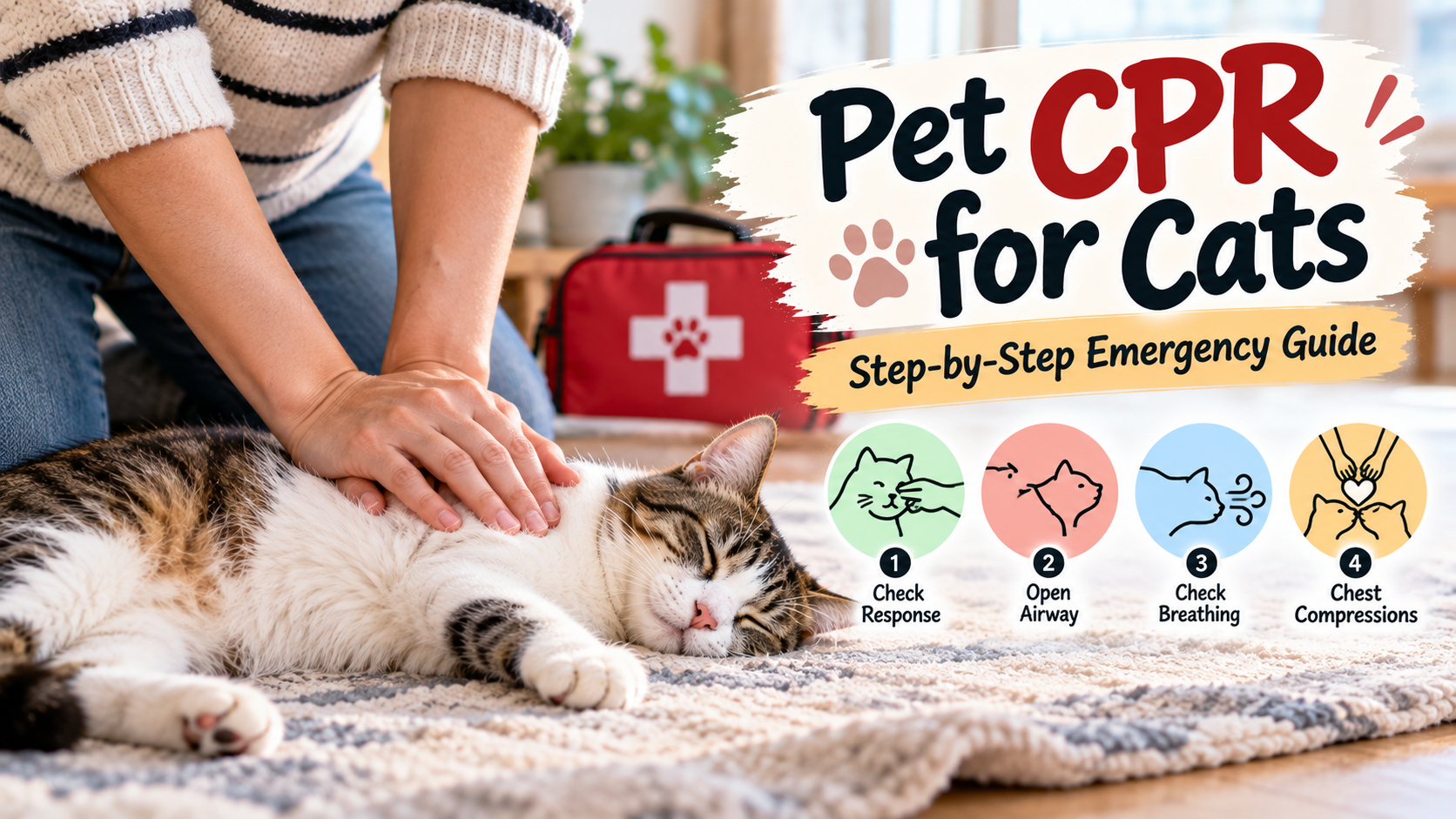
Pet CPR can help keep oxygen moving through your cat’s body during a life-threatening emergency, but it is not a replacement for veterinary care. If your cat is unconscious and not breathing normally, call an emergency veterinary clinic right away. Put the phone on speaker if possible so you can get instructions while you act.
This guide explains pet CPR for cats step by step. It is intended for an unresponsive cat that is not breathing normally and has no clear signs of circulation. If your cat is awake, breathing, coughing, choking, or having a seizure, do not start chest compressions. Keep them as calm and still as you can, and seek urgent veterinary advice.
What to do first
Before beginning CPR, quickly check that the scene is safe and that your cat is truly unresponsive. A frightened or painful cat may bite, even if they normally have a gentle personality.
Follow these first steps:
- Move your cat away from immediate danger. Remove them from traffic, water, smoke, electrical cords, or anything else that could injure you or your cat.
- Call an emergency veterinarian. Say that your cat is unresponsive and not breathing normally. Ask someone else to drive if possible.
- Check for a response. Call your cat’s name and gently touch their shoulder or paw. Do not shake them.
- Look for normal breathing. Watch the chest for up to 10 seconds. Occasional gasping is not normal breathing and should not reassure you.
- Open the airway. Gently extend the head and neck, pull the tongue forward, and look for a visible blockage.
If your cat is breathing normally, do not perform CPR. Keep the airway open, limit movement, and transport them to a veterinarian urgently if they are unconscious or seriously ill.
Pet CPR for cats step by step
The basic order is check, clear the airway, give breaths, perform compressions, and reassess. Work quickly, but try to stay controlled. Rough handling can cause additional injury.
Step 1: Position your cat
Place your cat on a firm, flat surface with their right or left side facing upward. For most cats, side-lying chest compressions are the simplest approach. Keep the head and neck in a straight, natural line so the airway stays open.
If your cat is very small, you may be able to wrap one hand around the chest and use your fingers and thumb for compressions. With a larger cat, use one or both hands over the widest part of the chest.
Do not spend time trying to find a perfect position. The main goals are to keep the cat on a firm surface, maintain an open airway, and place pressure over the chest rather than the abdomen.
Step 2: Check the mouth and airway
Open the mouth carefully and look for an object you can clearly see. If you can easily remove it with your fingers or tweezers, do so carefully. Never blindly sweep a finger into the throat. You could push an object farther down or get bitten.
If the tongue or gums are blue, gray, or very pale, your cat needs immediate emergency care. These color changes can happen when the body is not getting enough oxygen, but gum color can be difficult to judge in some cats. Do not delay CPR or transport while trying to interpret it.
Step 3: Give rescue breaths if your cat is not breathing
If your cat has no normal breathing, give rescue breaths while keeping the airway open.
- Close your cat’s mouth gently.
- Extend the neck enough to create a straight airway, without forcing it.
- Place your mouth over the nostrils. With a large cat, you may cover both nostrils. With a tiny kitten, use very small puffs and cover only the nose if that creates a seal.
- Give a gentle breath lasting about one second.
- Watch for the chest to rise slightly.
- Let the air leave and repeat once.
Use only enough air to see a small chest rise. Cats have small lungs, and forceful breaths can damage the lungs or push air into the stomach. If the chest does not rise, reposition the head and neck, check the mouth again for a visible obstruction, and try another gentle breath.
If you cannot safely give mouth-to-nose breaths, or you are worried about contact with vomit or blood, focus on chest compressions and follow the emergency veterinarian’s instructions. A CPR mask made for pets can provide a barrier, but it should not cause a delay during a true emergency.
Step 4: Find the correct spot for chest compressions
Place your hand over the widest part of the chest, usually just behind the front legs. For a thin cat, aim for the area over the heart and the middle of the chest. Avoid pressing directly over the lower ribs or the abdomen.
Your hand placement may need a small adjustment depending on your cat’s body shape. The goal is to compress the chest between the breastbone and the spine so blood can move through the body.
Step 5: Start chest compressions
Compress the chest at a rate of about 100 to 120 compressions per minute. This is roughly the rhythm of the song “Stayin’ Alive,” although keeping a steady rhythm matters more than trying to match a song perfectly.
Use the following technique:
- Keep your elbows and wrist reasonably firm.
- Press straight down on the chest.
- Compress the chest by about one-third to one-half of its depth.
- Allow the chest to return fully between compressions.
- Keep pauses as short as possible.
For most cats, two fingers or the thumb and fingers may be appropriate. A larger or heavier cat may need the heel of one hand, but use only enough force to produce a controlled chest compression. Very small kittens need much less pressure.
You may hear or feel a pop during CPR. This can mean a rib has fractured, but stopping to investigate can be more dangerous if your cat still has no breathing or circulation. Continue as carefully as you can and let the veterinary team assess injuries as soon as possible.
Step 6: Combine compressions and breaths
If you are able to give rescue breaths, use a cycle of:
- 30 chest compressions
- 2 gentle breaths
Return immediately to compressions after the breaths. Do not spend a long time checking for a pulse between every cycle.
If two people are present, one person can perform compressions while the other gives breaths, watches the airway, and speaks with the veterinary clinic. Switch roles if the person performing compressions becomes tired, but keep interruptions brief.
If you cannot give breaths, continue uninterrupted chest compressions while following the veterinarian’s advice. Compressions alone are better than doing nothing during a suspected cardiac arrest, but professional guidance is still needed.
Step 7: Reassess briefly
After about two minutes, or sooner if your cat begins moving or breathing normally, pause very briefly to check for signs of life. Look for:
- Normal, regular breathing
- Purposeful movement
- Coughing or swallowing
- A heartbeat or pulse you can clearly detect
Do not stop simply because your cat gasps. Gasping can occur during cardiac arrest and is not the same as normal breathing.
If your cat still has no normal breathing or clear signs of circulation, resume CPR immediately. Continue until one of these things happens:
- Your cat starts breathing normally and shows purposeful movement.
- A veterinary professional takes over.
- You are physically unable to continue.
- The environment becomes unsafe.
Even if your cat appears to recover, they still need emergency veterinary care. A cat may begin breathing again but have shock, internal injury, heart problems, poisoning, brain injury, or another serious condition that cannot be treated at home.
A quick CPR checklist
Use this condensed checklist if you need to remember the sequence under stress:
- Make sure the area is safe.
- Call an emergency veterinarian.
- Check for responsiveness and normal breathing for up to 10 seconds.
- Open the mouth and remove only a visible obstruction.
- Position the cat on their side on a firm surface.
- Give two gentle rescue breaths if the cat is not breathing.
- Begin chest compressions over the widest part of the chest.
- Compress at 100–120 times per minute and about one-third to one-half of the chest depth.
- Use 30 compressions followed by two breaths when possible.
- Reassess briefly after about two minutes and continue until help takes over or your cat recovers.
When should you not perform CPR on a cat?
CPR is for a cat who is unresponsive and not breathing normally, especially when there is no clear heartbeat or circulation. It is not a treatment for every emergency.
Do not start chest compressions if your cat is conscious and breathing normally. Compressions can cause injury. Instead, keep your cat quiet and call a veterinarian for advice.
You should also avoid delaying emergency care while trying to perform a long examination. You do not need to spend several minutes searching for a pulse. A pulse can be difficult to feel in a cat, and repeated checks waste time. If the cat is unresponsive and not breathing normally, begin the emergency sequence and contact a veterinary professional.
What if your cat is choking but still conscious?
A conscious choking cat may paw at the mouth, gag, cough, drool, breathe noisily, or panic. Keep your face and fingers away from the mouth. A cat in distress may bite suddenly.
Call an emergency veterinarian immediately. If you can see an object at the front of the mouth and can remove it safely, do so carefully. Do not push your fingers deep into the throat. If your cat collapses and stops breathing normally, begin the CPR steps above.
Even if you remove the object and your cat seems fine, veterinary evaluation is still wise. Choking can injure the throat and may cause breathing problems later.
Common mistakes during cat CPR
Knowing what not to do can make an emergency less dangerous.
Using too much force
A cat’s chest is small, and excessive pressure can injure the ribs or internal organs. Use controlled compressions and adjust the force for your cat’s size. A kitten needs much gentler pressure than a large adult cat.
Blowing too hard
Forceful breaths can overinflate the lungs or fill the stomach with air. Give small, gentle breaths and look for only a slight chest rise.
Searching too long for a pulse
It can be hard to locate a pulse on a cat, especially when you are frightened. Check quickly if you know how, but do not delay compressions while searching.
Blindly sweeping the mouth
A blind finger sweep can push an obstruction deeper. Remove only an object you can clearly see and grasp safely.
Stopping after one gasp
A gasp is not proof that normal breathing has returned. Watch for regular chest movement and purposeful activity.
Driving while performing CPR
The person driving cannot safely perform compressions. If you are alone, call the clinic, start CPR if needed, and arrange transport as quickly as possible. Follow the clinic’s instructions about whether to continue compressions during transport.
How to prepare before an emergency
Most people do not think about cat CPR until a crisis happens. A little preparation can save time.
- Save the phone number and address of the nearest emergency veterinary hospital.
- Keep your cat’s carrier easy to reach and leave the door open when it is not in use.
- Store a towel, gloves, and a small flashlight with the carrier.
- Learn basic pet first aid from a hands-on class taught by a qualified instructor.
- Ask your veterinarian to demonstrate where and how to check breathing and circulation.
- Keep medications, toxic cleaners, string, and small chewable objects away from your cat.
- Make sure everyone in the household knows who will call the veterinarian and who will get the carrier.
A pet first-aid class cannot guarantee an outcome, but it can make the steps feel less unfamiliar. In a real emergency, knowing the basics may help you act instead of freezing.
What happens after CPR?
A cat who needed CPR needs immediate professional assessment, even if they are awake again. The veterinary team may need to provide oxygen, examine the heart and lungs, treat shock, check blood glucose, look for poisoning or trauma, and monitor for complications.
Transport your cat in a secure carrier or sturdy box with ventilation. Keep them warm but do not place a heating pad directly against the body. Minimize handling and keep the head and neck in a comfortable position. If they are vomiting or unconscious, ask the veterinary clinic how to position them safely during transport.
Do not offer food, water, or medication unless a veterinarian tells you to do so. A weak or confused cat may inhale food or liquid, and some emergencies become worse with the wrong medication.
Final takeaways
Pet CPR for cats is an emergency measure for an unresponsive cat that is not breathing normally. Call an emergency veterinarian first, open the airway, give gentle breaths when possible, and perform chest compressions over the widest part of the chest at about 100–120 compressions per minute. Use 30 compressions followed by two breaths, keep pauses short, and continue until your cat recovers or professional help takes over.
CPR is only the beginning of treatment. A cat who collapses, stops breathing, or appears to recover after CPR needs urgent veterinary care.