
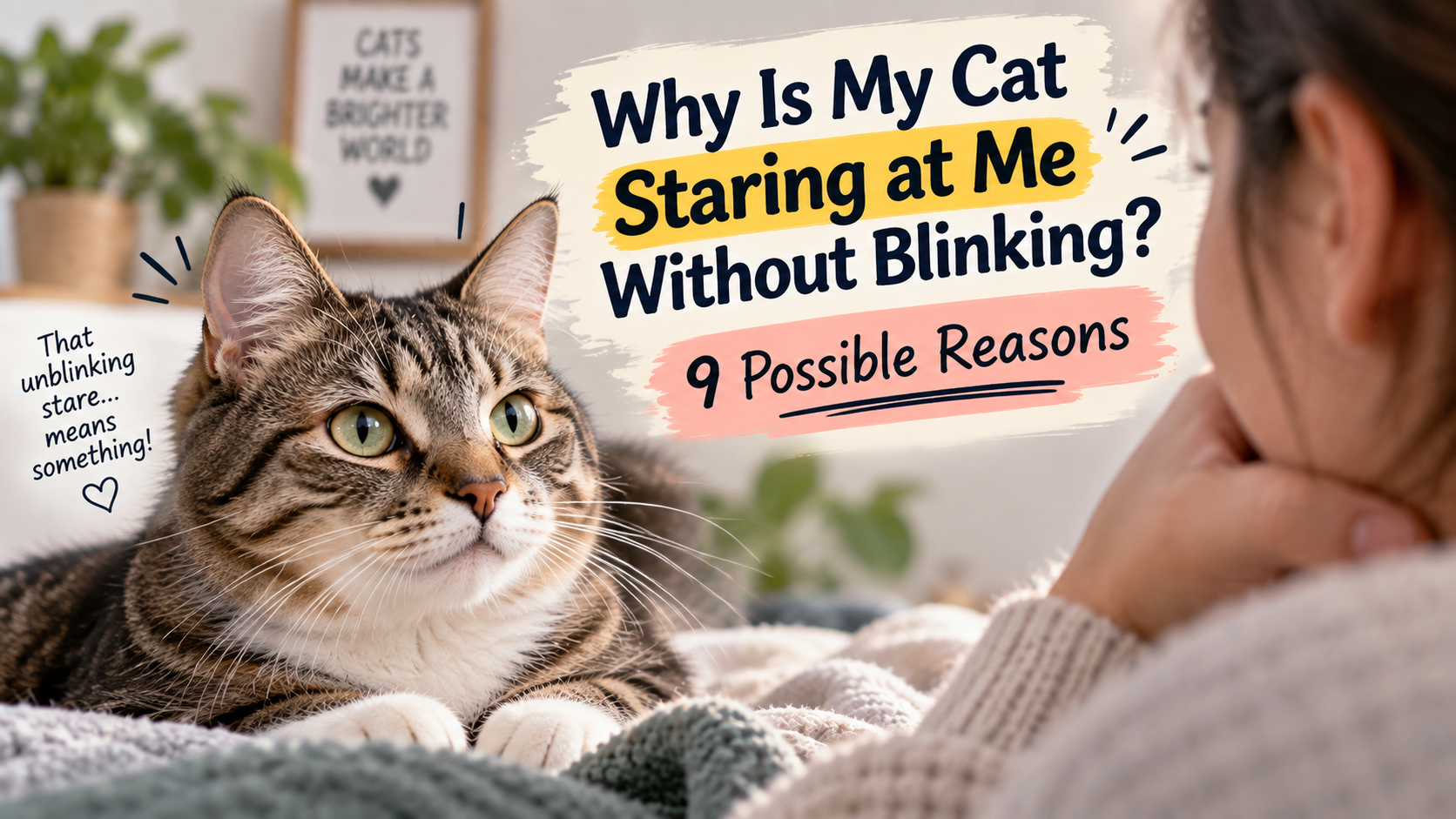
If you’ve ever wondered, “Why is my cat staring at me without blinking?”, the answer can be surprisingly simple: your cat may be watching you because it wants something, is curious about what you’re doing, feels comfortable around you, or is responding to something in its environment.
A cat’s stare does not have one universal meaning. You need to look at the rest of its body language, including its ears, pupils, tail, posture, and overall behavior.
A relaxed cat staring at you is very different from a cat staring with wide pupils, flattened ears, and a tense body.
Here are nine common reasons your cat may stare at you without blinking.
1. Your Cat Is Showing Affection
Sometimes a cat’s stare is simply part of a relaxed social interaction.
If your cat looks at you with a relaxed body, normal posture, and soft facial expression, there may be no reason to worry.
You may also notice your cat slowly closing its eyes or giving you a slow blink.
Slow blinking is often associated with relaxed feline communication. International Cat Care notes that a relaxed gaze and slow blinking can help communicate calmly with cats.
You can try slowly blinking back rather than staring intensely at your cat.
The important distinction is that a relaxed stare is not the same as an intense, tense stare.
2. Your Cat Is Curious
Cats are naturally observant animals.
If you’re doing something unusual, your cat may simply be trying to figure out what you’re doing.
For example, your cat might stare while you:
- Move furniture
- Open a package
- Cook something
- Use a new device
- Talk to someone
- Carry something unfamiliar
- Sit somewhere you normally don’t
Your cat may simply be gathering information.
If the rest of its body looks relaxed, curiosity is a very likely explanation.
3. Your Cat Wants Your Attention
Sometimes a stare is your cat’s way of getting you to notice it.
Your cat may stare at you because it wants:
- Petting
- Playtime
- Access to another room
- A favorite toy
- Interaction
- To be picked up
- Your attention
Pay attention to what happens immediately after the stare.
If your cat looks at you and then walks toward a toy, food area, door, or another location, it may be trying to direct your attention toward something.
Cats can learn that certain behaviors get a response from their owners.
4. Your Cat Expects Food
If your cat tends to stare at you around mealtimes, food may be the obvious answer.
Cats quickly learn household routines. If you normally feed your cat at a particular time, your cat may begin watching you as that time approaches.
You may also notice:
- Sitting near the food bowl
- Walking between you and the kitchen
- Vocalizing
- Looking at you and then looking toward the food area
- Becoming more active around mealtime
A food-related stare is especially easy to recognize if it happens at the same time every day.
However, avoid assuming that every stare means your cat is hungry. Cats can also stare simply because they have learned that staring gets attention.
5. Your Cat Is Showing Territorial Behavior
Cats are territorial animals, and staring can sometimes occur during situations involving territory or other animals.
For example, your cat may stare intensely at:
- Another cat
- A new pet
- A person entering the home
- An animal outside the window
- An area your cat considers important
The context and body language matter.
A territorial or confrontational cat may appear tense, with changes such as flattened ears, dilated pupils, an arched or stiff posture, or an agitated tail.
Cornell University College of Veterinary Medicine notes that cats can display territorial aggression toward animals or people they perceive as entering their established territory.
If your cat’s stare is accompanied by hissing, growling, swatting, or an aggressive posture, give it space rather than trying to approach or touch it.
6. Your Cat Is Communicating With You
Cats communicate using much more than vocal sounds.
Body posture, facial expression, eye position, tail movement, ear position, and behavior can all provide clues about what a cat is experiencing.
That’s why you shouldn’t interpret a stare by itself.
Consider the whole picture:
| What You Notice | Possible Meaning |
|---|---|
| Relaxed body + soft gaze | Comfortable or socially engaged |
| Stare + walking toward you | May want attention or something specific |
| Stare + food-bowl behavior | May be anticipating food |
| Wide pupils + tense posture | Fear, excitement, or arousal |
| Flattened ears + stiff body | Fear or defensive behavior |
| Staring at another animal | Possible territorial or confrontational behavior |
A cat’s body language is much easier to interpret when you look at several signals together.
7. Your Cat Is Afraid or Anxious
Not every stare is friendly.
A frightened or anxious cat may stare intensely because it is monitoring something it considers threatening.
Look for additional signs such as:
- Dilated pupils
- Flattened or sideways ears
- Crouching
- Tail tucked close to the body
- Flattened whiskers
- Hiding
- Hissing
- Growling
- Trying to escape
Cornell’s feline behavior guidance identifies dilated pupils, flattened ears, tucked tails, and changes in posture among signs associated with fear or aggression.
If your cat appears frightened, don’t force interaction. Give it space and identify what may be causing the fear.
The trigger could be a stranger, another animal, a loud noise, an unfamiliar object, or a recent change in the home.
8. Something in the Environment Has Caught Your Cat’s Attention
Sometimes your cat isn’t really staring at you.
It may be looking in your direction because something behind or near you has caught its attention.
Cats can notice subtle sounds, movements, reflections, smells, and visual changes that humans don’t immediately notice.
Your cat might suddenly stare toward:
- A window
- A ceiling
- A wall
- A doorway
- A small moving object
- Another animal outside
- An unfamiliar sound
Before assuming the behavior is about you, look around the room.
Your cat may be tracking something you haven’t noticed.
9. A Medical Problem May Be Involved
Occasional staring is usually not a reason to panic.
However, a new or unusual staring behavior combined with other changes deserves attention.
This is especially important if your cat appears to stare blankly and doesn’t respond normally to you or its surroundings.
Other concerning signs can include:
- Confusion or disorientation
- Sudden changes in behavior
- Loss of balance
- Unusual vocalization
- Changes in appetite or thirst
- Changes in sleep patterns
- Trouble walking
- Seizure-like episodes
- Repeatedly staring at walls or into space
- Not responding normally to familiar people or sounds
Cornell University College of Veterinary Medicine notes that prolonged staring into space or at walls can occur among the behavioral signs of cognitive dysfunction in older cats, particularly when accompanied by other changes such as disorientation, altered sleep patterns, or changes in interaction.
Vision or neurological problems can also cause noticeable changes in how a cat interacts with its surroundings. Cornell recommends reporting behavioral or physical signs that could indicate vision problems to a veterinarian.
This doesn’t mean that every cat staring at you has a medical problem. Context matters.
If the staring is new, persistent, or accompanied by other unusual symptoms, it’s best to have your cat evaluated by a veterinarian.
How to Tell What Your Cat’s Stare Means
The easiest way to understand your cat’s stare is to stop looking only at its eyes.
Look at the entire body.
Ask yourself:
Are the ears relaxed or flattened?
Relaxed ears usually suggest a calmer emotional state. Flattened or backward ears can indicate fear, irritation, or aggression.
What are the pupils doing?
Dilated pupils can occur with fear, excitement, or changes in lighting, so don’t use pupil size alone to determine what your cat is feeling.
What is the tail doing?
A relaxed tail is different from rapid flicking, puffing, or a tightly tucked tail.
Is the body loose or tense?
A relaxed body generally tells you much more than the stare itself.
What happened immediately before the staring started?
A new sound, another animal, feeding time, play, or an unfamiliar person may explain the behavior.
Should You Stare Back at Your Cat?
You don’t need to avoid eye contact completely, but don’t deliberately stare intensely at your cat.
A prolonged, intense stare can feel threatening in feline communication.
If your cat is relaxed and looking at you, try a slow blink and then look away.
This keeps the interaction calm rather than turning it into a staring contest.
If your cat appears fearful or aggressive, give it more space instead of attempting to make eye contact.
When Should You Talk to a Vet?
You don’t normally need to contact a veterinarian just because your cat occasionally stares at you.
However, veterinary advice is appropriate when the behavior is:
- New and persistent
- Accompanied by confusion
- Associated with changes in appetite or drinking
- Accompanied by balance or walking problems
- Associated with unusual vocalization
- Accompanied by seizure-like activity
- Happening alongside other major behavior changes
For older cats, repeated staring into space or at walls combined with disorientation or other behavioral changes deserves particular attention.
If possible, record a short video of unusual behavior. Showing your veterinarian exactly what you’re seeing can be more useful than trying to describe subtle movements from memory.
Frequently Asked Questions
Why is my cat staring at me without blinking?
Your cat may be curious, seeking attention, expecting food, communicating with you, or simply observing what you’re doing. A relaxed body and soft facial expression usually suggest a very different situation from a tense body, flattened ears, and dilated pupils.
Why does my cat stare at me when I’m sitting down?
Your cat may have learned that sitting down means you’re available for interaction. It could be waiting for petting, play, food, or simply observing you.
Does my cat stare at me because it loves me?
It can be part of a relaxed social interaction, but staring alone doesn’t prove affection. Look for other signs of comfort, such as relaxed body language, approaching you voluntarily, resting near you, or slow blinking.
Should I stare back at my cat?
Avoid prolonged, intense staring. If your cat is relaxed, a slow blink followed by looking away is a calmer form of interaction.
Why does my cat stare at me at night?
Your cat may be awake while you’re sleeping and simply observing you. It could also be looking for attention, food, play, or reacting to sounds or movement in the environment. If nighttime staring is a new behavior accompanied by confusion or other unusual symptoms, speak with your veterinarian.
Is staring at walls normal for cats?
Occasionally looking at a wall is not necessarily a problem. However, repeated blank staring at walls, particularly in an older cat and when accompanied by disorientation, altered sleep, or other behavior changes, should be discussed with a veterinarian.
Final Thoughts
So, why is your cat staring at you without blinking?
There isn’t one answer.
Your cat may be showing affection, satisfying its curiosity, asking for attention, expecting food, communicating something, or simply watching what you’re doing. In other situations, the stare may be connected to fear, territorial behavior, something happening in the environment, or, less commonly, a medical problem.
The most useful thing you can do is look beyond the eyes. Pay attention to your cat’s ears, pupils, tail, posture, and what was happening immediately before the stare.
A relaxed cat staring at you is usually very different from a cat staring with a tense body and flattened ears.
And if the behavior suddenly changes or comes with other concerning symptoms, don’t try to diagnose it from the stare alone. Talk to your veterinarian.
Trusted Resources
For additional information about feline behavior and health, these veterinary and feline-care organizations are useful starting points:
- Cornell Feline Health Center — feline behavior, health conditions, and signs that may require veterinary attention. Cornell Feline Health Center
- International Cat Care — practical guidance on feline behavior and cat-friendly handling. International Cat Care
- American Association of Feline Practitioners — feline-focused veterinary resources. American Association of Feline Practitioners