
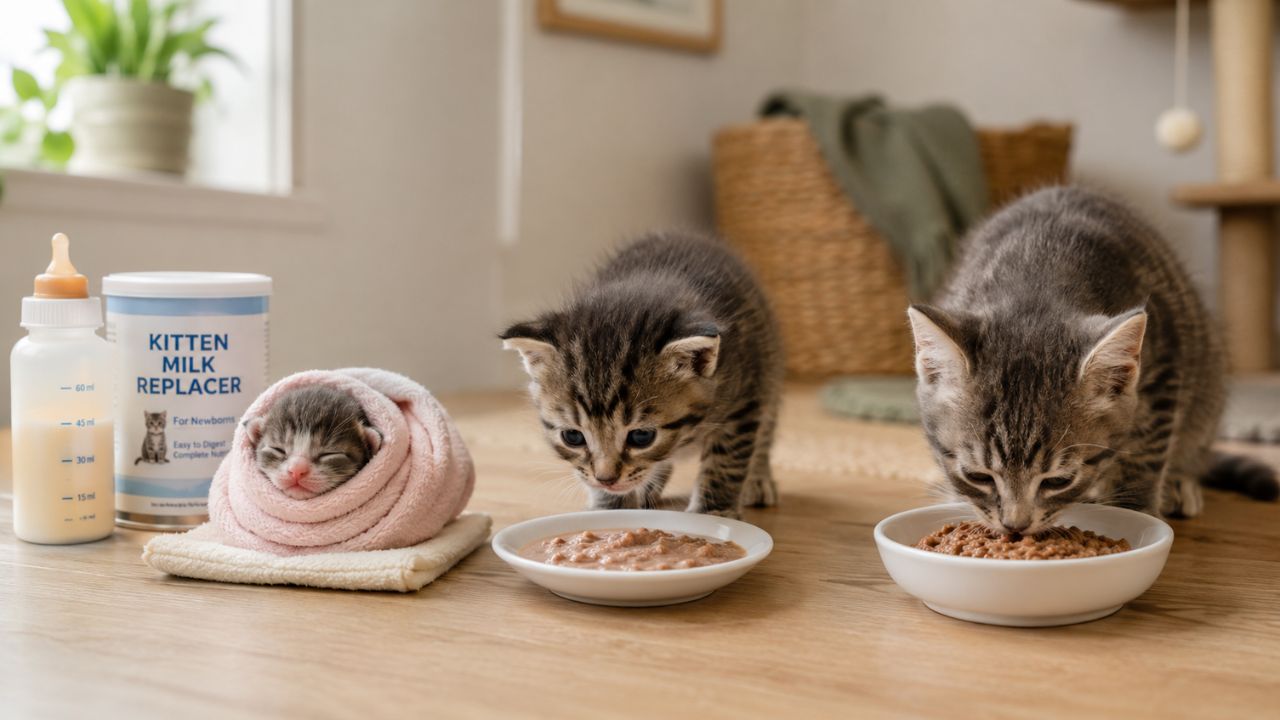
A kitten’s nutritional needs change quickly as it grows. A newborn kitten depends on its mother’s milk, while an older kitten needs a balanced diet that supports healthy growth, muscle development, and energy.
But how often should you feed a kitten? What should you feed at each age, and how much food does your kitten actually need?
This kitten feeding chart by age explains what to feed from birth through 12 months, how often to offer meals, and how to determine the right portion size. You’ll also learn when to introduce solid food, how to choose kitten food, and when to transition to adult food.
The most important thing to remember is that age determines the feeding stage, but your kitten’s weight, growth, health, and food’s calorie content help determine the amount.
Kitten Feeding Chart by Age
Use this chart as a starting point for feeding a healthy kitten. Individual needs vary, and newborn kittens require different care from fully weaned kittens.
| Kitten Age | What to Feed | How Often to Feed |
|---|---|---|
| Birth to 3 weeks | Mother’s milk; commercial kitten milk replacer if the mother cannot nurse | Frequent nursing; orphaned kittens need a specialized feeding schedule |
| 3–4 weeks | Mother’s milk plus a soft kitten-food mixture | Several small feeding opportunities |
| 4–6 weeks | Soft wet kitten food, gradually thickened as the kitten learns to eat | Several small meals daily |
| 6–8 weeks | Complete wet kitten food, dry kitten food softened if needed, or a combination | Around 4 meals daily |
| 8–12 weeks | Complete and balanced kitten food | Around 4 meals daily |
| 3–6 months | Complete kitten food, wet or dry | Usually 3 meals daily; some kittens benefit from more frequent meals |
| 6–12 months | Complete kitten food formulated for growth | Usually 2 meals daily; adjust to individual needs |
Important: Mother-raised kittens can nurse as needed, so they do not follow the same schedule as orphaned kittens receiving measured formula feeds. Bottle-feeding amounts and intervals should be based on the kitten’s weight, age, formula, and health.
According to the Cornell Feline Health Center’s feeding guidance, kittens generally do well with three meals daily until around six months, followed by two meals daily from six months to one year. The Merck Veterinary Manual also recommends multiple daily feedings for young kittens.
Quick Answer: How Often and How Much Should You Feed a Kitten?
- 8–12 weeks: Offer approximately four small meals daily.
- 3–6 months: Three meals daily is a practical routine for many kittens.
- 6–12 months: Two meals daily generally works well.
- Food amount: Follow the feeding directions on a complete kitten food, using your kitten’s current weight as a starting point. Adjust based on growth and body condition.
- Food type: Choose food labeled complete and balanced for growth or all life stages.
- Water: Provide fresh, clean drinking water at all times once your kitten is drinking independently.
There is no single number of cans, cups, or calories that is right for every kitten. A growing kitten’s needs change as its weight, activity, and development change.
How Often Should You Feed a Kitten?
Kittens need frequent meals because they are growing rapidly and have relatively small stomachs. As they mature, you can gradually reduce the number of meals while continuing to provide enough food for healthy growth.
Feeding Kittens From 8 to 12 Weeks
At this age, most kittens are completing the transition to solid food. Four small meals a day can help provide regular opportunities to eat without requiring one or two large meals.
For example, you could offer meals at:
- 7 a.m.
- 11 a.m.
- 3 p.m.
- 8 p.m.
Adjust these times to fit your household routine. The goal is to divide the kitten’s measured daily food allowance into manageable portions.
Feeding Kittens From 3 to 6 Months
Three meals a day works well for many kittens during this stage. Continue feeding a complete kitten food designed to support growth.
A practical schedule might include breakfast, an afternoon meal, and dinner.
Some kittens may still do better with smaller, more frequent meals. Pay attention to appetite, weight gain, and body condition rather than following a schedule rigidly.
Feeding Kittens From 6 to 12 Months
Many kittens can transition to two meals a day around six months of age.
For example, you might feed breakfast at 7 a.m. and dinner at 7 p.m. Divide the total daily allowance between those meals instead of providing a full daily allowance at each feeding.
Continue using kitten food formulated for growth until your kitten is ready to transition to an appropriate adult diet.
Can You Leave Food Out All Day?
Some kittens can manage their intake when food is freely available, but others eat more than they need. Free-feeding can also make it difficult to notice changes in appetite.
Measured meals make it easier to monitor how much your kitten eats. If you use an automatic feeder, account for every portion in the daily food allowance.
For additional guidance on choosing a balanced diet, see our Cat Nutrition Guide.
How Much Should You Feed a Kitten?
The right amount depends on your kitten’s current weight, growth rate, activity level, body condition, health, and the calorie content of the food.
Two kittens of the same age may need different portions. Similarly, two cans of different kitten foods may contain very different amounts of energy.
Rather than relying on a universal portion chart, use the food’s feeding instructions as a starting point and adjust according to your kitten’s progress.
Step 1: Check Your Kitten’s Current Weight
Weigh your kitten regularly and record the results. Young kittens grow quickly, so a portion that worked a few weeks ago may no longer be appropriate.
Daily weight monitoring is especially important for newborn and bottle-fed kittens. For a healthy, fully weaned kitten, weekly weighing is a practical way to monitor growth.
A kitten that stops gaining weight, loses weight, or appears weak should be assessed by a veterinarian.
Step 2: Read the Food’s Feeding Directions
Check the feeding chart on the package of your chosen kitten food.
Depending on the manufacturer, the instructions may use age, current weight, expected adult weight, or a combination of these factors.
Start with the recommendation for your kitten’s situation. Then monitor whether the amount supports steady growth and a healthy body condition.
The AAFCO guide to reading pet food labels explains that feeding directions are guidelines and may need adjustment to meet an individual animal’s needs.
Step 3: Check the Calorie Content
Look for the calorie statement on the food label. It may list kilocalories per can, pouch, cup, or kilogram.
If your veterinarian has provided a daily calorie target, you can use this formula:
Daily food amount = Daily calorie target ÷ Calories per serving
For example, suppose a can contains 100 kcal and your veterinarian has recommended 200 kcal per day for your kitten.
200 kcal ÷ 100 kcal per can = 2 cans per day.
If you divide that amount into four meals, each meal would contain half a can.
This is an example of the calculation, not a universal recommendation. Your kitten may need a different daily amount.
Step 4: Adjust Based on Growth and Body Condition
Look at your kitten’s overall condition instead of relying on weight alone.
A kitten in a healthy body condition will generally have ribs that can be felt beneath a thin layer of tissue and a visible waist when viewed from above. Ribs, the spine, and hip bones should not be sharply protruding.
If your kitten is gaining too much fat, the current portion may be excessive. If your kitten is losing weight or failing to grow, inadequate intake or an underlying health problem may be involved.
Do not sharply restrict a growing kitten’s food without veterinary advice.
For a more detailed portion guide, read our article on How Much Should a Kitten Eat?.
What Should You Feed a Kitten?
Once your kitten is ready for solid food, choose a diet that is complete and balanced for growth.
Kittens require appropriate amounts of protein, fat, vitamins, minerals, and energy to support their developing bodies. Food formulated for adult maintenance alone may not meet a growing kitten’s nutritional needs.
Wet Kitten Food
Wet kitten food can be a good option, particularly during weaning.
Its soft texture can make it easier for a newly weaned kitten to eat, and its moisture content contributes to overall water intake.
However, not every canned food is a complete meal. Some products are intended only as treats, toppers, or supplemental feeding.
Check the nutritional adequacy statement to make sure the food is suitable as the kitten’s main diet.
Dry Kitten Food
Dry kitten food can also provide complete nutrition when formulated for growth.
It is convenient to store and measure, and it works well with some automatic feeders and food puzzles.
Because dry food is often calorie-dense, measure portions rather than repeatedly refilling the bowl without tracking the total amount eaten.
Can Kittens Eat Both Wet and Dry Food?
Yes. A kitten can eat a combination of wet and dry food if both products are appropriate for its life stage.
The important thing is to count the calories from both foods together.
For example, if you offer wet food at breakfast and dry food at dinner, neither portion should be treated as an additional full daily allowance. Divide the total allowance between the two foods.
How to Choose the Right Kitten Food
Look for a nutritional adequacy statement indicating that the food is complete and balanced for growth or all life stages.
Terms such as premium, natural, holistic, and grain-free do not independently establish that a product meets a kitten’s nutritional needs.
The AAFCO pet food label guide explains how to identify the intended life stage and nutritional adequacy of a food.
You can also explore our guide to the best wet food for kittens for more information about choosing an appropriate product.
When Should You Start Weaning a Kitten?
Weaning is the gradual transition from mother’s milk or kitten milk replacer to solid food.
Most kittens begin showing interest in solid food at around three to four weeks of age. The process usually continues over the following weeks, with many kittens eating solid food independently by approximately six to eight weeks.
How to Introduce Solid Food
When your kitten is ready, offer a shallow dish of soft wet kitten food mixed with a little warm water.
For an orphaned kitten already receiving commercial kitten milk replacer, prepared formula can sometimes be used to create a familiar texture.
Allow the kitten to investigate and lick the mixture at its own pace. Do not force its face into the food.
As the kitten becomes more comfortable eating, gradually reduce the added liquid and introduce regular wet food or softened dry kitten food.
Provide fresh water and continue monitoring weight and appetite throughout the transition.
Do not stop milk feedings abruptly just because a kitten has tasted solid food. Reduce them as the kitten consistently eats enough complete solid food and continues to grow appropriately.
What If a Kitten Is Not Eating Solid Food?
Some kittens take longer than others to learn to eat independently. However, a kitten that is weak, losing weight, refusing food, or failing to progress through weaning needs veterinary advice.
Do not assume that continuing to offer milk indefinitely will solve the underlying problem.
What About Newborn Kittens and Bottle-Feeding?
Newborn kittens have different nutritional needs from older kittens. A healthy mother cat normally provides the most appropriate nutrition through nursing.
If a kitten is orphaned or cannot nurse adequately, a commercial kitten milk replacer may be needed. Cow’s milk is not an appropriate substitute for mother’s milk or a properly formulated kitten milk replacer.
Bottle-fed kittens need a feeding plan tailored to their age, weight, formula, and health. They may require frequent feeds, including overnight, and close monitoring of their weight.
Incorrect feeding technique can cause serious complications, so newborn kittens should never be fed like human babies or have formula forced into their mouths.
For detailed instructions, see our dedicated guide: How to Bottle-Feed a Kitten: Feeding Schedule, Formula, and Amounts.
Editorial note: Publish this bottle-feeding article and confirm its URL before activating the internal link.
Seek prompt veterinary help if a newborn kitten is cold, limp, unable to feed, losing weight, repeatedly vomiting, or experiencing breathing difficulties. Coughing or milk coming from the nose during or after feeding can indicate aspiration.
For veterinary background on neonatal care, consult the Merck Veterinary Manual’s guide to managing newborn puppies and kittens.
When Should You Switch From Kitten Food to Adult Food?
Many kittens transition to adult food between approximately nine and twelve months of age. The appropriate timing depends on growth, body condition, health, and individual veterinary advice.
Continue feeding a nutritionally appropriate growth diet while your kitten is developing. Do not switch to adult maintenance food simply because the kitten looks bigger.
When it is time to change foods, make the transition gradually unless your veterinarian recommends otherwise. A sudden change may cause digestive upset or food refusal.
Spaying or neutering can also affect energy requirements. Monitor your kitten’s body condition after the procedure and adjust portions with veterinary guidance when needed.
Common Kitten Feeding Mistakes to Avoid
Measuring portions by eye. Small differences can add up. Measure food consistently, using a kitchen scale for dry food when practical.
Ignoring calorie content. Wet and dry foods differ in energy density. Their portions are not interchangeable by volume.
Refilling the bowl without tracking intake. This can result in overfeeding and makes appetite changes harder to detect.
Changing food too quickly. Introduce a new food gradually unless your veterinarian advises an immediate change.
Adding unnecessary supplements. A kitten eating a complete and balanced growth diet generally does not need routine vitamin or mineral supplements. Add supplements only when there is a specific veterinary reason.
Switching to adult food too early. Growing kittens need nutrition formulated for their developmental stage.
Ignoring appetite or weight changes. Persistent vomiting, diarrhea, weakness, reduced appetite, or poor growth should not be treated simply by changing portion sizes.
Frequently Asked Questions
How many times a day should I feed my kitten?
Many kittens aged eight to twelve weeks do well with approximately four small meals daily. From three to six months, three meals is a practical routine for many kittens. From six to twelve months, two meals daily generally works well.
How much wet food should a kitten eat per day?
There is no universal number of cans or pouches. Check the food’s calorie content and feeding directions, then account for your kitten’s weight, growth, and body condition. Your veterinarian can help establish an appropriate daily calorie target.
Can a four-week-old kitten eat dry food?
A four-week-old kitten may begin exploring softened kitten food. Soft wet food or a thin food mixture is often easier to manage during early weaning. Milk remains important during this transition.
Does an eight-week-old kitten still need milk?
Most healthy, fully weaned eight-week-old kittens can obtain their nutrition from complete kitten food and fresh water. They generally do not need cow’s milk. If the kitten cannot eat enough solid food or is losing weight, seek veterinary advice.
Can kittens eat adult cat food?
Adult maintenance food should not be the main diet for a growing kitten unless a veterinarian specifically recommends it. Choose food formulated for growth or all life stages.
Should kittens have food available all day?
Measured meals help you track food intake and reduce the risk of overfeeding. Free-feeding may work for some kittens, but it is not suitable for every individual.
When should I contact a veterinarian about feeding?
Contact a veterinarian if your kitten loses weight, fails to gain weight, repeatedly vomits, has persistent diarrhea, refuses food, or seems unusually weak or lethargic. Very young kittens can deteriorate quickly, so do not delay seeking advice when symptoms are concerning.
Final Thoughts
A reliable kitten feeding chart by age helps you understand what to feed, how often to offer meals, and when your kitten’s nutritional needs change.
For many healthy kittens, four small meals daily works well during early post-weaning, followed by three meals during the next growth stage and two meals from around six months onward. The exact routine should reflect your kitten’s needs.
The right portion depends on current weight, the food’s calorie content, growth, body condition, and health. Choose a complete and balanced diet formulated for growth, monitor your kitten regularly, and seek veterinary advice when appetite or weight changes are concerning.
Use the chart as a starting point, not a rigid rule. Healthy, steady growth matters more than following a fixed number of cups or cans.