
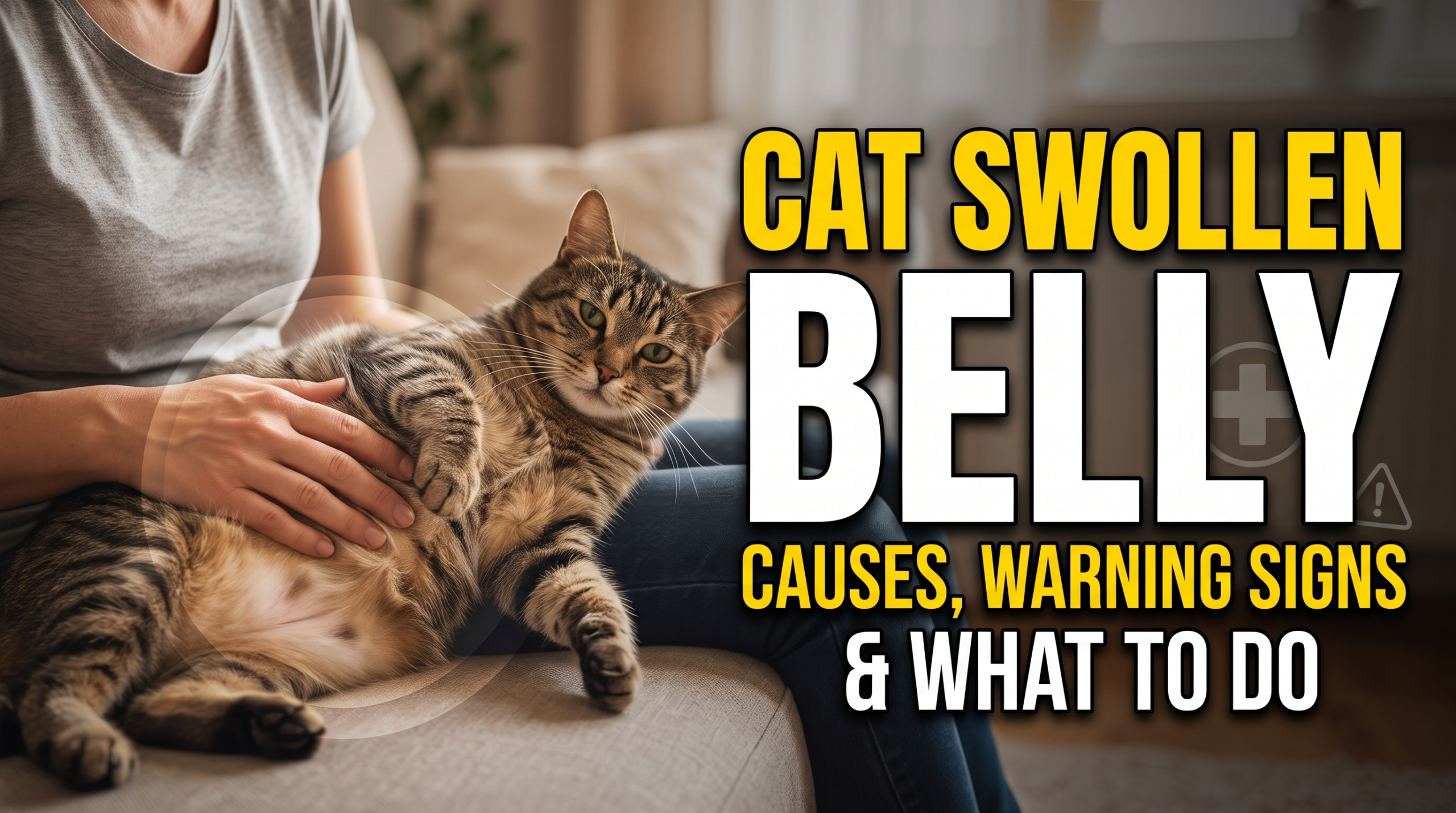
A swollen belly in a cat can have a simple explanation, such as eating too much, but it can also point to parasites, fluid buildup, an intestinal blockage, or another health problem. The appearance of the swelling matters, but so do your cat’s age, behavior, appetite, litter box habits, and other symptoms.
If your cat’s abdomen suddenly becomes large, tight, painful, or firm—or your cat is vomiting, struggling to breathe, very weak, or unable to urinate—contact a veterinarian right away. A swollen belly is not something to diagnose by appearance alone.
What does a swollen belly look like in a cat?
A cat with abdominal swelling may have a belly that looks rounder, hangs lower, or feels firmer than usual. The change may be obvious, or it may show up as a subtle difference when your cat walks, sits, or stretches.
You may also notice:
- A tight or hard-looking abdomen
- Reluctance to lie down, jump, or be touched
- Hiding or acting unusually quiet
- Vomiting, diarrhea, or constipation
- Eating less or refusing food
- A change in thirst or urination
- Faster breathing or difficulty breathing
- Weight loss despite a larger-looking belly
- Pale, yellow, or bluish gums
Some cats naturally have a loose flap of skin and fat along the lower belly called the primordial pouch. This pouch can swing from side to side when a cat walks and does not usually mean the abdomen is swollen. A true swollen belly is more likely to involve a change in size, shape, firmness, or comfort.
Cat swollen belly causes
The possible causes range from mild and temporary to life-threatening. You cannot reliably tell which one is responsible without an examination, and sometimes a veterinarian will need blood work or imaging to find the answer.
1. Overeating or temporary stomach upset
A cat may look rounder after eating a large meal, getting too many treats, or eating food that does not agree with them. Gas can also make the abdomen appear fuller for a short time.
This is more likely to be a minor issue if your cat is otherwise acting normal, breathing comfortably, using the litter box, and returning to their usual shape within a short period. Still, repeated bloating is worth discussing with a veterinarian, especially if it comes with vomiting, diarrhea, pain, or a poor appetite.
Do not give your cat human gas medicine, laxatives, or pain relievers unless a veterinarian specifically tells you to. Some common human medications can be dangerous for cats.
2. Intestinal parasites
Roundworms and other intestinal parasites can cause a swollen, rounded belly, especially in kittens. A kitten with worms may also have poor growth, diarrhea, vomiting, dull fur, or visible worms or segments in the stool or vomit. Some infected cats show few signs at first.
Kittens are particularly vulnerable because parasites can interfere with nutrition and cause anemia or intestinal irritation. Outdoor cats may also be exposed through contaminated soil, prey, or contact with infected animals.
A veterinarian can examine a stool sample and recommend a deworming treatment that is appropriate for your cat. Avoid using an over-the-counter product without guidance. Different parasites require different medications, and some products are unsafe if used incorrectly.
3. Constipation
A buildup of stool can make a cat’s abdomen look larger or feel uncomfortable. You may see your cat visiting the litter box repeatedly, straining, producing small hard stools, or passing no stool at all. Some cats cry, vomit, hide, or stop eating when constipation becomes severe.
Constipation can happen because of dehydration, hair ingestion, reduced activity, pain, or another medical problem. Older cats may have arthritis that makes it difficult to enter or use the litter box comfortably.
Never give a human enema or laxative unless your veterinarian has prescribed a specific product and explained how to use it. Some enemas contain ingredients that are toxic to cats. A cat that is straining may also have a urinary blockage, which is an emergency and can be mistaken for constipation.
4. Pregnancy
An unspayed female cat that has had access to a male may develop a gradually enlarging abdomen during pregnancy. Other possible signs include weight gain, increased appetite, swollen mammary glands, and nesting behavior. These signs are not enough to confirm pregnancy, however.
A veterinarian can confirm pregnancy more safely than trying to press on the belly at home. Do not squeeze or repeatedly handle an enlarged abdomen. If the cat is unspayed and has a swollen belly, an examination can also help rule out serious reproductive problems.
5. Pyometra, or a serious uterine infection
Pyometra is a potentially life-threatening infection of the uterus in an unspayed female cat. It often develops after a heat cycle, but the timing and signs can vary. The uterus can enlarge and fill with infected material, causing the abdomen to become swollen or painful.
Possible signs include:
- Drinking and urinating more than usual
- Loss of appetite
- Vomiting or diarrhea
- Lethargy or weakness
- Fever or a low body temperature
- Vaginal discharge, although discharge may be absent
- A painful or enlarged abdomen
Pyometra requires urgent veterinary treatment. Do not wait for discharge to appear, because a closed infection may have no visible discharge and can become dangerous quickly. Spaying prevents pyometra and also prevents unwanted pregnancies.
6. Fluid buildup in the abdomen
Fluid can collect in the abdomen for several reasons. This is sometimes called abdominal effusion or ascites. Possible underlying problems include liver disease, heart disease, kidney disease, severe inflammation, cancer, or low blood protein.
A cat with fluid buildup may have a gradually expanding belly while losing muscle or weight elsewhere. You may also notice tiredness, reduced appetite, vomiting, pale or yellow gums, or breathing changes. In some cases, the abdomen feels soft and fluid-filled rather than hard.
Fluid in the abdomen is a symptom, not a diagnosis. A veterinarian may need to take a sample of the fluid and perform blood tests or imaging to determine why it is present.
7. An enlarged organ or abdominal mass
The liver, spleen, kidneys, or other structures can become enlarged because of inflammation, infection, bleeding, or cancer. A mass may also grow in the abdomen. Some problems develop slowly, while others cause a sudden change if bleeding or another complication occurs.
The signs can be vague. Your cat may lose weight, eat less, vomit, seem tired, or simply look different around the middle. An enlarged organ or mass usually cannot be identified by gently feeling the abdomen at home, and pressing on a painful belly may make the situation worse.
8. Intestinal blockage or a swallowed object
Cats may swallow string, ribbon, yarn, hair ties, rubber bands, plastic, or pieces of toys. These objects can become stuck in the stomach or intestines. A blockage may cause abdominal pain and swelling along with vomiting, drooling, loss of appetite, constipation, or extreme tiredness.
String-like objects are especially dangerous because one end can become anchored while the intestines bunch up around it. If you see string coming from your cat’s mouth or anus, do not pull it. Pulling can tear the digestive tract. Call a veterinarian immediately.
A suspected blockage is an emergency. Do not give food, oil, or a laxative to force the object through unless a veterinarian directs you to do so.
9. Trauma or internal bleeding
A fall, car accident, animal attack, or hard impact can injure organs and cause bleeding inside the abdomen. The belly may become swollen, painful, or firm. Some injuries are not obvious at first, especially if a cat hides after being hurt.
Emergency signs include pale gums, rapid breathing, weakness, collapse, cold paws, or a sudden reluctance to move. Keep your cat as still and calm as possible and seek emergency veterinary care. Use a carrier with a towel or blanket for support, and handle the abdomen gently.
10. Feline infectious peritonitis and other serious diseases
Feline infectious peritonitis, often called FIP, can cause fluid buildup in the abdomen in some cats. It is more common in young cats, but age alone does not confirm or rule it out. Other possible signs include fever, poor appetite, weight loss, low energy, and breathing difficulty if fluid collects around the lungs.
Many other illnesses can look similar, so a swollen belly does not prove that a cat has FIP. A veterinarian may use the history, physical examination, blood tests, imaging, and fluid analysis to work toward a diagnosis. Prompt evaluation matters because treatment options and supportive care depend on the underlying cause.
When is a swollen belly in a cat an emergency?
Seek emergency veterinary care if your cat has abdominal swelling plus any of these signs:
- Sudden or rapidly increasing swelling
- A hard, tight, or very painful belly
- Repeated vomiting or retching
- Trouble breathing or open-mouth breathing
- Collapse, severe weakness, or confusion
- Pale, gray, blue, or yellow gums
- Straining to urinate or producing little or no urine
- Straining to pass stool with worsening pain
- Known trauma, poisoning, or swallowed string or another object
- A swollen belly in an unspayed female that is sick or lethargic
Male cats deserve special attention if they are repeatedly visiting the litter box, crying, licking the genital area, or producing little urine. A urinary blockage can become fatal quickly and may look like constipation or general abdominal discomfort.
If your cat seems comfortable and the swelling is mild, call your regular veterinarian for advice rather than waiting several days to see what happens. Kittens, senior cats, and cats with chronic disease should be assessed sooner.
What should you do if your cat’s belly is swollen?
Start by observing your cat without repeatedly touching or pressing the abdomen. Write down when you first noticed the change and whether it appeared suddenly or gradually.
Check for useful details:
- Is your cat eating and drinking normally?
- Have they vomited or had diarrhea?
- When did they last pass stool and urine?
- Are they straining in the litter box?
- Could they have swallowed string, a toy, or another object?
- Is your cat spayed or neutered?
- Has there been a fall, fight, or other injury?
- Has your cat received parasite prevention and routine veterinary care?
Take a photo of the abdomen if the swelling changes over time. If possible, bring a fresh stool sample to a routine appointment, but do not delay emergency care to collect one.
Keep your cat indoors, quiet, and warm while arranging care. Do not force food or water if your cat is vomiting or seems painful. Do not give human medicine or attempt home treatment for a suspected blockage, constipation, infection, or fluid buildup.
How veterinarians find the cause
Your veterinarian will usually begin with questions about the timeline, appetite, litter box use, vomiting, medications, parasite prevention, reproductive status, and possible access to objects or toxins. They will examine the abdomen and check your cat’s hydration, temperature, heart rate, breathing, gums, and overall condition.
Possible tests include:
- Blood tests: These can look for anemia, infection, inflammation, organ changes, and other clues.
- Urinalysis: This helps assess urinary health and may be especially important if your cat is straining in the litter box.
- Fecal testing: This can help identify certain intestinal parasites.
- X-rays: These may show constipation, a blockage, gas patterns, enlarged organs, or other changes.
- Ultrasound: This can provide a closer look at organs, the intestinal tract, the uterus, masses, and fluid.
- Fluid or tissue sampling: A sample may help identify infection, bleeding, inflammation, or cancer.
Treatment depends entirely on the cause. It may involve deworming, fluids, medication, a special diet, removal of a blockage, surgery, treatment for an infection, or management of an underlying organ disease.
Can you prevent a swollen belly?
You cannot prevent every cause, but several habits reduce risk and help you notice problems earlier:
- Keep your cat’s vaccinations and routine examinations up to date.
- Use parasite prevention recommended by your veterinarian.
- Keep string, ribbon, thread, rubber bands, and small toys out of reach.
- Feed measured portions and limit sudden diet changes.
- Provide fresh water and clean litter boxes.
- Have an unspayed female cat evaluated for spaying if breeding is not planned.
- Watch appetite, weight, stool, urine, and energy level as part of normal care.
- Keep cats indoors or use supervised outdoor access to reduce trauma and exposure risks.
Regularly running your hands over your cat during calm petting can help you notice changes, but it should be gentle. A home check is not a substitute for a veterinary examination.
The bottom line
The main cat swollen belly causes include overeating, constipation, parasites, pregnancy, uterine infection, fluid buildup, organ disease, trauma, and intestinal blockage. Some causes are mild, but others can become life-threatening without quick treatment.
If the belly is suddenly swollen, painful, firm, or paired with vomiting, weakness, breathing trouble, pale gums, or difficulty urinating, seek veterinary care immediately. When in doubt, call a veterinarian. Early advice is safer than trying to diagnose an abdominal problem at home.