
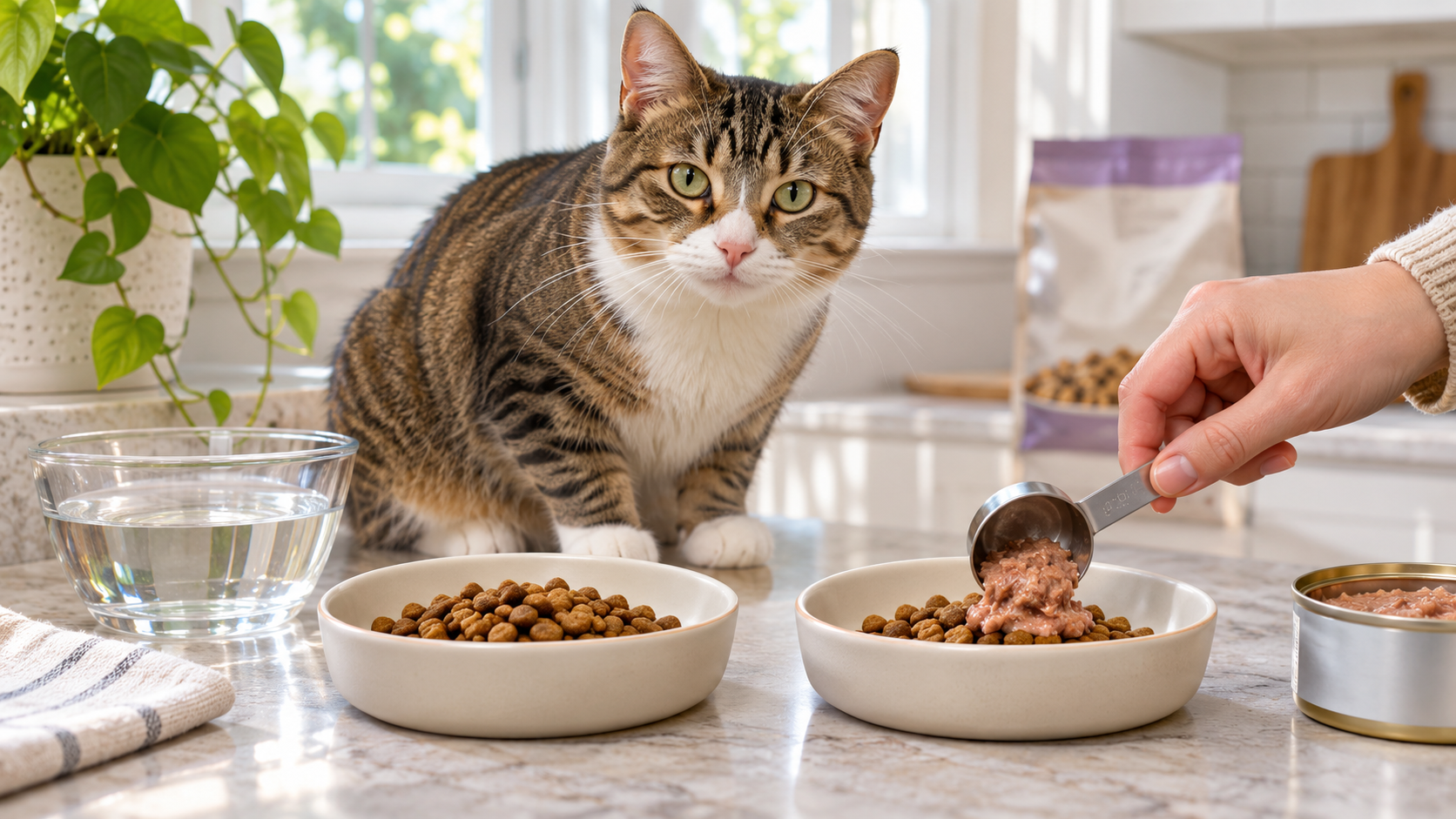
Changing your cat’s food can be necessary when your cat reaches a new life stage, develops a health condition, or simply needs a different formula. But making the change too quickly can lead to vomiting, diarrhea, or food refusal. For most healthy cats, a gradual transition over 7 to 10 days is a practical starting point. Some cats need several weeks, especially when the new food has a different texture, smell, or flavor.
Quick Answer: To switch cat food safely, start by replacing about 25% of your cat’s current daily food allowance with the new food. Increase the new food gradually over 7 to 10 days while reducing the old food. If your cat has a sensitive stomach or refuses the new formula, slow down the process. Some cats need 2 to 6 weeks or even longer. Never let your cat go without food just to force acceptance of a new diet.
Key Takeaways
- Most healthy cats can start with a gradual 7 to 10-day food transition.
- Picky cats and cats that dislike new textures may need several weeks to adjust.
- Use calorie information on food labels when calculating portions, especially when switching between dry and wet food.
- Never starve a cat into accepting a new formula. Maintaining adequate food intake is more important than completing a transition on schedule.
- Mild digestive changes can happen, but repeated vomiting, persistent diarrhea, or appetite loss needs veterinary attention.
- Prescription diets and food allergy trials require individual veterinary instructions.
Why Should You Switch Cat Food Gradually?
Cats can be sensitive to changes in food smell, taste, texture, and temperature. A formula that looks similar to the old one to you may smell completely different to your cat.
A sudden change can cause digestive upset or make a cat refuse the new food. Some cats accept a new formula within a few days, while others need much longer.
The American Animal Hospital Association (AAHA) explains in its food transition guidance that cats may need up to 40 days to accept a new diet. Cats that are strongly attached to a particular texture or food type may need an especially slow transition.
A gradual change also gives you time to notice whether your cat is eating normally and tolerating the new formula.
Should You Always Change Cat Food Gradually?
Usually, yes. However, the right approach depends on why you’re changing the food.
| Your Cat’s Situation | Recommended Approach |
|---|---|
| Changing brands or flavors | Gradual transition over 7 to 10 days |
| Switching from dry to wet food | Gradual transition with calorie adjustments |
| Picky eater or sensitive stomach | Slower transition over several weeks |
| Switching to a prescription diet | Follow your veterinarian’s specific plan |
| Suspected food allergy | Follow a strict veterinary elimination diet |
| Recalled, spoiled, or contaminated food | Stop feeding the affected product and contact your veterinarian |
If a food has been recalled or appears spoiled, don’t keep feeding it just to complete a gradual transition. The FDA advises pet owners to stop feeding unsafe products and contact their veterinarian if their pet becomes sick. Keep the packaging and lot information when reporting a problem. See the FDA’s pet food safety and storage guidance.
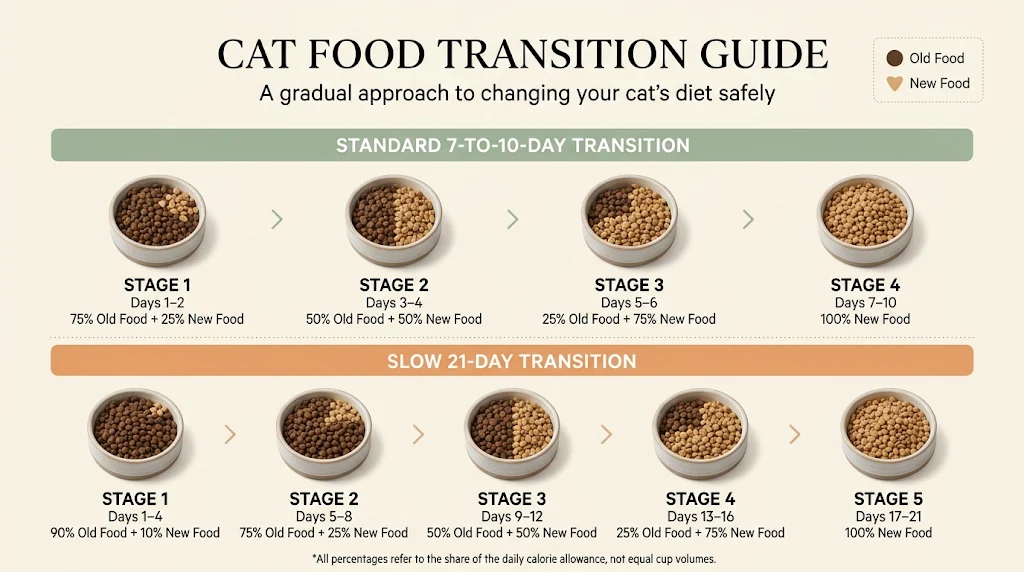
The Standard 7-to-10-Day Cat Food Transition Schedule
For a healthy cat moving between two reasonably similar foods, this schedule is a practical starting point.
| Transition Period | Old Food | New Food |
|---|---|---|
| Days 1–2 | 75% | 25% |
| Days 3–4 | 50% | 50% |
| Days 5–6 | 25% | 75% |
| Days 7–10 | 0% | 100% |
The percentages represent each food’s share of the planned daily calorie allowance. Don’t assume that one cup of dry food and one cup of wet food provide the same calories.
How to use this schedule:
- Start with 75% of the old food and 25% of the new food.
- Watch your cat’s appetite and litter box habits.
- Increase the new food only when your cat is comfortable with the current mixture.
- Move to the next stage if your cat is eating normally and showing no concerning symptoms.
- If your cat struggles, stay at the current stage longer instead of forcing the next change.
The veterinarian-authored PetMD guide to switching cat food also recommends a gradual transition and emphasizes adjusting portions when changing between wet and dry formulas.
Remember, the schedule is a starting point, not a deadline. Some cats need more time.
A Slower 21-Day Transition Plan for Picky Cats
Some cats turn away from a new food after one sniff. Others eat it for a day and then suddenly refuse it.
If your cat has a history of food refusal, digestive sensitivity, or strong texture preferences, a slower approach may work better.
Here is an illustrative 21-day schedule:
| Transition Period | Old Food | New Food |
|---|---|---|
| Days 1–4 | 90% | 10% |
| Days 5–8 | 75% | 25% |
| Days 9–12 | 50% | 50% |
| Days 13–16 | 25% | 75% |
| Days 17–21 | 0% | 100% |
You don’t have to finish this schedule in exactly 21 days. If your cat needs more time, hold each stage longer.
Veterinary nutrition experts at Tufts University’s Petfoodology note that some pets need 4 to 6 weeks to change foods without digestive upset. AAHA also notes that certain cats may need up to 40 days.
If your cat has ongoing vomiting, diarrhea, or a diagnosed digestive condition, ask your veterinarian whether a food transition is appropriate before continuing.
How to Switch From Dry Food to Wet Food
Switching from dry kibble to canned food can be harder than changing between two similar dry formulas.
The biggest differences are moisture, calorie density, smell, and texture.
According to the Cornell Feline Health Center’s feeding guidance, canned cat food contains at least 75% moisture. This means your cat may need a larger volume of wet food to receive the same calories as a smaller portion of dry food.
Introduce the new texture slowly
If your cat has always eaten crunchy kibble, don’t assume they’ll enjoy pâté or shredded food immediately.
Try these steps:
- Place a small amount of wet food in a separate shallow dish beside the usual dry food.
- Let your cat investigate the new food without pressure.
- Once your cat starts eating it, gradually increase the amount.
- Reduce the dry food according to the calorie difference.
- Keep fresh water available throughout the transition.
Some cats prefer eating the two foods separately rather than having them mixed together.
Warm refrigerated wet food slightly
Cold food straight from the refrigerator may be less appealing to some cats.
Let it approach room temperature or warm it gently toward body temperature. Stir it thoroughly and check for hot spots before serving. Never serve food that feels hot.
Calculate calories instead of matching bowl sizes
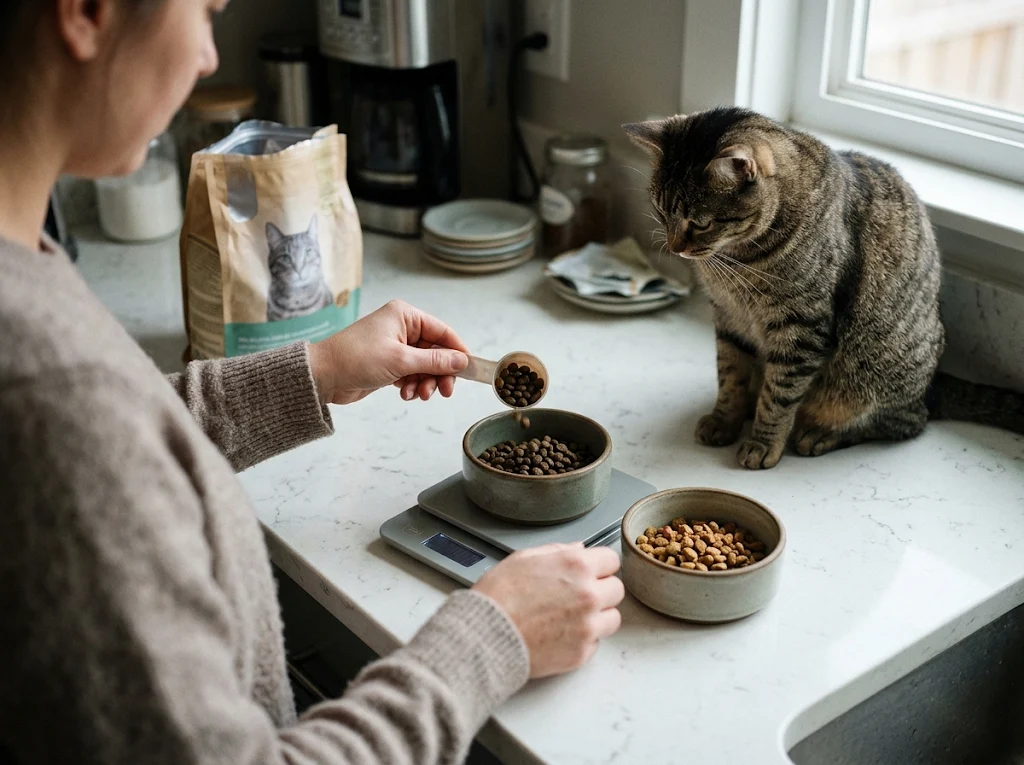
For example, one cup of dry food may contain substantially more calories than one cup of canned food.
Check the package for:
- Calories per cup of dry food.
- Calories per can or pouch of wet food.
- Recommended daily feeding amounts.
If you’re unsure how much to offer, ask your veterinarian to calculate an appropriate daily portion.
How to Switch From Wet Food to Dry Food
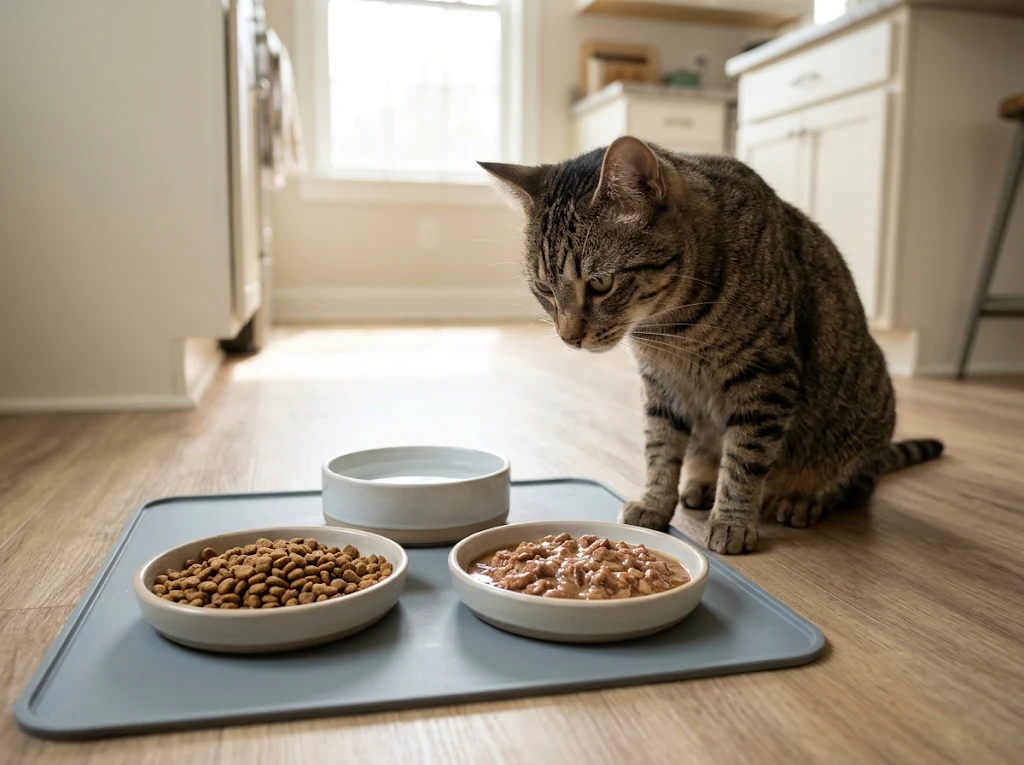
Moving from wet food to dry food also requires a gradual approach.
Cats that are used to soft food may not immediately enjoy crunchy kibble. Some may sniff the new food and walk away, even when they’re hungry.
Start by offering a small amount of dry food in a separate dish. If your cat accepts it, gradually increase the portion while reducing the wet food.
Keep these points in mind:
- Don’t replace wet food with the same volume of dry food.
- Check the calorie difference before adjusting portions.
- Provide fresh water in an easily accessible location.
- Monitor your cat’s appetite, body weight, and litter box habits.
- Don’t leave moistened kibble sitting out for extended periods.
You can also ask your veterinarian whether a mixed wet-and-dry feeding plan would suit your cat better than switching entirely to dry food.
What to Do If Your Cat Refuses the New Food
Food refusal is one of the biggest challenges during a diet transition.
Your cat may dislike the smell, texture, flavor, or temperature. Sometimes the new food is simply unfamiliar.
Instead of forcing the change, try these approaches.
1. Offer the Foods Side by Side
If your cat refuses a mixed bowl, place the old and new foods in separate dishes.
This lets your cat explore the new food without having to eat it to reach the familiar meal.
2. Start With a Smaller Amount
If 25% new food is too much, begin with a much smaller amount, such as 5% or 10%.
Keep the old food as the main portion until your cat begins accepting the new formula.
3. Keep Feeding Times Consistent
Feed your cat in a quiet, familiar location. Avoid changing the feeding schedule, food bowl, and food formula all at once.
A predictable routine can make the transition easier.
4. Avoid Too Many Toppers
A small amount of a veterinarian-approved topper may help some cats accept a new formula.
However, don’t add random treats, meat, supplements, or flavored products to a prescribed elimination diet. They can interfere with the purpose of the trial.
5. Never Starve Your Cat Into Eating
This is one of the most important safety rules.
If your cat refuses the new food, offer the familiar food rather than leaving only the new formula in the bowl.
A cat that stops eating can develop serious health complications, including hepatic lipidosis, also known as fatty liver disease.
The Cornell Feline Health Center explains that appetite loss can seriously affect an adult cat’s health within as little as 24 hours. Kittens younger than six weeks can face a life-threatening risk after only 12 hours without food.
If an adult cat has not eaten for 24 hours, contact your veterinarian promptly. Seek help sooner for young kittens, cats with existing medical conditions, or any cat showing signs of illness.
What to Do If Your Cat Gets Diarrhea or Vomits During a Food Switch
Some cats experience mild digestive changes when trying a new formula.
A small change in stool consistency doesn’t automatically mean the new food is unsuitable. However, repeated or worsening symptoms should never be dismissed as normal adjustment.
If Your Cat Has Mildly Soft Stool
If your cat is still eating, drinking, and behaving normally:
- Stop increasing the amount of new food.
- Stay at the current transition stage.
- If needed, return to the last ratio your cat tolerated.
- Monitor appetite and stool consistency.
- Contact your veterinarian if the problem continues or gets worse.
Don’t keep switching between several different foods to see which one works. That can make it harder to identify the cause.
Warning Signs That Need Veterinary Attention
Contact your veterinarian promptly if you notice:
- Repeated vomiting.
- Persistent or watery diarrhea.
- Blood in the stool or vomit.
- Refusal to eat or a substantial drop in appetite.
- Unusual tiredness or weakness.
- Signs of dehydration.
- Hiding, abdominal discomfort, or unusual behavior.
Repeated vomiting, severe weakness, significant bleeding, or an inability to keep water down may require urgent veterinary care.
Should You Give Your Cat Probiotics?
Not automatically.
Probiotics and other supplements may be appropriate in certain situations, but they aren’t necessary for every cat experiencing digestive upset.
Ask your veterinarian before adding a probiotic, fiber supplement, or digestive product. This is particularly important if your cat is eating a prescription diet.
Special Rules for Prescription Cat Food
Switching to a prescription diet is different from changing ordinary food brands.
Your veterinarian may recommend a therapeutic diet for chronic kidney disease, urinary problems, diabetes, food allergies, or gastrointestinal conditions.
The transition needs to support the medical goal without causing food refusal or inadequate calorie intake.
Switching to a Kidney Diet
Cats with chronic kidney disease may need a therapeutic renal diet.
The 2026 iCatCare consensus guidelines for feline chronic kidney disease recommend introducing a new renal diet gradually over at least 1 to 2 weeks alongside the existing food.
Some cats may accept the new diet more easily when the foods are offered side by side instead of being mixed.
Don’t introduce an unfamiliar therapeutic food while your cat is actively nauseated or unwell unless your veterinarian specifically directs you to do so.
Maintaining adequate calorie intake is especially important for cats with kidney disease.
Switching to a Urinary or Diabetes Diet
Urinary diets are designed for specific urinary health goals. The appropriate formula depends on the cat’s diagnosis and veterinary assessment.
Cats receiving insulin for diabetes may also need a coordinated feeding and medication schedule.
Don’t change a diabetic cat’s food or feeding routine without discussing the plan with the veterinarian managing its treatment.
Switching Food Because of a Suspected Allergy
A suspected food allergy requires a different approach from an ordinary food transition.
Your veterinarian may recommend a hydrolyzed-protein diet or a diet containing a protein your cat hasn’t previously eaten.
The VCA Animal Hospitals guide to feline elimination-challenge diet trials explains that the elimination phase should last at least eight weeks, even though some cats show improvement sooner.
During a strict elimination trial:
- Feed only the prescribed trial diet.
- Avoid unapproved treats and table scraps.
- Don’t add supplements or flavored products without veterinary approval.
- Check whether medications contain animal proteins or flavorings.
- Follow your veterinarian’s instructions for the challenge phase.
An improvement in symptoms alone doesn’t confirm a food allergy. The full elimination and challenge process helps determine whether a particular ingredient is responsible.
Switching Kitten Food to Adult Cat Food
Kittens need food formulated to support growth. Adult maintenance food may not provide the same nutritional profile required by a growing kitten.
Many cats are ready to move toward adult food around their first birthday, although the timing depends on growth, breed, and individual needs.
When making the change:
- Choose an adult formula appropriate for your cat’s life stage.
- Ask your veterinarian whether the timing is right.
- Use a gradual transition rather than changing the food overnight.
- Monitor weight, appetite, and stool consistency.
If you’re still comparing growth formulas, our guide to choosing wet food for kittens explains what to look for on a kitten food label.
Should You Change Food for a Senior Cat?
Not every older cat needs a special senior formula.
Some healthy senior cats do well on their existing complete and balanced diet. Others may need a different food because of dental disease, weight changes, kidney disease, or another diagnosed condition.
Before changing your senior cat’s food, consider:
- Whether your cat is maintaining a healthy weight.
- Whether chewing has become uncomfortable.
- Whether appetite or thirst has changed.
- Whether your veterinarian has identified a medical reason for a new diet.
Our Senior Cat Food Guide explains how age, weight, dental health, and diagnosed conditions affect food choices.
If a senior cat suddenly starts eating less or losing weight, arrange a veterinary examination rather than assuming the current food is the problem.
Common Mistakes to Avoid When Switching Cat Food
Even a well-intentioned diet change can go wrong if you rush the process.
| Common Mistake | What to Do Instead |
|---|---|
| Changing food overnight without a medical reason | Use a gradual transition |
| Measuring new and old food by equal cup volume | Check calorie density and calculate portions |
| Forcing a picky cat to eat the new food | Offer familiar food and slow the transition |
| Changing food while the cat is nauseated | Ask your veterinarian when to begin |
| Adding several new foods and treats at once | Introduce one change at a time |
| Assuming all prescription diets use the same schedule | Follow the specific veterinary plan |
| Waiting 48 hours when a cat stops eating | Contact a veterinarian promptly |
| Leaving opened wet food unrefrigerated | Follow storage instructions and refrigerate unused portions promptly |
The FDA’s pet food storage recommendations advise promptly refrigerating or discarding unused canned and pouched food. Store dry food according to the manufacturer’s instructions and keep its original packaging information for reference.
Frequently Asked Questions About Switching Cat Food
How long does it take to switch cat food?
Most healthy cats can start with a 7 to 10-day transition. Picky cats and cats that dislike the new texture may need several weeks. Some cats need up to 40 days to accept a different diet.
Can I switch my cat’s food overnight?
Usually, a sudden switch isn’t recommended because it may cause digestive upset or food refusal. However, if a product is recalled, contaminated, or spoiled, stop feeding it and ask your veterinarian what to offer instead. A veterinarian may also recommend a faster change for a specific medical reason.
Can changing cat food cause diarrhea?
Yes. Some cats develop softer stools or diarrhea after a sudden diet change. Slow the transition and contact your veterinarian if symptoms persist, worsen, or occur with vomiting, appetite loss, or lethargy.
Should I mix dry and wet cat food together?
You can mix them if your cat accepts the texture and the combination provides the appropriate daily calories. If your cat refuses the mixture, offer the foods in separate dishes and introduce the new texture gradually.
What if my cat refuses the new food completely?
Don’t withhold the old food to force acceptance. Offer the familiar diet, try a smaller amount of the new food separately, and ask your veterinarian for help if your cat continues refusing food.
Do I need to rotate cat food brands regularly?
No. Healthy cats don’t need frequent brand changes simply for variety. A complete and balanced diet appropriate for the cat’s life stage can be maintained if it suits the individual cat. Any suspected allergy or intolerance should be investigated with veterinary guidance rather than random food rotation.
How do I know if the new food is right for my cat?
Look for consistent appetite, normal stool, stable energy, and a healthy weight trend. A cat that develops repeated digestive problems, refuses meals, or loses weight needs veterinary assessment rather than repeated trial-and-error food changes.
The Bottom Line: Make the Change at Your Cat’s Pace
Learning how to switch cat food safely isn’t about following a schedule perfectly. It’s about helping your cat accept a suitable new diet while maintaining enough calories and watching for signs of trouble.
For most healthy cats, a gradual 7 to 10-day transition is a sensible starting point. Picky cats may need several weeks, while cats with medical conditions need a plan tailored by their veterinarian.
Start with a small amount of the new food, keep the feeding routine familiar, and increase the new portion only when your cat is ready. If your cat refuses food or develops concerning symptoms, don’t force the transition.
A successful food change is one your cat can tolerate, eat consistently, and benefit from over time.