
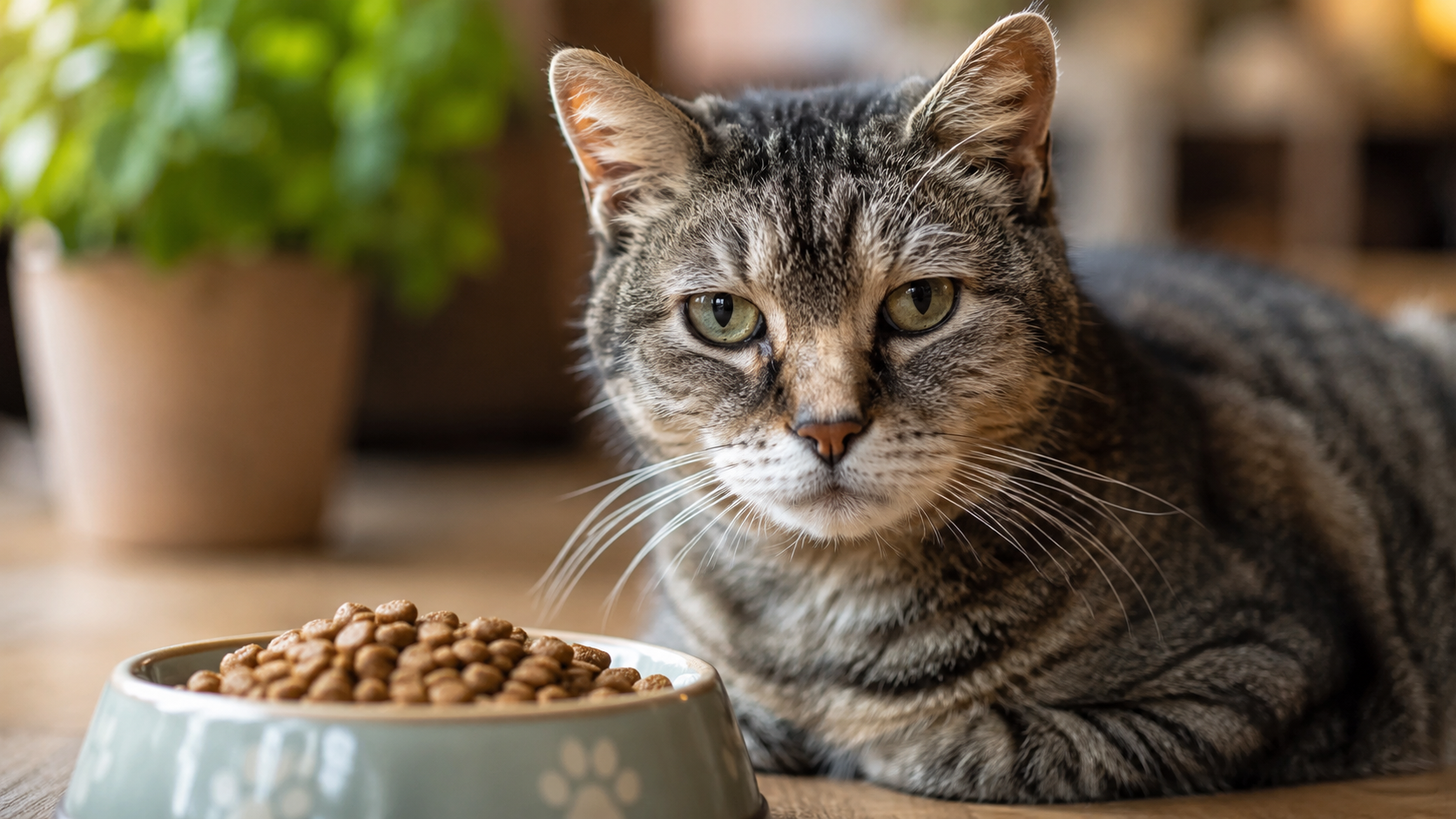
There isn’t one dry food that’s perfect for every senior cat. However, the best options have a few things in common: they’re AAFCO-certified for adult or all-life-stages, offer easily digestible high-quality protein (usually 30% or more on a dry matter basis unless your cat has kidney disease), have calories suited for less active cats, and include support for joints, digestion, and dental health. The best choice depends mostly on your cat’s health, not just her age.
Cats are usually considered “senior” starting around 11 years old, with 15+ often labelled “super senior.” As your cat ages, her body changes in ways that directly affect what she should eat and dry food, in particular, comes with both benefits and trade-offs you’ll want to understand before you buy.
This guide walks through what senior cats actually need, how to evaluate a bag of kibble beyond the marketing on the front, and when dry food isn’t the right call at all.
How a Senior Cat’s Nutritional Needs Change
Ageing affects cats in several overlapping ways, and good senior food is designed around these shifts rather than just a lower calorie count.
Digestion often becomes less efficient. Many older cats absorb fat and protein less effectively than they did as adults, which is part of why some senior formulas actually contain more protein, not less, to compensate for that reduced absorption.
Muscle loss (sarcopenia) is common. Cats can quietly lose lean muscle mass as they age even if their weight on the scale looks stable. Adequate, high-quality protein helps slow this decline.
Activity level typically drops. Less movement means fewer calories are needed, which is why many senior formulas are calorie-adjusted compared to adult maintenance food.
Dental health can decline. Worn or missing teeth, gum disease, and stomatitis are common in older cats and can make crunching dry kibble uncomfortable, which is worth watching for regardless of what food you choose.
Chronic conditions become more likely. Kidney disease, hyperthyroidism, diabetes, arthritis, and inflammatory bowel disease all increase in frequency with age, and each one can change what “ideal nutrition” looks like for that individual cat.
This is the key point competing guides often skip: senior cat nutrition isn’t one-size-fits-all the way kitten nutrition largely is. A healthy 12-year-old and a 12-year-old with early kidney disease need meaningfully different diets.
Dry vs Wet Food for Senior Cats
Many senior cat owners wonder about this, but the real answer is that it depends on your cat’s health, not just what you prefer.
| Hydration | Low (~6–10% moisture) | High (~70–80% moisture) |
| Convenience | Easy to free-feed, longer shelf life | Must be refrigerated after opening |
| Dental chewing | Some texture/abrasive benefit | Little to no dental benefit |
| Calorie density | Higher per gram, easy to overfeed | Lower per gram, harder to overfeed |
| Cost per day | Usually lower | Usually higher |
Cats don’t naturally drink much water because their ancestors got most of their moisture from prey. This becomes more important as cats get older, since kidney function often declines and staying hydrated helps. Many vets suggest feeding wet food along with dry, or encouraging your cat to drink more water, especially if dry food is the main part of their diet.
Dry food isn’t unsafe or “bad” for senior cats. It’s simply not automatically the best hydration strategy for an ageing cat, and that’s worth factoring into your decision rather than choosing purely on convenience.
What to Look for on the Label
Before comparing specific products, it helps to know what actually separates a well-formulated senior dry food from one that’s just marketed toward older cats.
1. An AAFCO Nutritional Adequacy Statement
Look for a statement confirming the food is “complete and balanced” for “adult maintenance” or “all life stages,” following AAFCO nutrient profiles. Importantly, AAFCO does not currently have a specific “senior” life-stage category. Hence, a bag labelled “Senior” is still legally formulated to meet either the adult maintenance or all-life-stages standard; the word “senior” itself is a marketing term, not a regulated nutritional category. That doesn’t make senior-labelled food meaningless; reputable brands do adjust protein, calories, fibre, and added nutrients for older cats. It just means you shouldn’t rely on the word “senior” alone.
2. Protein Quality, Not Just Protein Percentage
Look for named animal proteins (chicken, turkey, salmon) as the first ingredients rather than vague terms like “meat meal” or “animal by-product” without species specified. For a healthy senior cat without kidney disease, higher-quality protein is generally beneficial, since it helps preserve lean muscle mass. If your cat has diagnosed kidney disease, protein levels and type should instead be guided by your veterinarian, since some kidney-support diets deliberately moderate protein.
3. Calorie Density Appropriate to Activity Level
A less active 12-pound cat doesn’t need the same calorie load as an active 5-year-old of the same weight. Check the calorie content per cup or per 100 grams and compare it to what your vet recommends for your cat’s ideal body weight.
4. Added Joint Support
Glucosamine and chondroitin are common additions in senior formulas and may help support joint comfort, though evidence in cats specifically is more limited than in dogs. Omega-3 fatty acids (from fish oil) are more consistently linked to anti-inflammatory benefits.
5. Fibre for Digestive Regularity
Moderate fibre (from beet pulp, pumpkin, or similar sources) can help with hairballs and constipation, both more common in less active senior cats.
6. Kibble Size and Texture
Smaller, easier-to-chew kibble is important for cats with dental problems, missing teeth, or jaw pain. Ingredient lists won’t tell you this, so check reviews or try a sample bag.
Nutrient Targets to Compare Against
Use this as a general reference point when comparing bags side by side. These are common ranges seen in well-formulated senior dry foods for cats without kidney disease; they are not prescriptive numbers, since individual needs vary.
| Crude protein | 30–45% |
| Crude fat | 12–20% |
| Fiber | 2–6% |
| Calories | ~300–400 kcal per 100g (varies by formula) |
If your cat has a diagnosed condition like chronic kidney disease, diabetes, or a history of urinary crystals, these general ranges don’t apply — follow your veterinarian’s specific recommendation instead.
Best Dry Food for Senior Cats by Situation
Rather than naming one “winner,” it’s more useful to match the formula to the specific senior cat in front of you.
For a generally healthy senior cat
Look for an AAFCO-adequate adult maintenance or all-life-stages formula with named-meat-first ingredients, moderate-to-high protein, and calorie content matched to your cat’s ideal weight. This describes most reputable mainstream and premium senior lines.
For a senior cat with a sensitive stomach
Look for limited-ingredient formulas with a single novel protein source, added prebiotics or probiotics, and easily digestible carbohydrates like rice rather than a long list of proteins and grains. Introduce any new food gradually; see our guide on how to transition your cat to a new food.
For a senior cat prone to weight gain
Choose a formula specifically labelled for “weight management” or “indoor/less active,” which typically has higher fibre and lower fat to help maintain fullness with fewer calories. Portion control matters as much as the formula itself here; see our guide on weight management for overweight senior cats.
For a senior cat with early kidney concerns
Don’t self-select a “kidney support” food. These are typically therapeutic diets requiring a veterinary diagnosis and prescription, since they moderate protein and phosphorus in ways that could actually harm a cat who doesn’t need it. Talk to your vet first, and in the meantime, watch for early signs of kidney disease like increased thirst and urination.
For a senior cat that eats dry food reluctantly
Some older cats prefer wet food as their teeth and sense of smell change. Rather than forcing dry food, consider whether a wet-food-primary or mixed-feeding approach see our guide on the best wet food for senior cats might suit her better.
Common Mistakes Owners Make
- Switching foods too fast. A sudden switch can cause vomiting or diarrhoea even with a high-quality food. Transition over 7–10 days, mixing old and new food in increasing ratios.
- Assuming “senior” on the bag means it’s automatically right for your cat. As noted above, it’s a marketing category, not a guaranteed nutritional match.
- Free-feeding dry food without measuring. Dry kibble is calorie-dense, and it’s easy to overfeed a less active senior cat this way, contributing to obesity.
- Ignoring dental pain as a reason for reduced eating. If your cat suddenly avoids dry food, a dental exam should come before a food switch.
- Choosing a “kidney” or other therapeutic formula without a diagnosis. These diets are formulated for specific medical needs and aren’t appropriate as a general senior food.
- Not accounting for hydration. Relying on dry food alone, with no attention to water intake, may not be ideal for a cat whose kidney function is already declining with age.
Myth vs. Fact
| “Senior cats need less protein.” | Most healthy senior cats actually need equal or more high-quality protein to help preserve muscle mass low protein is typically only appropriate with diagnosed kidney disease. |
| “Dry food cleans a cat’s teeth.” | Kibble offers minimal dental benefit for most cats; dental disease still requires proper veterinary dental care regardless of diet. |
| “All senior formulas are basically the same.” | Formulas vary widely in protein source, calorie density, and added joint/digestive support the label matters more than the word “senior.” |
| “Grain-free is automatically healthier for older cats.” | There’s no strong evidence that grain-free dry food benefits senior cats specifically; ingredient quality matters more than the presence of grain. |
Signs Your Senior Cat’s Food May Not Be Working
Watch for these signs, and bring them up with your veterinarian rather than switching foods repeatedly on your own:
- Ongoing vomiting or soft stool after a full transition period
- Noticeable weight loss or gain over a few months
- Reduced coat quality or excessive shedding
- Reluctance to eat dry kibble specifically (may point to dental pain)
- Increased thirst or urination (can indicate kidney or thyroid issues, not just a food problem)
When to Involve Your Veterinarian
Any senior cat with a new or worsening health issue weight loss, increased thirst, vomiting, lethargy, or reduced appetite should see a veterinarian before you change diets, since these can be early signs of conditions like kidney disease, hyperthyroidism, or diabetes that need proper diagnosis rather than a new bag of food. Annual (or twice-yearly, for cats over 10) veterinary checkups with bloodwork are one of the best tools for catching these issues early, often before symptoms show up in the food bowl at all.
Frequently Asked Questions
At what age is a cat considered “senior”?
Most veterinary guidelines consider cats senior starting around 11 years old, with cats 15 and older often described as “super senior” or geriatric.
Is dry food bad for senior cats?
No, dry food isn’t inherently bad for senior cats, but it provides much less moisture than wet food, which matters more as kidney function can decline with age. Many owners feed a mix of both.
How much protein does a senior cat need?
Most healthy senior cats benefit from moderate-to-high quality protein, generally in the 30–45% range on a dry matter basis, unless they have diagnosed kidney disease, in which case protein needs should be set by a veterinarian.
Should I switch my cat to a “senior” formula at a specific age?
There’s no strict cutoff. Many owners transition somewhere between 10 and 12 years old, but the better trigger is a noticeable change in weight, activity, or a veterinarian’s recommendation rather than age alone.
Can senior cats eat kitten or all-life-stages food?
Yes, a healthy senior cat can eat an all-life-stages formula that meets AAFCO standards, since it’s nutritionally adequate for adult cats too. It may be more calorie-dense than a dedicated senior formula, so portion size matters.
What’s better for weight loss in senior cats: dry or wet food?
Wet food is often easier to manage for weight loss because it’s less calorie-dense and adds fullness through moisture, but a properly portioned weight-management dry food can also work well.
Do senior cats need a food with glucosamine for joints?
It may help support joint comfort, especially in cats showing signs of stiffness or reduced jumping, though evidence specifically in cats is more limited than in dogs. It’s a reasonable addition but not a substitute for veterinary care if your cat shows signs of arthritis.
How do I know if my senior cat has a sensitive stomach?
Signs include intermittent vomiting, soft stool, or reduced appetite that isn’t explained by an obvious illness. A limited-ingredient diet trial, done under veterinary guidance, can help identify a sensitivity.
Is grain-free dry food better for older cats?
Not necessarily. There’s no strong evidence that grain-free diets offer specific benefits for senior cats; what matters more is overall ingredient quality and whether the formula meets your cat’s individual needs.
How often should I feed my senior cat dry food?
Most senior cats do well with two or more measured meals a day rather than free-feeding, which makes it easier to monitor appetite changes, often one of the earliest signs something’s wrong.
Final Takeaways
- There’s no single “best” dry food for every senior cat; the right choice depends on your individual cat’s health, weight, and any diagnosed conditions.
- Look past the word “senior” on the bag and check for an AAFCO adequacy statement, named protein sources, and calorie content appropriate to your cat’s activity level.
- Healthy senior cats generally need equal or more high-quality protein; low-protein diets are typically reserved for cats with diagnosed kidney disease.
- Hydration matters more as cats age; consider pairing dry food with wet food or encouraging more water intake.
- Any new or worsening symptoms weight change, increased thirst, vomiting, appetite loss deserve a veterinary visit before a food switch, not after.
- If you’re still deciding between formats, our guide on dry vs wet food for senior cats breaks down the trade-offs in more detail.
1 thought on “Best Dry Food for Senior Cats: A Vet-Informed Buying Guide”
Comments are closed.