
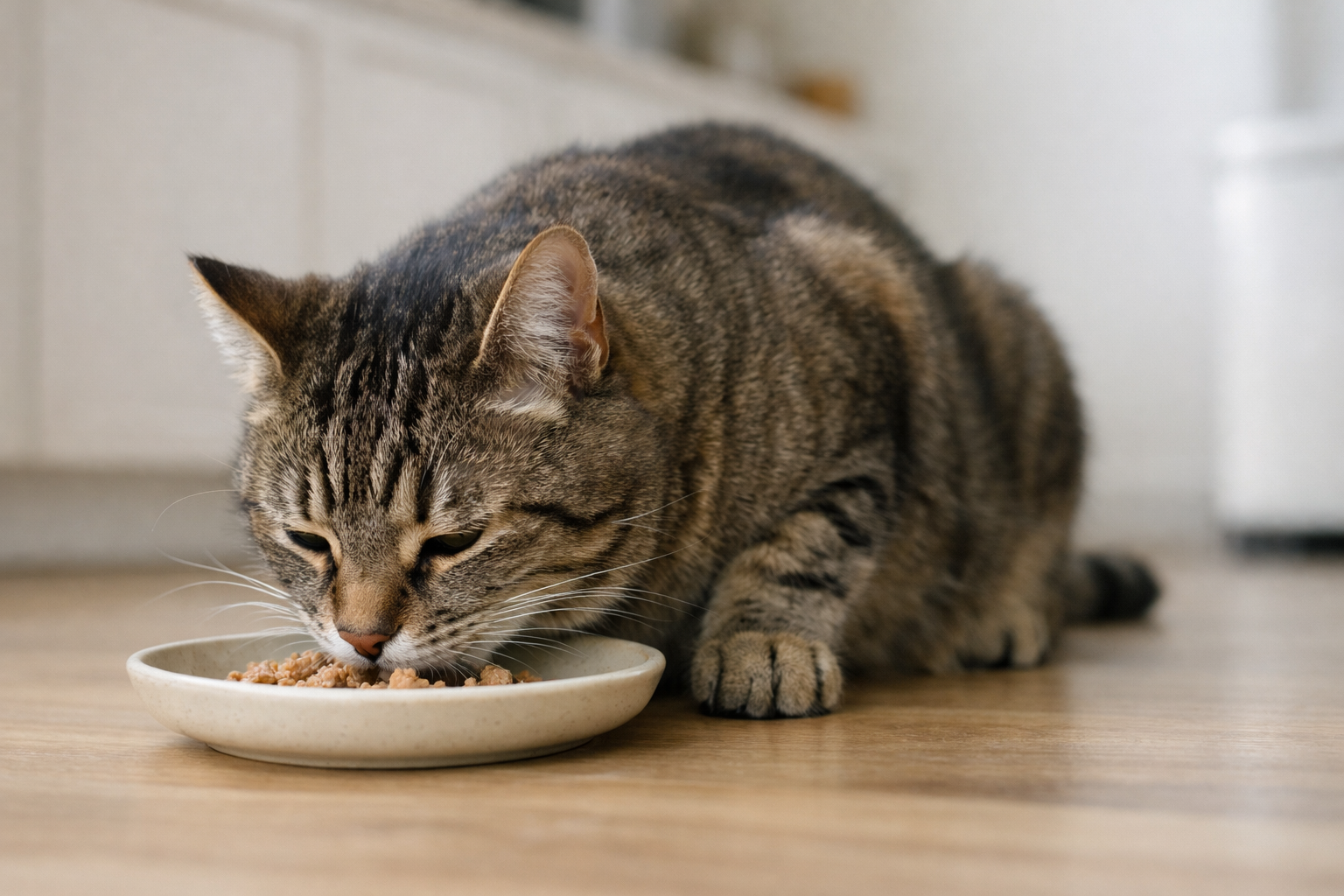
For many healthy adult cats, two or more measured meals a day are a sensible choice. Three or four smaller meals may suit cats that rush their food, seek food between meals, or enjoy frequent feeding opportunities. But feeding more often is not automatically healthier: the total daily calories, nutritional quality, and your cat’s medical needs matter more than the number of meals.
If your cat is comfortable on two meals, maintains a healthy weight, and eats an appropriate complete and balanced diet, you don’t need to add meals just to improve the schedule. If long gaps seem to cause problems, dividing the same daily food allowance into smaller servings is worth considering.
The key distinction is simple: more feeding opportunities, not more food.
How many times a day should a cat eat?
There isn’t one ideal meal frequency for every cat. Age, appetite, household routines, and health all affect what works.
For a healthy adult cat, start with at least two measured meals spaced through the day. Three or four meals are another reasonable option if they fit your cat and your schedule. Meal frequency alone has not been established as a universal way to prevent obesity or improve long-term health.
| Cat or situation | Practical starting point | What may change the plan |
|---|---|---|
| Healthy adult cat | Two measured meals, or several smaller meals | Appetite, body condition, and feeding behavior |
| Weaned kitten | Usually three to four meals daily | Age, growth, and ability to eat enough at each meal |
| Healthy senior cat | Two or more meals, adjusted for comfort | Dental problems, appetite changes, or illness |
| Cat with a medical condition | An individualized veterinary plan | Medication timing, food requirements, and symptoms |
These are starting points, not prescriptions. Very young or unweaned kittens need a separate feeding plan, and a cat receiving treatment may need a schedule that differs from general advice.
Why smaller, more frequent meals can suit some cats
Cats naturally hunt small prey and may eat repeatedly when food is available. That helps explain why some domestic cats prefer several small feeding opportunities rather than one large serving. It doesn’t prove that every pet cat needs a particular number of meals.
Smaller portions may reduce gulping
A cat that rapidly swallows a large meal may bring food back up afterward. Smaller servings, offered slowly, can help some cats pace themselves. A suitable slow feeder may also help.
However, repeated vomiting or regurgitation shouldn’t simply be blamed on eating too fast. Contact your veterinarian if it keeps happening, particularly if you also notice weight loss, discomfort, or reduced appetite.
More feeding opportunities can add activity
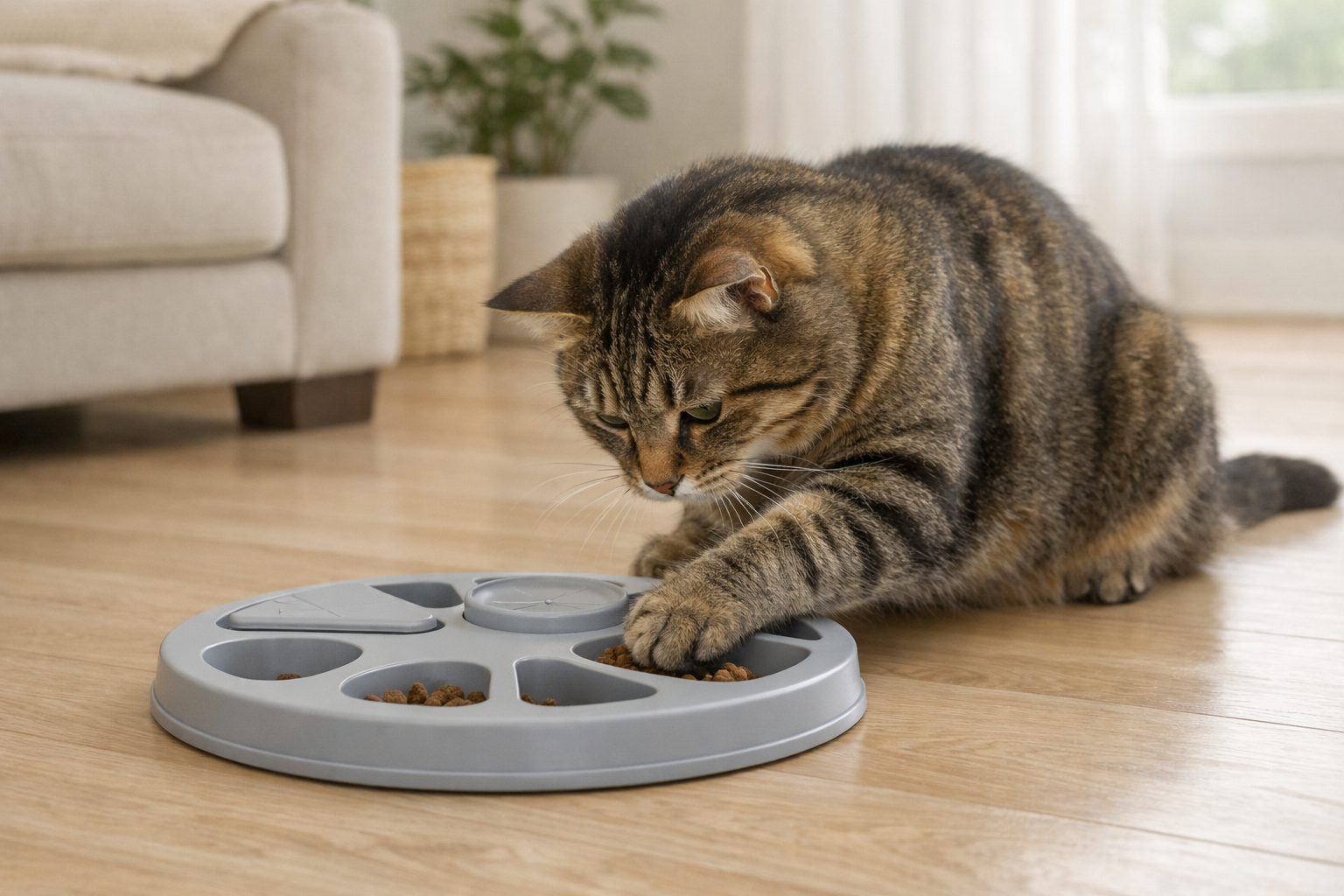
A small meal in a puzzle feeder gives a cat something to investigate and work for. For indoor cats, this can make feeding more engaging than repeatedly eating from a full bowl.
Start with an easy puzzle. A feeding activity should not be so difficult that the cat gives up or cannot get enough food.
Predictable meals can make the day easier
Some cats become restless around long gaps between meals. A scheduled midday serving or small bedtime meal may help, especially when meals follow a consistent routine.
Still, persistent hunger is not always a scheduling problem. A sudden increase in appetite—especially with weight loss, increased thirst, or larger urine clumps—needs veterinary attention rather than just another feeding.
More meals should not mean more food
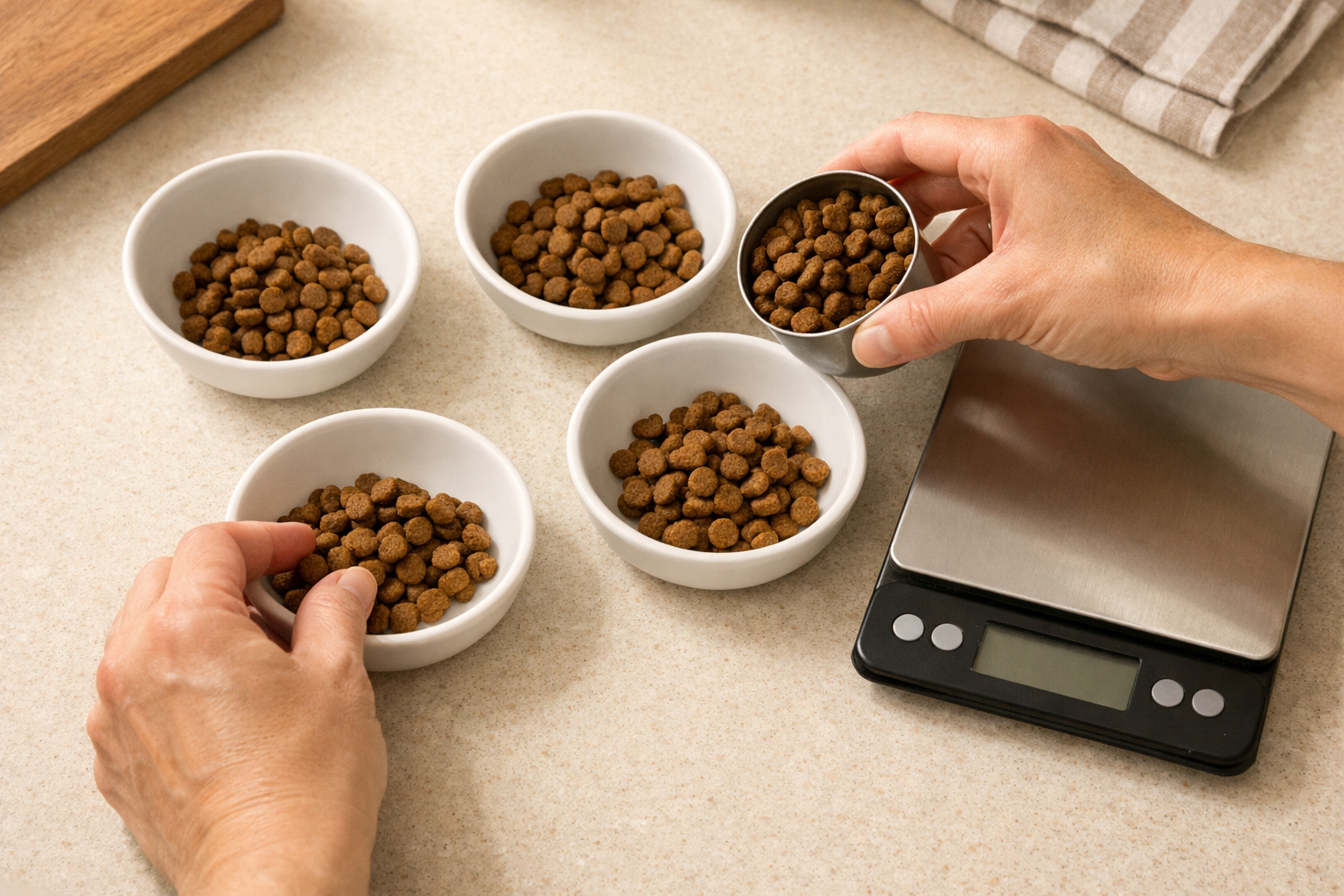
The most common mistake when adding meals is keeping breakfast and dinner unchanged, then adding lunch and snacks on top. Those extras can gradually increase calorie intake.
Instead, divide your cat’s existing appropriate daily allowance into additional portions.
For example, if a veterinarian has recommended 200 calories a day for a particular cat, that allowance could be split into:
- Two meals of 100 calories.
- Three meals of approximately 67 calories.
- Four meals of 50 calories.
The 200-calorie figure is an arithmetic example, not a recommendation for your cat. Calorie needs vary with size, body condition, activity, life stage, and health.
Count wet food, dry food, and treats together
If you combine canned and dry food, both contribute to the same daily total. Treats, food used for training, and edible supplements count too.
Use the calorie information on the packaging rather than assuming every pouch, can, or scoop contains the same amount. Dry foods can differ substantially in calories per cup. Weighing dry food with a kitchen scale generally gives more consistent portions than estimating by eye.
The feeding guide on a package is a starting estimate. Your cat’s weight trend and body condition help determine whether that estimate fits. Ask your veterinary team to show you how to assess body condition if you’re unsure.
A heavier cat should not be put on a severe food restriction simply because you’re reorganizing meals. Safe weight loss requires an appropriate calorie target and adequate nutrition.
Two meals, several meals, or food left out all day?
Meal feeding and free feeding are different approaches. Frequent measured meals control when food is offered and how much is available. Free feeding usually means food remains available for extended periods, sometimes with the bowl topped up whenever it looks low.
Two measured meals
Breakfast and dinner are straightforward for many households. They let you track intake and often work well for adult cats that eat comfortably without becoming distressed between meals.
Keep the routine reasonably consistent. If your cat struggles with the gap, you can move part of one meal to a midday or bedtime feeding without increasing the daily allowance.
Three or four measured meals
This approach can suit cats that prefer small portions or benefit from slower access to food. It requires more planning, but a timed feeder can handle one of the meals.
There is no need to keep adding meals if your cat is already doing well. Six or eight feedings are not automatically better than three or four.
Food available throughout the day
Some cats can maintain a healthy weight with access to a measured daily allowance of dry food. Others eat more than they need when food is always available.
Unlimited topping-up makes it harder to know how much a cat eats. It can also hide appetite changes or food stealing in a multicat home. If you leave dry food available, measure the day’s allowance and monitor what remains rather than continually refilling the bowl.
Wet food requires additional attention to temperature and food safety. Follow the manufacturer’s storage and discard instructions; don’t assume canned food can safely sit out all day.
Build a feeding schedule around your actual day
A useful schedule is one you can maintain. You don’t need to be home every few hours to feed a healthy adult cat well.
Here are three examples using the same daily calorie allowance:
| Routine | Example meal times | How to divide the food |
|---|---|---|
| Two meals | 7 a.m. and 7 p.m. | Roughly half at each meal |
| Three meals | 7 a.m., 3 p.m., and 10 p.m. | Three measured portions |
| Four meals | 7 a.m., noon, 6 p.m., and 10 p.m. | Four measured portions |
These times are examples, not medical requirements. Shift them to fit your household. Portions don’t have to be identical, as long as the daily total remains appropriate.
For a cat that wakes you before dawn, one option is to reserve some of the daily food for a timed early-morning feeding. Avoid routinely responding to every nighttime demand with extra food, which can teach the cat that waking you produces a snack.
If nighttime hunger or restlessness is new, especially in an older cat, arrange a veterinary check rather than assuming it is a learned habit.
Make small meals work when you’re away from home
An automatic feeder can provide a measured meal while you’re at work. Choose one compatible with the food you use, and test its portions before relying on it. A setting labeled as one portion may not correspond to a specific calorie amount.
For wet food, use a feeder designed for that purpose and follow its cooling and holding-time instructions. Cooling features don’t make food safe indefinitely.
Other practical options include:
- An easy food puzzle: Use part of the daily dry-food allowance, not an extra serving.
- Separate feeding areas: Give each cat a quiet place to eat without competition.
- A microchip-access feeder: This may help when one cat steals another’s food or needs a different diet.
In a multicat home, several shared bowls don’t guarantee that each cat gets the correct amount. Watch who eats from which bowl. One cat may finish quickly and move to a housemate’s portion while the slower eater walks away.
Kittens, senior cats, and medical conditions need extra thought
Kittens need enough opportunities to fuel growth
Weaned kittens generally need more frequent meals than adults because they’re growing and have smaller stomachs. Three to four meals a day is a common starting point for younger kittens, with frequency adjusted as they mature.
Feed a complete and balanced diet appropriate for growth. Don’t use an adult cat’s restricted calorie allowance for a kitten, and don’t stretch out feedings simply to fit an adult schedule. Ask your veterinarian about portions and meal frequency as the kitten grows.
Older cats may need easier access, not just more meals
Age alone doesn’t determine feeding frequency. An older cat with a stable appetite and healthy body condition may do well on the same schedule as before.
But a senior cat that takes only a few bites may have dental pain, nausea, or another problem. Smaller fresh meals can sometimes help with intake, but they don’t replace investigating the cause. Keep food easy to reach, away from stairs or other obstacles if mobility is limited.
Medical feeding plans take priority
Cats with diabetes, kidney disease, gastrointestinal problems, or other illnesses may need specific foods, feeding patterns, or monitoring. For a cat receiving insulin, meal timing and medication need to follow the veterinarian’s plan.
Don’t change prescribed treatment or medication timing to fit a new meal schedule. If the cat won’t eat as expected, contact the treating veterinary team for instructions.
Change the routine without accidentally underfeeding
A cat accustomed to grazing may not immediately eat a full portion when food appears at a set time. Make the transition gradually rather than abruptly removing access and waiting for hunger to force cooperation.
A practical approach is to:
- Measure the current daily intake. Include all foods and treats, and check whether that amount is appropriate.
- Choose manageable meal times. Start with a routine you can follow consistently.
- Redistribute the allowance. Move some food into the new meal instead of adding calories.
- Observe actual eating. Note what is offered, what is left, and whether another pet takes it.
- Track the result. Watch appetite, comfort after meals, and weight over the following weeks.
If you’re also changing the food itself, a gradual diet transition is generally easier to tolerate. Changing both food and schedule at once can make it harder to identify the cause of digestive upset or refusal.
Don’t try to make a cat accept a schedule by allowing prolonged food refusal. Contact your veterinarian promptly if intake drops substantially. A cat eating nothing for about 24 hours needs veterinary advice; seek help sooner for kittens, cats with medical conditions, or any cat that seems unwell. Repeated vomiting, marked weakness, or breathing difficulty warrants urgent care.
Choose the fewest meals that meet your cat’s needs
Multiple daily meals can be a useful way to manage portions, add enrichment, and accommodate a cat’s eating preferences. They aren’t a substitute for the right diet or an appropriate daily calorie allowance.
For many healthy adult cats, two measured meals work well. If your cat seems more comfortable with three or four smaller meals, redistribute the same daily food and see how they respond. A successful routine keeps your cat eating reliably, supports a healthy body condition, and works in your household.
For additional nutrition guidance, recommended resources include the WSAVA Global Nutrition Committee, Cornell Feline Health Center, and your veterinary team. These are source recommendations, not verified links or claims that this article has received veterinary review.