
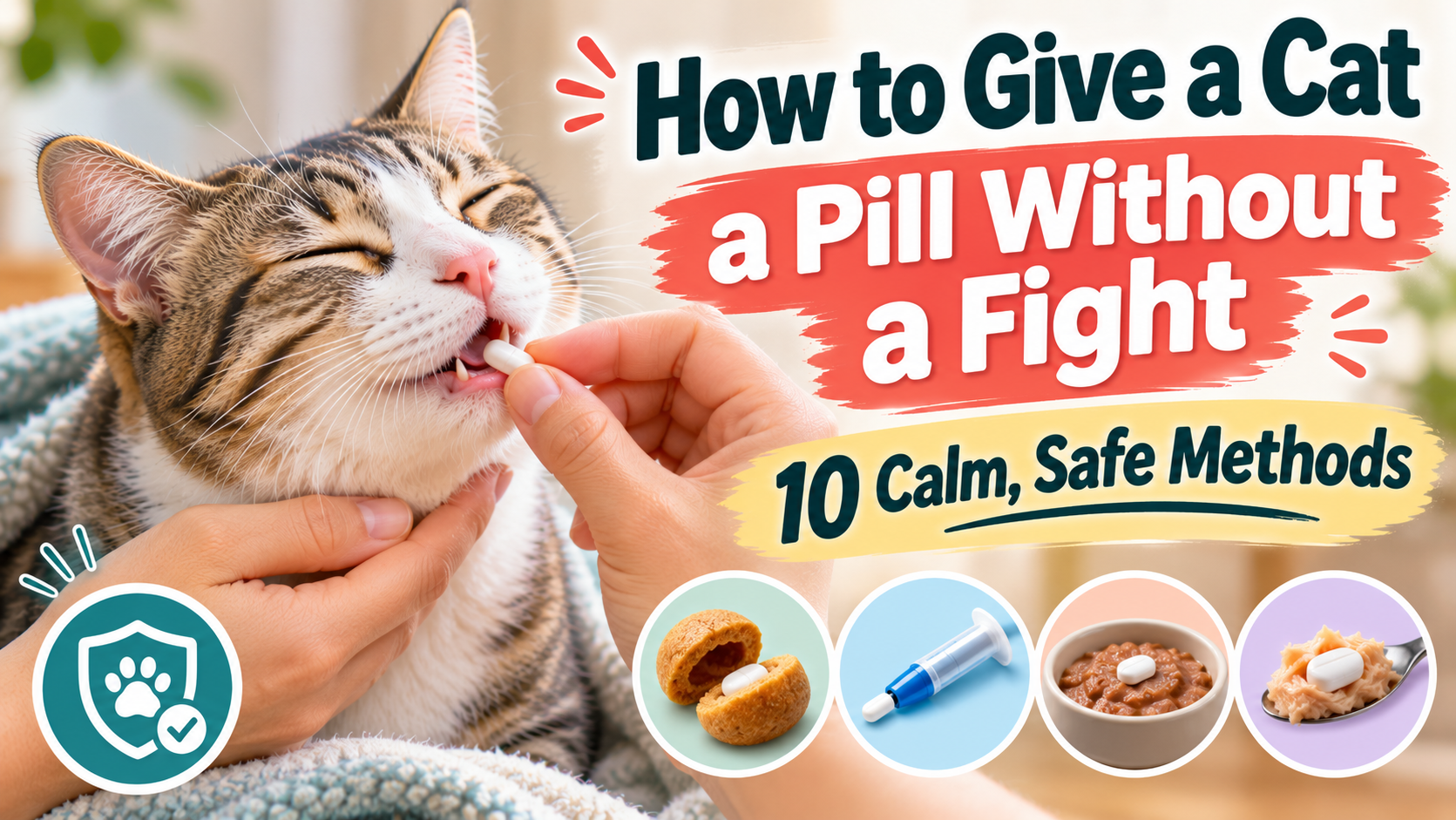
Giving a cat medicine can turn into a wrestling match quickly. Your cat may clamp their mouth shut, spit out the pill, scratch, bite, or disappear under the bed as soon as they see the medication bottle. The good news is that how to give a cat a pill without a fight is less about using force and more about choosing the right method, preparing ahead of time, and keeping the experience short.
Start by asking your veterinarian or veterinary pharmacist whether the pill can be crushed, split, mixed with food, or changed into a liquid. Some medicines must be given whole, and others can become unsafe or less effective if altered. Once you know what is allowed, try the least stressful option first—such as hiding the pill in an approved treat—before moving to gentle direct pilling.
Before giving your cat a pill
A few minutes of preparation can make the process much easier. Have everything ready before you bring your cat over:
- The correct pill and dose
- A small amount of an approved treat or food, if permitted
- A towel, if your cat needs gentle restraint
- A pill popper, if your veterinarian has shown you how to use one
- A small bowl of water or a favorite reward
- A quiet room with the door closed
Read the label carefully. Check whether the medicine should be given with food, on an empty stomach, or at a particular time. If you are unsure, call the veterinary clinic rather than guessing.
It also helps to choose a calm time. Avoid trying to give medicine while your cat is already frightened, playing intensely, or hiding. Sit on the floor or use a stable surface where your cat cannot easily slip. Keep your movements slow and your voice quiet.
Make the pill less suspicious
Handle the medication before calling your cat over. Open the bottle, prepare the treat, and remove any packaging noises first. Cats quickly learn that the sound of a pill bottle means something unpleasant is coming.
Don’t chase your cat around the home. Chasing increases fear and teaches your cat to run away from you. Instead, wait until they are relaxed, or calmly bring them to a small, quiet room.
Method 1: Hide the pill in a vet-approved treat
For some cats, hiding the medicine is the easiest solution. You may be able to use a commercial pill pocket, a soft treat designed to hold a pill, or a small amount of wet food. Ask your veterinarian first, because some medications should not be given with food, and your cat may need to receive the entire dose rather than nibble around it.
To use a pill pocket or soft treat:
- Prepare one plain treat without medicine.
- Give it to your cat so they start eating normally.
- Place the pill inside the next treat and seal it completely.
- Offer the medicated treat right away.
- Watch to make sure your cat swallows the pill instead of chewing around it.
- Follow with another plain treat if allowed.
The first plain treat helps prevent your cat from becoming suspicious. Use only a small amount of food so your cat is likely to finish it.
Some cats will eat the treat but leave the pill on the floor. Check the area and your cat’s mouth after they finish. If the pill is missing and you are not sure whether it was swallowed, don’t give another dose unless your veterinarian tells you to. Giving a second pill could lead to an accidental overdose.
Method 2: Mix the medicine with food only when approved
A small serving of wet food can work for some medications. However, mixing a pill into your cat’s full meal is often a bad idea. If your cat refuses the food, eats only part of it, or develops an aversion to that flavor, you may not know how much medicine they received.
If your veterinarian approves mixing the medicine with food:
- Use a small portion your cat will finish completely.
- Avoid adding the medicine to a large meal.
- Use food your cat already likes.
- Watch your cat eat the entire portion.
- Give the rest of the meal afterward, if appropriate.
Never crush or open a capsule unless your veterinarian or pharmacist confirms that it is safe. Some pills have a coating, extended-release design, or other feature that changes how the medicine works when altered.
Method 3: Give the pill by hand
If treats do not work, direct pilling may be the most reliable method. It can sound intimidating, but the process is usually quicker and calmer when you know where to place your hands.
The goal is to open your cat’s mouth gently, place the pill far enough back on the tongue, and encourage swallowing without squeezing the throat.
Step-by-step direct pilling
- Prepare the pill first. Have it ready in your fingers or on a clean surface. If your veterinarian recommends lubrication, use only the product they approve.
- Place your cat on a stable surface. You can also sit on the floor with your cat between your legs. Avoid a high table where a frightened cat could fall.
- Keep your cat facing away from you. This position can make backing away less likely.
- Hold the head gently. Place one hand over the top of the head, with your thumb on one side and fingers on the other. Do not squeeze the neck.
- Tilt the nose slightly upward. The lower jaw may begin to open naturally.
- Use a finger to lower the jaw. Open the mouth gently and place the pill toward the back of the tongue—not directly down the throat.
- Close the mouth. Hold it closed without forcing it tightly. Stroke the throat gently or blow very lightly toward the nose to encourage a swallow.
- Watch for swallowing. A lick of the nose, swallowing motion, or relaxed mouth may indicate that the pill went down.
- Reward your cat. Offer a treat, praise, or a favorite activity if they are willing.
Do not push your fingers deep into the mouth, and don’t rush if your cat is struggling hard. A cat can bite even when they are normally gentle. If you cannot safely open the mouth, stop and ask your veterinarian to demonstrate the technique.
Method 4: Use a pill popper
A pill popper, also called a pill gun, is a narrow device that helps place the pill toward the back of the tongue while keeping your fingers away from the teeth. It can be useful for cats that bite or for owners who have trouble reaching the correct spot by hand.
A pill popper must be used carefully. If it is inserted too far or used forcefully, it can injure the mouth or throat. Ask a veterinary professional to show you how to use the specific device before trying it at home.
The basic process is similar to hand pilling: hold your cat’s head gently, open the mouth, position the device correctly, release the pill, and encourage swallowing. The device should never be jabbed into the throat.
Some pill poppers can also deliver a small amount of water after the pill. Follow your veterinarian’s instructions. Water may help move certain pills into the stomach, but the amount and method matter. Never squirt liquid quickly into the back of your cat’s throat, because it could be inhaled.
Method 5: Ask for a liquid or compounded version
If your cat repeatedly refuses pills, ask whether the medicine comes in another form. Depending on the drug, your veterinarian may be able to prescribe a liquid, flavored preparation, injectable medication, or a form applied to the skin. Not every medicine is suitable for every alternative, so the vet must choose the option.
Liquid medicine still needs to be given correctly. Place the syringe into the side of the mouth, behind the canine tooth, and direct the liquid into the cheek pouch. Give it slowly in small amounts, allowing your cat time to swallow. Do not tilt the head far back or squirt liquid straight down the throat.
A flavored liquid may be easier for some cats, but others dislike the taste more than a pill. If your cat foams or drools after medicine, that may be a reaction to the taste rather than a sign that the full dose was lost. Call your veterinarian for instructions before repeating it.
How to restrain a cat safely
Some cats need gentle restraint, but restraint should be limited to what is necessary. A towel wrap can help keep the legs from scratching while leaving the head exposed.
To use a towel:
- Spread a towel on the floor or another secure surface.
- Place your cat in the center, facing away from you.
- Wrap one side around the body, then the other, keeping the front legs inside if needed.
- Make sure the towel is snug but not tight.
- Leave the neck and head free, and check that your cat can breathe comfortably.
A towel should not be used to pin a cat down forcefully. Stop if your cat is panting, breathing with an open mouth, becoming limp, or showing severe distress. These signs require immediate attention, and the medicine can wait while you contact a veterinary professional.
For a very fearful or aggressive cat, two people may be safer than one. One person can provide calm, steady support while the other gives the medication. If that still does not work, ask the clinic whether a technician can administer the medicine or teach you a better approach.
What to do if your cat spits out the pill
First, stay calm. Check whether the pill is whole, partly dissolved, or missing. The right next step depends on the medication and how much time has passed.
- If the pill is whole and clearly on the floor, you may be able to give it again, but check that it is clean and follow your vet’s instructions.
- If the pill is partly dissolved or chewed, call the veterinary clinic before giving more.
- If you cannot find the pill, don’t automatically repeat the dose.
- If your cat vomits after taking the medicine, ask the vet whether another dose is needed.
Different medications behave differently, so there is no universal rule for replacing a rejected or vomited dose. Write down what happened and contact the clinic if you are unsure.
Common mistakes that make pilling harder
Chasing your cat
Chasing turns medication into a home-wide game of avoidance. Prepare the room and calmly bring your cat to you instead.
Hiding medicine in a full meal
Your cat may refuse the meal or eat only part of it. A small approved treat is easier to monitor.
Crushing every pill
Some medications should never be crushed. Always check first.
Holding the mouth open too long
The longer the struggle lasts, the more frightened your cat may become. Prepare everything before opening the mouth and aim for a quick, gentle attempt.
Showing frustration
Cats respond to tension and sudden movements. If you feel yourself getting angry or rushed, stop, take a break, and try again later if the dosing schedule allows.
Repeating a dose without checking
A second dose can be dangerous when the first dose may already have been swallowed. Ask the vet when there is any doubt.
How to make future doses easier
You can train your cat to tolerate parts of the process even when they are not taking medicine. Keep these practice sessions very short:
- Touch the cheeks gently, then offer a treat.
- Lift the chin for a second, then reward.
- Briefly touch the lips without opening the mouth.
- Practice a gentle towel wrap for a few seconds.
- Let your cat see a pill popper without using it, followed by a reward.
Stop before your cat becomes upset. Over several days, these small steps can make handling feel more familiar. Never practice by putting an actual medication in your cat’s mouth unless it is prescribed and it is time for the dose.
It can also help to keep a simple medication record. Mark down the time, dose, and whether your cat swallowed it. This is especially useful when more than one person cares for the cat.
When to contact your veterinarian
Call your veterinarian if you cannot give the medication safely, your cat bites you, your cat has severe distress, or you are unsure whether the dose was swallowed. You should also ask for help if your cat repeatedly vomits, develops facial swelling, has trouble breathing, becomes unusually weak, or shows another concerning reaction after taking the medicine.
If your cat bites deeply, clean the wound and seek medical advice promptly. Cat bites can become infected, even when the skin wound looks small.
Your veterinarian may suggest a different medication form, adjust the schedule, demonstrate pilling, or have a trained staff member give the dose. Missing a dose is sometimes less risky than forcing medication in an unsafe way, but that decision depends on the drug—so ask before skipping it.
The easiest approach for most cats
The best method depends on your cat’s personality and the medication. A treat or pill pocket may work for a food-motivated cat. A careful direct technique may be faster for a cat that refuses hidden medicine. A liquid or compounded option may be better when pills consistently cause fear.
The basic plan is simple: confirm the medication rules, prepare everything first, use the gentlest method that works, reward your cat, and ask for professional help when the process becomes unsafe. With patience and a consistent routine, giving a cat a pill can become a brief task instead of a daily battle.