
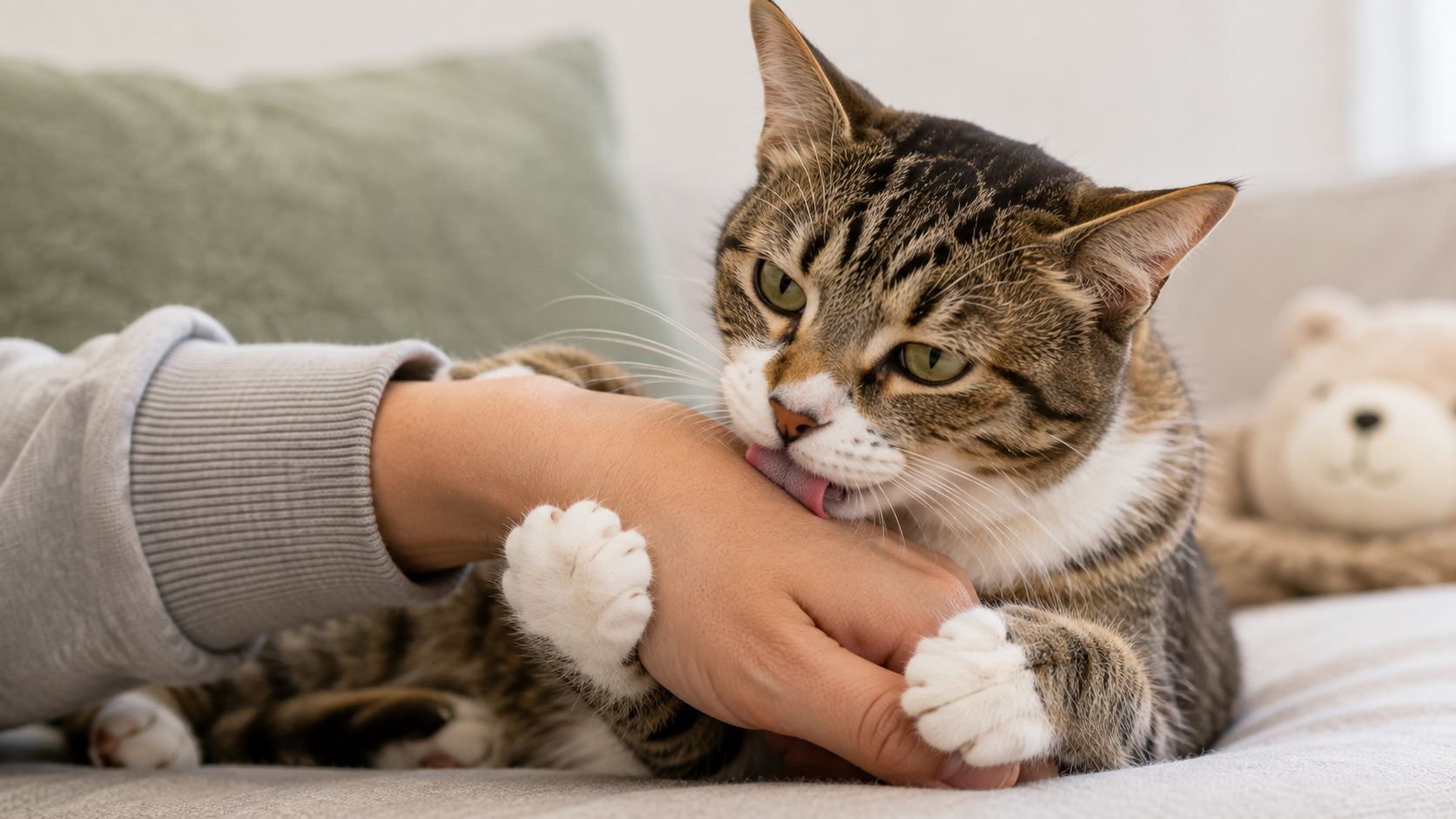
The lick after the bite doesn’t necessarily mean your cat is apologizing.
A cat that bites and then licks you may be grooming, playing, ending an overstimulating petting session, or shifting between different levels of excitement. A soft nibble followed by relaxed licking is very different from a hard bite preceded by a lashing tail and flattened ears.
That is why “bite, then lick” has no single translation.
Cats use their mouths during several normal behaviors. Social grooming between cats can include both licking and gentle biting, while play can involve grabbing and mouthing. Some cats also bite when petting exceeds their tolerance.
The useful question isn’t simply, “Why does my cat bite then lick me?”
It is:
What happened before the bite, how hard was it, and what did the rest of my cat’s body do?
Those clues usually tell a much clearer story.
The Bite Matters More Than the Lick
Owners naturally focus on the strange sequence:
Bite.
Lick.
Bite again.
But the intensity and context of the bite carry more practical information than the fact that licking followed it.
A gentle mouth contact that barely puts pressure on your skin is not equivalent to a defensive bite that punctures the hand.
Start by separating three broad patterns.
Gentle nibble followed by calm licking
Your cat remains loose and comfortable. The ears are neutral. There is no growling, hissing, frantic tail movement, or attempt to escape.
This pattern can fit social grooming or another relaxed form of close contact.
Cats groom social partners, and research on cat-to-cat behavior describes allogrooming as licking that may also include gentle biting of the fur.
We should be careful about extending that evidence too far. Research describing cats grooming other cats does not prove that every cat gently mouthing and licking a human is performing exactly the same social behavior.
Still, when a cat voluntarily approaches you, remains relaxed, gives a light nibble, and continues licking, an affiliative or grooming-related interpretation is reasonable.
Quick bite during active play, then licking
A different pattern appears when the cat is highly animated.
The cat may grab your arm, bunny-kick, mouth your hand, release it, lick briefly, then try to grab again.
That interaction fits play much better than grooming.
Cornell identifies play aggression as a common form of feline aggression and recommends directing biting and scratching toward toys rather than hands or other body parts.
Bite during petting, followed by a few licks
This pattern often causes the most confusion because the interaction began pleasantly.
Your cat asks for attention.
You pet them.
They appear comfortable.
Then, bite.
The cat may remain beside you and even lick your hand afterward.
That doesn’t mean the bite was accidental or that the lick canceled it. The cat may simply have reached its tolerance limit for that type or duration of physical contact.
Cornell describes petting-induced aggression in cats and notes that possible explanations include overstimulation and the cat attempting to control when petting ends.
The lick can coexist with that message.
“Stop petting me” and “I still want to sit beside you” are not contradictory.
A Cat Can Want Contact Without Wanting Endless Petting
This distinction solves many apparently mixed feline messages.
A cat can:
- want to sit on your lap
- enjoy three cheek scratches
- dislike ten strokes down the back
- remain socially interested
- lick your hand
- object when you resume touching
Humans tend to treat physical affection as a continuous invitation.
Cats may be more selective.
Current FelineVMA guidance emphasizes that human-cat interactions should be positive, predictable, and adapted to the preferences of the individual cat.
A cat approaching you therefore isn’t necessarily granting permission for every kind of handling.
The cat may want proximity rather than petting.
Or cheek scratches rather than full-body strokes.
Or thirty seconds of interaction rather than five minutes.
That distinction matters particularly for cats that repeatedly bite at the same point during a petting session.
Watch for the Five Seconds Before the Bite
The warning often appears before teeth touch skin.
Cornell notes that cats experiencing petting-induced aggression may show tail lashing, dilated pupils, and ears moving backward before they bite.
FelineVMA also identifies changes in ear position, pupils, whiskers, posture, vigilance, and other facial or body signals as indicators that a cat’s emotional state is changing.
You might notice:
- the tail beginning to flick
- ears rotating sideways
- pupils becoming larger
- the body becoming suddenly tense
- skin twitching along the back
- the cat turning its head toward your hand
- whiskers changing position
- the cat stopping purring or abruptly becoming still
- a paw reaching toward your hand
- the cat trying to move away
The individual signals aren’t perfect emotion detectors.
Look for the change.
A relaxed cat that suddenly stiffens and turns toward your hand is telling you more than a static picture of what its ears look like.
Stop petting at that point.
You don’t need to wait for the bite to confirm that the cat has had enough.
Try the Pause Test Instead of Testing Your Cat’s Patience
For cats that become bitey during petting, a simple practical technique can make interactions easier.
Pet briefly.
Then stop.
Take your hand away and see what your cat chooses to do.
If the cat:
- leans into you
- rubs against the hand
- moves closer
- places the head under your fingers
you can offer another short round of gentle petting.
If the cat remains still, turns away, leaves, or looks tense, let the interaction end.
This isn’t a diagnostic test, and it doesn’t provide a scientific measurement of a cat’s emotional state. It is simply a way of giving the cat repeated opportunities to opt into more contact instead of assuming that one approach means unlimited handling.
That approach is consistent with feline-care guidance favoring interactions tailored to individual preferences and stopping physical contact when aggression signals appear.
The Licking May Be Social Grooming, But Don’t Call Every Bite a “Love Bite”
“Love bite” is a popular phrase.
It is not a precise behavioral diagnosis.
There is genuine evidence that grooming has a social function between cats. Allogrooming is categorized as an affiliative behavior, and observations show that cats may lick and gently bite social partners during grooming.
That makes gentle bite-and-lick sequences interesting.
But calling every bite affectionate can cause owners to overlook important distinctions.
A hard bite isn’t made harmless because licking follows.
A defensive bite isn’t converted into grooming because the cat later calms down.
And a cat biting when an arthritic hip is touched isn’t expressing affection through its teeth.
Use “love bite” only as an informal description of very gentle, non-injurious mouthing in an otherwise relaxed interaction.
It shouldn’t replace body-language assessment.
Play Has Its Own Bite-Lick Pattern
Young or highly playful cats may move rapidly between grabbing, biting, licking, kicking, stalking, and pouncing.
To the cat, your moving fingers can become part of the game.
The problem is that human skin makes poor prey.
CDC guidance advises avoiding rough play with cats and kittens because hand-based rough play increases opportunities for bites and scratches.
If your cat grabs and mouths your hands during play:
Stop moving the hand.
Pulling rapidly can make the interaction more exciting and may also worsen scratches.
Then redirect the cat toward something appropriate to chase and bite, such as an interactive wand toy or larger kick toy.
Cornell likewise recommends keeping toys used during play aggression at a distance from the hands.
The idea isn’t to remove predatory play.
It is to change its target.
Don’t Turn Your Hands Into Toys
Using fingers to wrestle with a kitten can look harmless when the teeth and claws are tiny.
The behavior becomes considerably less charming when the same animal is an adult.
If biting consistently starts during play, establish a simple rule:
Skin ends the game. Toys continue it.
When teeth make inappropriate contact, pause the interaction rather than shouting, wrestling back, or turning the bite into a bigger game.
Then offer an appropriate play outlet later.
Positive reinforcement and redirection are preferable to punishment. FelineVMA warns that physical or verbal punishment can increase fear, stress, and fear-related aggression.
Licking After a Bite Is Not an Apology We Can Prove
One especially tempting explanation is:
“My cat realized they hurt me, so they licked me to say sorry.”
There isn’t good evidence that allows us to translate the sequence that specifically.
The licking could be part of grooming.
The cat may have shifted from high arousal back toward calmer social contact.
The bite and lick may both be components of play.
Or the cat may simply have stopped objecting once you stopped touching them.
A human-style apology requires us to assume an internal intention we cannot verify from the behavior.
You don’t need that interpretation to appreciate the interaction.
Your cat may still be closely bonded to you.
We just shouldn’t turn a plausible story into established feline psychology.
Use the Whole Cat to Decode the Sequence
The same bite-and-lick behavior means something different depending on what surrounds it.
More consistent with relaxed social contact
Look for:
- loose muscles
- neutral or forward ears
- soft facial expression
- voluntary proximity
- gentle mouth pressure
- relaxed licking
- no attempt to flee
- returning for further contact
More consistent with overstimulation
Look for:
- petting immediately before the bite
- increasingly active tail movement
- ears turning backward
- sudden tension
- the cat watching your hand
- repeated biting after a predictable amount of petting
Cornell specifically associates tail lashing, dilated pupils, and backward ears with impending petting-related aggression in some cats.
More consistent with play
Look for:
- stalking the hand
- grabbing with the front paws
- kicking with the hind legs
- repeated attempts to reengage
- pouncing on moving fingers
- similar behavior toward toys
More consistent with fear or distress
Look for:
- flattened ears
- crouching
- hissing
- growling
- piloerection
- attempts to retreat
- very tense posture
- defensive swatting
FelineVMA identifies combinations of these behaviors as possible signs of protective emotions and distress.
Context beats labels.
Why Does My Cat Bite Then Lick Me While I’m Petting Them?
This is one of the clearest situations to evaluate.
Start by asking where you’re petting.
Many cats have individual preferences. A cat may seek cheek or head contact but become uncomfortable when strokes move farther down the body.
Then ask how long the interaction lasts before the bite.
If your cat reliably becomes tense after roughly the same amount of stroking, end future sessions sooner rather than repeatedly crossing the threshold.
Cornell recommends keeping petting brief in cats with petting-induced aggression, avoiding restraint or punishment, and stopping contact when warning signs develop.
The goal isn’t to make the cat endure longer petting sessions.
It’s to create interactions both of you can enjoy without reaching the bite.
Why Does My Cat Bite Then Lick My Hand?
Hands are involved in almost everything interesting that happens between a cat and a person.
Hands:
- deliver food
- initiate petting
- move toys
- pick cats up
- groom them
- touch sensitive areas
- become accidental play targets
So “my cat bites my hand” doesn’t narrow the motivation very far.
Ask what the hand was doing immediately beforehand.
A still hand being gently licked and nibbled: social grooming is plausible.
A moving hand being stalked and grabbed: play is more likely.
A petting hand bitten after repeated strokes: petting intolerance deserves consideration.
A hand touching one particular body area immediately before a sudden bite: pain or sensitivity deserves more attention.
The hand is the location.
The sequence provides the explanation.
What If My Cat Bites, Licks, Then Bites Again?
That repeated sequence often suggests that the interaction remains stimulating.
The cat may be combining play and grooming-like behavior, or moving repeatedly above and below its tolerance threshold.
Rather than trying to determine which individual bite is affectionate, stop using your hand as the object of the interaction.
Give the cat a brief period without touch.
If they still seem playful, redirect to a toy.
If they settle calmly beside you, leave the interaction there.
Repeatedly testing whether the next bite will be softer rarely provides useful information.
Sudden Biting Can Be a Pain Clue
A cat that has always enjoyed petting and abruptly begins biting when touched deserves a different approach from a kitten that has always played roughly.
Pain can change tolerance for physical contact.
Cornell notes that cats experiencing pain may bite or scratch when someone touches or moves a painful area. Osteoarthritis is one example, but many sources of discomfort can potentially change a cat’s response to handling.
Watch for a new bite-and-lick pattern alongside:
- reduced jumping
- stiffness
- hiding
- appetite changes
- reluctance to be handled
- sensitivity in one body area
- reduced grooming or unusual grooming
- changes in sleep
- lower activity
- irritability
- other sudden changes from normal behavior
Don’t repeatedly press the suspected painful area to “test” it.
Record what you noticed and discuss the behavioral change with your veterinarian.
Skin Rippling and Sudden Biting Deserve Special Attention
One less common condition worth knowing about is feline hyperesthesia syndrome.
Cornell describes feline hyperesthesia as extreme sensitivity, most commonly affecting the back near the base of the tail. Affected cats may suddenly react when touched, bite, show dilated pupils, develop rippling skin, vocalize, or intensely scratch or groom themselves. Importantly, Cornell also stresses that other causes of pain, skin disease, parasites, allergies, and related problems need to be ruled out before hyperesthesia is diagnosed.
Do not diagnose hyperesthesia because your cat occasionally nips during petting.
Consider veterinary evaluation if you see a distinctive new combination such as:
- dramatic skin rippling
- extreme sensitivity along the back
- sudden frantic biting at the body
- tail chasing
- unexplained vocalization
- episodes of intense agitation
- self-injury
Those signs warrant investigation rather than an assumption that the cat is simply overstimulated.
What to Do When the Bite Happens
Your response should depend on the context, but a few principles work well.
Stop the interaction.
If petting triggered the bite, give your cat a physical-contact break. Cornell specifically recommends ending petting when signs of aggression appear.
Don’t hit, yell, or spray the cat.
Punishment can increase fear and aggression and interfere with learning.
Don’t immediately resume petting because the cat licked you.
The lick doesn’t necessarily mean the cat is asking you to restart the activity that triggered the bite.
Redirect play toward a toy.
If the interaction was clearly playful, move teeth and claws away from skin and toward an appropriate object.
Notice the threshold next time.
If your cat consistently warns you after a certain amount or type of touch, end the interaction before reaching that point.
Managing the pattern is more effective than winning an argument with a cat about whether biting is polite.
If the Bite Breaks Your Skin, Treat It as a Wound
Behavioral meaning becomes secondary once a tooth punctures skin.
Cat bites can introduce bacteria even when the wound looks small. The CDC advises immediately washing cat bites and scratches with warm soapy water. Its current guidance recommends seeking medical attention when a wound is serious, becomes red, warm, painful, or swollen, when the cat appears ill, or when rabies vaccination status is uncertain.
CDC guidance on Capnocytophaga goes further and advises contacting a doctor or urgent-care clinic after a dog or cat bite because animal bites can transmit several bacterial infections.
If your cat bites through the skin:
- Wash the wound thoroughly with soap and running water.
- Don’t dismiss a deep puncture because it looks small.
- Follow current medical guidance about whether the wound should be professionally assessed.
- Watch for redness, swelling, increasing pain, warmth, drainage, or fever.
- Discuss rabies exposure with a healthcare or public-health professional when the cat’s vaccination status or circumstances create uncertainty.
People with weakened immune systems should be particularly cautious about animal bites and discuss exposure with a healthcare professional.
Is It Normal for a Cat to Bite Then Lick You?
Sometimes.
Gentle mouthing and licking can occur within normal feline social or play behavior, particularly when the cat is relaxed and no one is getting hurt. Social grooming between cats itself can include both licking and gentle biting.
What is less normal or at least more important to investigate is:
- biting hard enough to injure
- escalating aggression
- sudden biting in a previously tolerant cat
- biting whenever one specific body area is touched
- biting accompanied by obvious fear
- dramatic skin rippling or self-mutilation
- significant behavioral changes elsewhere
- bites that seem unpredictable and severe
The presence of licking afterward doesn’t remove those concerns.
Does My Cat Bite and Lick Me Because They Love Me?
A relaxed cat that voluntarily stays close, socially grooms you, and seeks repeated friendly contact may clearly have a positive social relationship with you.
The scientific evidence is stronger for social grooming as an affiliative behavior between cats than for translating human-directed bite-and-lick sequences into a specific emotion such as love.
So “affectionate interaction” may be a reasonable description in some situations.
“Every bite followed by licking means love” is not.
Why Does My Cat Purr, Bite Me, Then Lick Me?
Purring doesn’t automatically settle the question.
Look at the sequence.
A loose, comfortable cat that purrs, gently mouths, licks, and remains relaxed may be engaging in affiliative contact.
A cat that purrs during petting but then develops a twitching tail, backward ears, muscle tension, and a sharp bite may have reached its handling limit.
Body language provides more useful information than purring by itself.
Why Does My Kitten Bite Then Lick Me?
Play should be high on the list.
Kittens frequently interact with the world through chasing, grabbing, wrestling, and biting, and inappropriate hand-directed play can become a habit if fingers are consistently used as toys. Cornell recommends redirecting play aggression toward appropriate toys, while CDC advises avoiding rough hand play with cats and kittens.
Use wand toys, tossable toys, and larger objects the kitten can grab and kick.
Keep your fingers out of the prey role.
Should I Let My Cat Gently Bite Me?
You don’t necessarily have to interrupt every moment of harmless mouth contact.
Still, allowing teeth on hands can create ambiguity, particularly in a playful cat that becomes more excited quickly.
If your cat’s gentle nibbles reliably remain soft and happen during calm interaction, you may simply choose to disengage when you have had enough.
If pressure escalates, redirect earlier.
For households with young children, discouraging hand-directed biting is particularly sensible because children may miss feline warning signals and may not know when to stop. Cornell specifically recommends careful supervision around cats with a history of petting-induced aggression.
Give the Lick and the Bite Separate Meanings
The mistake is trying to force both actions into one sentence:
“My cat bit me and then licked me, so the licking must explain the bite.”
It may not.
A cat can move from grooming to play.
From comfortable contact to overstimulation.
From biting to calm social contact.
From petting intolerance to remaining peacefully beside you.
Those states can change within seconds.
The next time your cat bites and then licks, notice three things:
How hard was the bite?
What happened immediately before it?
What did the ears, tail, eyes, and body do?
A relaxed nibble followed by grooming may require no intervention at all. A predictable bite during petting tells you to shorten or change the interaction. A playful grab belongs on a toy instead of your hand. And a sudden new sensitivity to touch deserves veterinary attention because pain can change how cats respond to handling.
The lick isn’t an eraser.
It’s simply the next piece of feline behavior and the whole sequence is what tells the story.