
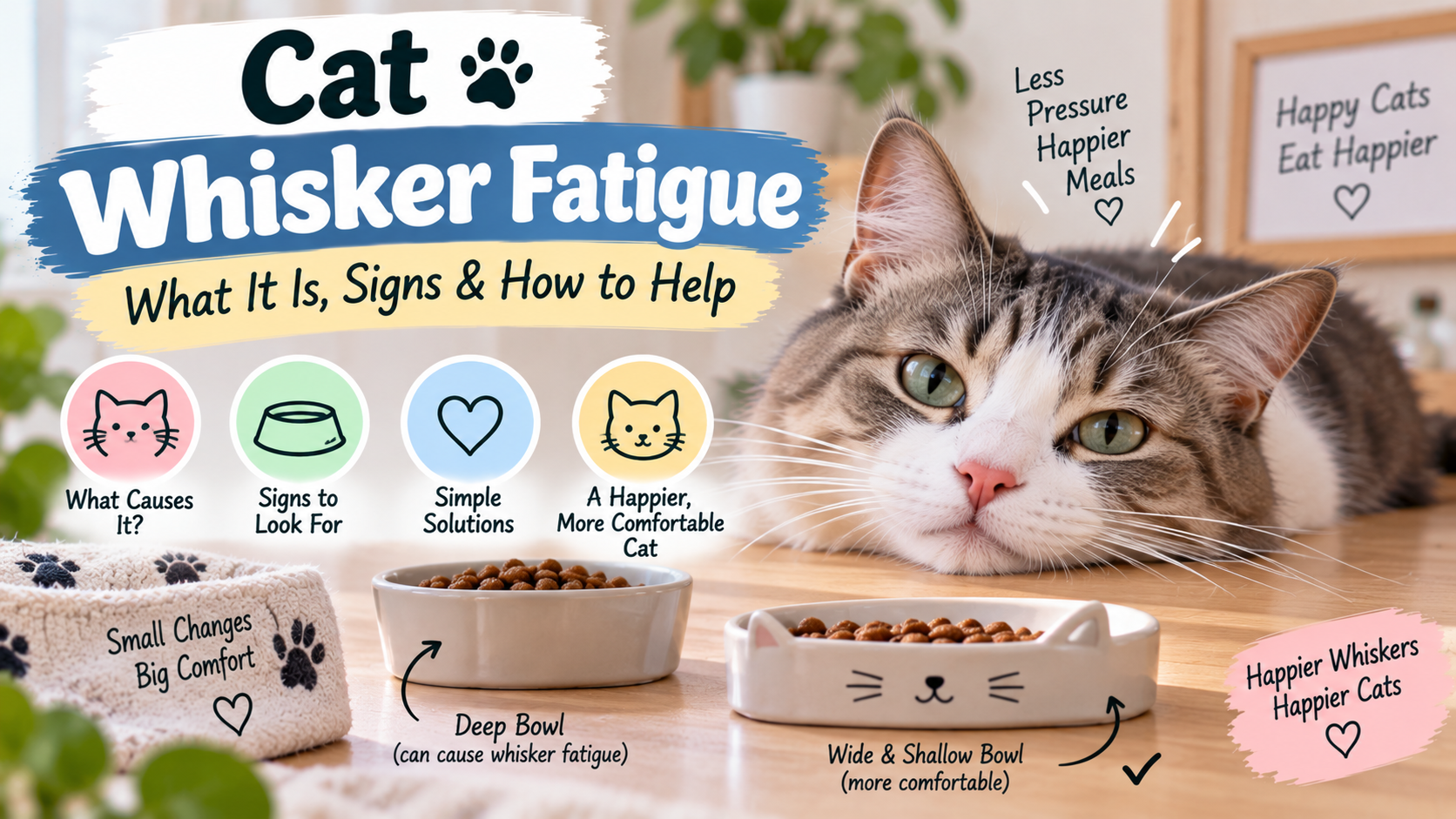
Cat whisker fatigue is it real? The short answer is: whisker-related stress or overstimulation may happen, but “whisker fatigue” is not a clearly established medical diagnosis.
Your cat’s whiskers are sensitive tools that help them judge spaces, detect nearby movement, and understand their surroundings. Because of that sensitivity, some cats may dislike having their whiskers repeatedly pressed against the sides of a food or water bowl. They may paw at the food, eat less comfortably, or walk away from a bowl they used to enjoy.
However, those signs can also come from dental pain, nausea, stress, an unappealing bowl, or another health problem. So it’s best to treat a whisker-friendly bowl as a simple comfort change—not as a substitute for veterinary care.
What Is Cat Whisker Fatigue?
“Whisker fatigue” is a common term used to describe possible discomfort or overstimulation when a cat’s facial whiskers repeatedly touch objects. The term often comes up when a cat seems reluctant to eat from a deep or narrow dish.
A cat’s whiskers, also called vibrissae, are thicker and more deeply rooted than ordinary hairs. Each whisker connects to sensitive nerve endings that help your cat notice nearby surfaces, air movement, and changes in their environment.
That doesn’t mean whiskers become tired in the same way your muscles do after exercise. A more accurate way to describe the concern is whisker sensitivity or whisker stress.
Why can a bowl bother some cats?
When a cat eats from a deep, narrow bowl, their cheeks and whiskers may brush the rim or sides. Some cats don’t seem to care. Others may find the repeated contact irritating, especially if the bowl is small or their face has to press into it to reach the food.
This may be more noticeable with cats that have:
- Long or especially prominent whiskers
- Flat faces or short noses
- A strong preference for certain bowls or feeding spots
- A history of becoming stressed by changes in their surroundings
- Food placed in a deep container that makes reaching difficult
Every cat is different. A cat with short whiskers may dislike a narrow bowl, while another cat with long whiskers may happily eat from one for years.
Is Whisker Fatigue a Real Medical Condition?
No. Whisker fatigue is not generally recognized as a specific veterinary disease or diagnosis. Still, the discomfort described by cat owners may be real for some individual cats.
The label can be useful when it encourages an owner to notice how a cat interacts with a bowl. But it can also be misleading if every change in eating behavior is blamed on whiskers.
A cat that suddenly refuses food may be experiencing mouth pain, illness, anxiety, or a problem with the food itself. Cats often hide signs of discomfort, so a change in eating habits deserves attention.
A good approach is to make an easy bowl adjustment while also watching your cat closely. If the problem continues, becomes worse, or affects how much your cat eats and drinks, contact a veterinarian.
Signs That Your Cat May Dislike Their Bowl
There is no single test for whisker stress. Instead, look for a pattern that happens around a particular dish or feeding setup.
Possible signs include:
- Pawing food out of the bowl before eating it
- Eating only from the middle or edges of the dish
- Dropping food onto the floor and eating it there
- Walking away from food that your cat usually likes
- Pacing around the bowl or appearing hesitant
- Flattening the ears or pulling the head back from the dish
- Rubbing the face after eating
- Preferring food placed on a flat plate
- Drinking more comfortably from a wide, shallow container
- Eating normally when food is offered in a different dish
One sign by itself doesn’t prove that whisker contact is the problem. For example, pawing at food can also mean your cat wants to move it to a preferred location, dislikes the food’s smell, or feels uncomfortable while chewing.
The most useful clue is often what happens after you change the feeding setup. If your cat begins eating more comfortably from a wide, shallow dish while everything else stays the same, the original bowl may have been part of the problem.
Whisker Fatigue Symptoms Versus Signs of Illness
A bowl-related issue usually has a fairly specific pattern: your cat appears interested in food but struggles with the dish, then eats more normally from another surface.
Health problems tend to cause broader changes. Your cat may eat less everywhere, lose interest in favorite treats, drool, chew on one side, vomit, hide, lose weight, or seem tired.
| What you notice | A bowl may be involved | A veterinary problem may be possible |
|---|---|---|
| Refuses one bowl but eats from a flat plate | More likely | Still monitor closely |
| Refuses all food | Less likely | Contact a veterinarian promptly |
| Pawing food out, then eating it | Possible | Could also be mouth pain or nausea |
| Drooling, bad breath, or trouble chewing | Unlikely to be only whiskers | Dental or other medical issue possible |
| Sudden appetite change | Not enough information | Needs careful attention |
| Hiding, vomiting, diarrhea, or weakness | Unlikely to be only whiskers | Veterinary advice is warranted |
This comparison is only a guide. Cats can have more than one issue at the same time. A cat may dislike a bowl and also have dental pain, for example.
How to Test Whether the Bowl Is the Problem
You can try a simple, low-risk bowl experiment at home. The goal is to change one thing at a time and observe your cat’s response.
1. Offer food on a wide, shallow dish
Use a clean, stable plate or a shallow cat dish. The food should be easy to reach without your cat pushing their face into a narrow container.
Avoid using a plate with sharp edges, cracks, or a slippery surface. If the plate slides across the floor, place it on a non-slip mat.
2. Keep the food the same
Don’t change the food and the bowl at the same time if you’re trying to identify the cause. A sudden food change can affect appetite and digestion, making the result harder to understand.
3. Watch the whole meal
Notice whether your cat approaches the dish, sniffs the food, takes a few bites, paws at it, or walks away. Also watch for chewing trouble, drooling, repeated swallowing, or signs of nausea.
4. Try a wide, shallow water bowl too
Some cats prefer a broad water dish because it’s easier to drink without touching the sides. Keep the bowl in a quiet spot away from litter boxes and busy walkways.
5. Clean the bowl regularly
Old food residue and smells can put cats off, even when the bowl looks clean. Wash food and water dishes often with mild dish soap and rinse them well.
If your cat eats normally from the shallow dish and shows no other concerning signs, continuing with that setup is reasonable. You don’t need to make the change more complicated than it needs to be.
What Kind of Bowl Is Best for a Cat With Possible Whisker Sensitivity?
The best bowl is one your cat can use comfortably and safely. In many cases, a wide, shallow bowl or flat plate works well because it allows easy access without pressing the whiskers against high sides.
Look for these features:
- A broad opening
- Low sides
- A stable, non-slip base
- Smooth surfaces that are easy to wash
- No sharp edges or chipped areas
- A size that lets your cat eat without crowding their face
Material can matter too, although individual preferences vary. Stainless steel, ceramic, and glass can all be practical choices when they are made for food use, kept clean, and free of cracks or damage.
Plastic bowls may hold scratches and odors over time. That doesn’t mean every plastic bowl causes a problem, but replacing a scratched or smelly dish is a sensible step.
Should the bowl be raised?
A raised bowl may help some cats, especially those that have difficulty bending down. But raising a bowl does not automatically solve whisker sensitivity. The opening still needs to be wide enough for comfortable eating.
Ask your veterinarian before making major feeding changes for a cat with arthritis, neck pain, swallowing problems, or another medical condition. The most comfortable height depends on the individual cat.
Other Reasons Your Cat May Avoid a Bowl
Before deciding that whisker fatigue explains the behavior, consider the other common possibilities.
Dental pain
Dental disease, sore gums, a damaged tooth, or mouth inflammation can make eating uncomfortable. A cat with mouth pain may drop food, chew slowly, drool, have bad breath, or prefer soft food.
Some cats continue to act hungry but struggle once they start eating. That pattern should not be dismissed as a bowl preference.
Food freshness and smell
Cats rely heavily on smell. Food that has been left out too long, stored poorly, or served at an unfamiliar temperature may be less appealing. Strong cleaning-product smells on a bowl can have the same effect.
Stress or an uncomfortable feeding location
A dish placed beside a noisy appliance, in a busy hallway, or near another animal may make mealtimes stressful. Some cats prefer to eat where they can see what is happening and leave easily if they feel threatened.
Try feeding your cat in a quiet area where other pets and people won’t crowd them.
Bowl movement or noise
A lightweight bowl that slides, tips, or clanks against the floor can scare a sensitive cat. A stable dish or a non-slip mat may help.
Nausea or another illness
Nausea, stomach problems, kidney disease, pain, and other medical conditions can change a cat’s appetite. A cat may sniff food, seem interested, and then turn away because eating makes them feel worse.
That pattern needs more attention than a simple bowl change, especially if it lasts or comes with other symptoms.
When Should You Call the Veterinarian?
Contact your veterinarian if your cat’s appetite changes suddenly, if they refuse food, or if eating appears painful. Don’t assume the cause is whisker fatigue just because your cat paws at food or avoids a deep bowl.
Seek veterinary advice promptly if you notice:
- Refusal to eat or a major drop in food intake
- Drooling or repeated lip-smacking
- Bad breath with chewing difficulty
- Blood in the mouth or food
- Vomiting or diarrhea
- Weight loss
- Unusual tiredness or hiding
- Trouble swallowing
- A swollen face or painful reaction when touched
- Changes that continue after switching to a shallow dish
Cats can become seriously unwell when they eat too little, and the risk is especially concerning for overweight cats. If you’re not sure how much your cat has eaten or how long the appetite change has lasted, call your veterinary clinic for guidance rather than waiting.
How to Make Mealtimes More Comfortable
A whisker-friendly bowl is only one part of a good feeding setup. These simple changes can help many cats feel more relaxed:
- Feed in a quiet place. Keep the dish away from loud machines, heavy foot traffic, and other pets that may rush your cat.
- Keep food and water fresh. Wash dishes regularly and replace stale water.
- Use separate food and water dishes. Some cats prefer not to have food floating in or sitting beside their water.
- Give each cat enough space. In multi-cat homes, feed cats apart if one cat guards the food or makes another nervous.
- Keep meals predictable. A familiar routine can make feeding feel safer.
- Avoid forcing your cat to eat. Pushing a cat’s face into a bowl can increase fear and make the problem harder to understand.
- Change one thing at a time. This makes it easier to see what actually helps.
You may also find that your cat prefers a plate for wet food but a different container for dry food. There’s no rule that says every meal has to use the same dish.
Can You Trim a Cat’s Whiskers?
No. Do not trim, shave, or pluck your cat’s whiskers. Whiskers are important sensory structures, and cutting them can interfere with how your cat understands nearby objects and spaces.
Whiskers naturally fall out and grow back over time, but intentionally removing them is not a way to treat possible whisker stress. If a whisker is accidentally cut, it usually grows back, but ask your veterinarian if the skin is injured or your cat seems disoriented.
The safer solution is to change the bowl or feeding environment, not the whiskers.
The Bottom Line: Cat Whisker Fatigue Is It Real?
Cat whisker fatigue is not a confirmed medical diagnosis, but some cats may experience discomfort or irritation from repeated whisker contact with narrow, deep bowls. A wide, shallow dish is an easy change that may help, and there is little downside when the dish is stable, clean, and safe.
Still, appetite changes should never automatically be blamed on whiskers. If your cat refuses food, seems painful while eating, loses weight, drools, vomits, or acts unwell, contact a veterinarian. The safest approach is to improve the feeding setup while staying alert for signs of a real health problem.