
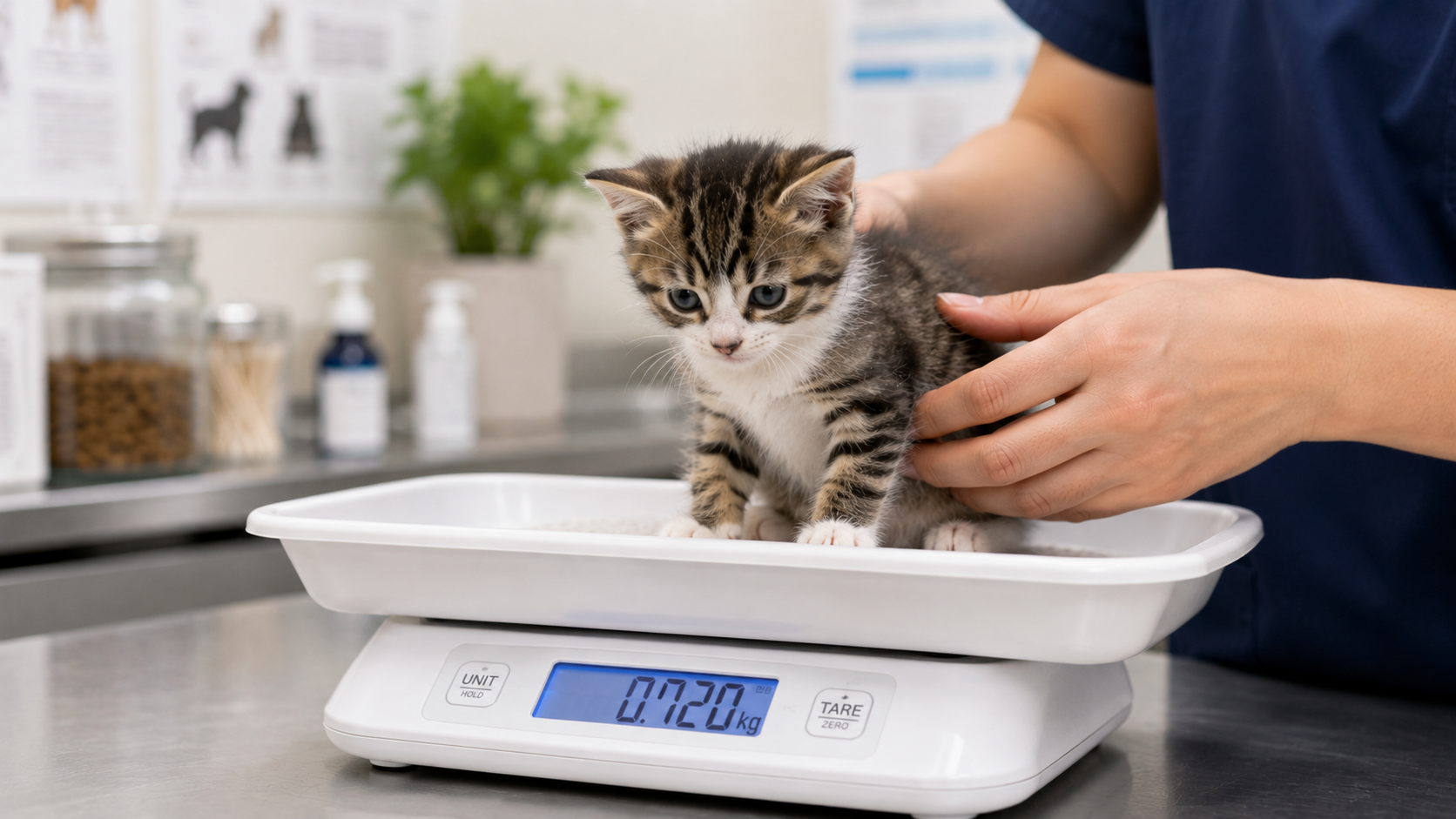
There’s no single fixed amount, kitten portions depend on current weight, the calorie density of the specific food, and growth stage. As a starting point, follow the feeding guidelines printed on your kitten’s food for their current weight, then adjust based on body condition every one to two weeks. A kitten with visible ribs and no waist may need more; one with a barely felt waist may need less. Lets checkout how much should a kitten eat?
Key Takeaways
- Bag feeding guidelines are a starting point based on weight, not a fixed rule for your individual kitten.
- Body condition, feeling the ribs and waist, is a more reliable ongoing check than weight alone.
- Kittens need more calories per pound than adult cats because they’re actively growing.
- Wet and dry food differ significantly in calorie density, so portions aren’t interchangeable by volume.
- Recheck portion size roughly every two weeks during the first six months.
- Sudden appetite loss (12+ hours without eating) needs veterinary attention, not a portion adjustment.
Why Bag Instructions Are a Starting Point, Not a Rule
Every kitten food package includes feeding guidelines, usually organized by weight. These are a reasonable starting point because they’re based on the food’s actual calorie content, but they’re built for an average kitten, and your kitten’s metabolism, activity level, and growth rate may run higher or lower than average.
The practical approach: measure out what the package recommends for your kitten’s current weight, feed that for one to two weeks, then check body condition rather than assuming the number is fixed. If your kitten is gaining well and staying lean, the amount is working. If not, it’s worth adjusting rather than sticking to the label out of habit.
The Body Condition Check That Matters More Than the Scale
Weight alone can be misleading, since a kitten’s healthy weight range shifts constantly during growth. Body condition, what you can see and feel, is a more reliable everyday check.
| Body Condition | What You’ll Feel or See | Feeding Adjustment |
|---|---|---|
| Ribs easily visible, little fat cover | Kitten may be underfed for current growth stage | Consider increasing portion slightly and monitor over a week |
| Ribs felt easily under a thin layer of fat, waist visible from above | Typical healthy range for a growing kitten | Continue current amount, recheck in two weeks |
| Ribs harder to feel, waist less defined | May be slightly overfed, or normal during a growth spurt | Monitor for a few more days before adjusting |
| Ribs difficult to feel, no waist visible | Likely overfed for current activity level | Reduce portion gradually and discuss with your vet if it persists |
Running your hands gently along your kitten’s sides periodically, not just glancing at them, gives a clearer picture than weight numbers alone, especially since growing kittens naturally look leaner some weeks and rounder during growth spurts.
Why Kittens Need More Calories Per Pound Than Adult Cats
A kitten’s calorie needs per pound of body weight are substantially higher than an adult cat’s, since they’re simultaneously building muscle, bone, and organs while fueling high activity levels. This is the underlying reason kitten-specific formulas are calorie-dense compared to adult maintenance food, and why feeding an adult-formula amount to a kitten, even by weight, would generally undersupply their growth needs.
This need gradually decreases as kittens approach their first birthday and growth slows, which is part of why feeding guidelines change by age as well as weight.
Wet Food, Dry Food, and Why Portions Aren’t Interchangeable by Volume
Wet and dry kitten food differ enough in calorie density that you can’t simply match volumes between them. A cup of dry kibble contains meaningfully more calories than a cup of wet food, largely because wet food is mostly water. If you’re feeding a combination of both, this matters: doubling up a “normal” portion of each isn’t accounted for on either bag’s label individually.
The workaround is straightforward. Check the calories per serving on both packages, and treat portions as calorie budgets split between the two foods rather than as two separate full portions. A veterinarian can help set an approximate daily calorie target for your kitten’s weight and activity level if you want more precision than trial-and-adjustment offers. An online kitten calorie calculator can offer a starting estimate too, though it’s built on population averages the same way bag guidelines are.
Signs Your Current Portion Isn’t Quite Right
A kitten who seems constantly hungry between meals, cries persistently at feeding times, or has slowed weight gain over a couple of weeks may need a modest increase. A kitten gaining weight quickly without a corresponding growth spurt, or whose waist has disappeared, may be getting more than needed. Neither situation is usually urgent on its own, it’s the kind of thing to adjust gradually and recheck, not a sign something has gone seriously wrong.
Sudden appetite loss is a different category. A kitten who refuses to eat for more than 12 hours, seems lethargic, or shows other signs of illness needs veterinary attention rather than a portion adjustment, since kittens have limited energy reserves and can decline faster than adult cats when they stop eating.
Common Questions About Kitten Portions
Should I free-feed my kitten or measure out meals?
Measured meals make it far easier to track whether portions need adjusting. Free-feeding can work for some kittens, but it makes overfeeding harder to catch early, particularly in multi-cat households.
Is it normal for a kitten’s appetite to change week to week?
Yes. Growth happens in spurts rather than a steady line, so appetite naturally fluctuates. Consistent, sustained changes are more meaningful than day-to-day variation.
Can I use an online kitten calorie calculator?
These can give a reasonable starting estimate based on weight and age, but they’re built on population averages, similar to bag guidelines. Treat the result as a starting point to adjust from, not a fixed target.
How often should I recheck my kitten’s portion size?
Roughly every two weeks during the first six months works well, since that’s often enough time to see whether weight gain and body condition are tracking appropriately.
Do different breeds need different portion sizes?
Larger breeds that grow for longer, such as Maine Coons, may need adjusted portions later in their first year compared to smaller breeds. Body condition and a vet’s guidance matter more than breed alone.
Is it possible to overfeed a kitten trying to help it grow faster?
Yes. Faster weight gain isn’t the goal, appropriate, steady growth is. Overfeeding a kitten doesn’t accelerate healthy development and can lead to excess weight gain instead.
What if my kitten finishes its portion instantly and still seems hungry?
This is worth watching over a few days rather than reacting to a single meal. If it’s consistent alongside a lean body condition, a modest increase is reasonable.
Should portion size change after spaying or neutering?
Some kittens become slightly less active after the procedure, which can affect how many calories they actually need. Monitoring body condition afterward is a reasonable way to catch any drift early.
When should I switch from kitten portions to adult portions?
Most kittens transition to adult food and portion sizes around their first birthday, though larger breeds may need a longer growth period, a detail worth confirming with your veterinarian.
Getting the Amount Right Over Time
Portion size for a kitten isn’t a number you set once, it’s a starting estimate from the food label that you adjust based on how your kitten actually looks and grows. Checking body condition every couple of weeks will tell you more than any chart alone. If your kitten’s weight gain stalls, accelerates unexpectedly, or their appetite changes suddenly, that’s worth a conversation with your veterinarian rather than a guess at the right fix.
Refferences
World Small Animal Veterinary Association (WSAVA)
Cornell Feline Health Center
Association of American Feed Control Officials (AAFCO)