
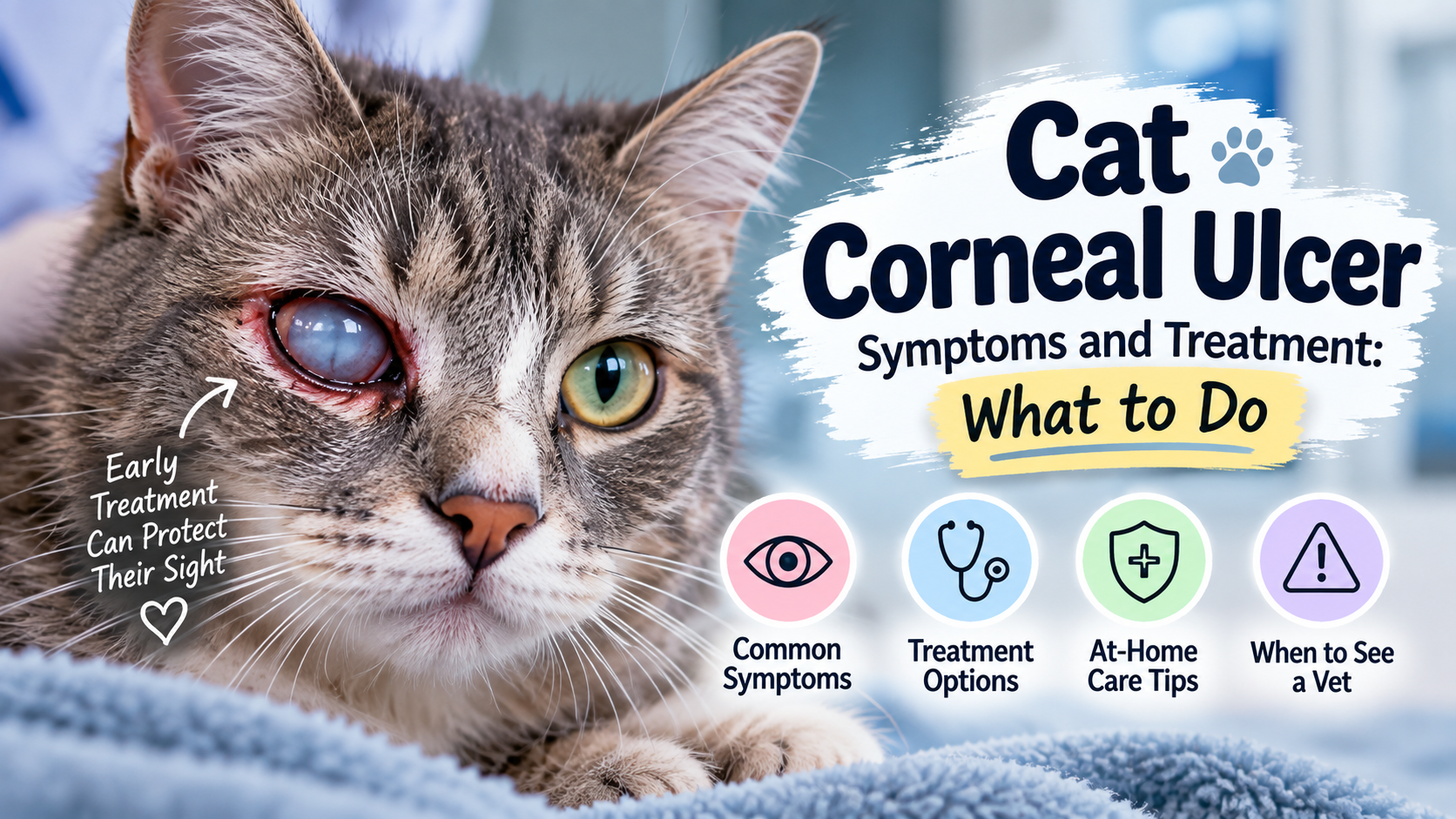
A corneal ulcer is a painful wound on the clear outer surface of a cat’s eye. Common cat corneal ulcer symptoms include squinting, keeping the eye closed, excessive tearing, redness, light sensitivity, and rubbing the face. Some ulcers are small and heal quickly with treatment, while deeper ulcers can damage the eye and threaten vision.
A suspected corneal ulcer needs a veterinary examination. Eye problems can worsen quickly, and an eye that looks only mildly irritated may still have a serious injury underneath. Don’t use leftover eye drops or human medication unless your veterinarian specifically tells you to do so.
What is a corneal ulcer in a cat?
The cornea is the clear, curved layer covering the front of the eye. It helps protect the eye and allows light to enter. A corneal ulcer happens when the outer layer of the cornea is scraped, damaged, or destroyed.
You can think of it as a scratch or open sore on the surface of the eye. Because the cornea contains many sensitive nerves, even a small ulcer can hurt a lot.
A corneal ulcer may develop after:
- A scratch from another cat, a plant, or a sharp object
- Dust, grit, fur, or another irritant trapped in the eye
- A viral eye infection, especially feline herpesvirus
- Bacterial infection
- Dry eye or poor tear production
- Eyelashes or eyelids rubbing against the cornea
- An eyelid that rolls inward, known as entropion
- A problem that prevents the eyelids from closing normally
- Chemical exposure or other trauma
Some cats, including those with flat faces and prominent eyes, may be more vulnerable to corneal injuries. Still, any cat can develop an ulcer.
Cat corneal ulcer symptoms to watch for
The signs can vary depending on the ulcer’s depth, location, and cause. A cat may show only one or two symptoms at first.
1. Squinting or holding the eye closed
This is one of the most common signs. Your cat may squint constantly, blink more than usual, or refuse to open the affected eye. Eye pain often causes this protective response.
2. Excessive tearing or eye discharge
The eye may water much more than normal. Discharge can be clear and watery, or it may become thick and yellowish if infection is present. Tears running down the face can also irritate the skin below the eye.
3. Redness and swelling
The white part of the eye or the pink tissue around it may look red. The eyelids may become swollen, and the third eyelid—a pale membrane in the inner corner—may partly cover the eye.
4. Cloudiness or a visible spot on the cornea
The clear surface of the eye may look hazy, blue-gray, or cloudy. You might see a small white or gray spot. However, ulcers are not always visible at home. A normal-looking cornea does not rule one out.
5. Sensitivity to light
A cat with a painful eye may hide in dark areas, turn away from bright windows, or keep the eye tightly shut in sunlight. Light sensitivity is a reason to arrange veterinary care promptly.
6. Rubbing or pawing at the face
Your cat may rub the eye against furniture, carpet, or their paw. This can make the ulcer deeper, introduce bacteria, or cause additional damage. Preventing rubbing is one of the most useful things you can do while waiting for an appointment.
7. Behavior changes
Eye pain may cause a cat to hide, become less active, eat less, or act unusually irritable. Some cats become quiet rather than showing obvious distress.
8. Changes in vision
Your cat may bump into objects, hesitate on stairs, or seem unsure in unfamiliar rooms. Vision changes are especially concerning and require prompt veterinary assessment.
How urgent is a cat corneal ulcer?
Any suspected corneal ulcer should be checked by a veterinarian as soon as possible. Go to an emergency veterinary clinic or seek same-day care if the eye is severely swollen, cloudy, bleeding, bulging, or has a visible deep wound.
Urgent care is also needed if your cat:
- Cannot open the eye
- Has sudden vision problems
- Is repeatedly rubbing or scratching the eye
- Has thick yellow, green, or bloody discharge
- Seems severely painful or unusually quiet
- Has experienced a fight, chemical exposure, or penetrating injury
- Has a foreign object stuck in or near the eye
- Has a rapidly worsening eye problem
A deep ulcer can lead to a weakened cornea, leakage of eye fluid, or loss of the eye in severe cases. This is why waiting to see whether it improves on its own can be risky.
How veterinarians diagnose a corneal ulcer
A veterinarian will examine the eye and may check the eyelids, tear production, pupils, and the rest of the eye. The most common test for an ulcer uses fluorescein stain.
Fluorescein is a special dye that usually does not stick to healthy corneal tissue. It collects in damaged areas and makes an ulcer easier to see under a blue light. The test is quick and commonly performed during an eye examination.
Your veterinarian may also look for the reason the ulcer developed. For example, they may check for:
- A scratch or foreign material
- Eyelid abnormalities
- Poor tear production
- Signs of feline herpesvirus
- Infection or inflammation
- Problems with the eye’s ability to close and protect itself
Very deep or complicated ulcers may require additional testing or examination by a veterinary ophthalmologist.
Cat corneal ulcer treatment options
Treatment depends on how deep the ulcer is and what caused it. The goal is to control infection, reduce pain, protect the eye, and support healing.
Antibiotic eye medication
A veterinarian may prescribe antibiotic drops or ointment to help prevent or treat a bacterial infection. Use the medication exactly as directed, even if the eye appears better after a few doses.
Do not share eye medication between pets. A medicine that helped one cat may be wrong for another, especially if the ulcer has a different cause.
Antiviral treatment
If feline herpesvirus is suspected, your veterinarian may recommend antiviral medication. Herpesvirus can cause eye ulcers and may flare during periods of stress or illness. Antibiotics do not treat the virus itself, although they may be prescribed if a secondary bacterial infection is also present.
Pain relief
Corneal ulcers can be very painful. Your veterinarian may prescribe pain medication or a drug to reduce painful muscle spasms inside the eye. Never give human pain relievers unless a veterinarian specifically directs you to do so. Several common human medications can be dangerous or fatal to cats.
An Elizabethan collar
An e-collar, sometimes called a cone, helps stop your cat from rubbing the eye. It may be inconvenient, but rubbing can turn a small ulcer into a serious injury. Make sure your cat can eat, drink, and use the litter box comfortably while wearing it.
Treatment for the underlying problem
If dry eye, an eyelid abnormality, or trapped debris caused the ulcer, that problem must be treated too. Otherwise, the ulcer may heal slowly or return.
Surgery for deep or nonhealing ulcers
Some ulcers are too deep or unstable to heal safely with medication alone. A veterinary ophthalmologist may recommend surgery or a protective procedure to support the cornea. The exact approach depends on the injury and the condition of the eye.
Surgery is more likely to be considered when an ulcer is rapidly deepening, does not respond to medication, has caused a weakened area, or threatens the eye’s structure.
What to do at home while waiting for the vet
You cannot safely diagnose or treat a corneal ulcer at home, but you can protect your cat’s eye until they are examined.
- Keep your cat indoors. This reduces exposure to dust, plants, fights, and further injury.
- Use an e-collar if you have one and your cat is rubbing. Introduce it calmly and check that it fits properly.
- Keep the room comfortably dim. Bright light may be uncomfortable.
- Follow prescribed instructions carefully. Wash your hands before and after applying eye medication.
- Give each eye medication separately if more than one was prescribed. Ask your veterinarian how long to wait between products.
- Keep the eye area clean on the outside. You can gently wipe discharge from the fur with clean, damp cotton or gauze. Don’t scrub the eyeball or press on the eye.
- Attend follow-up appointments. The ulcer may need another fluorescein stain to confirm that it has healed.
Do not try to remove a deeply embedded object. Do not put contact lens solution, herbal products, essential oils, or non-prescribed drops in the eye.
Eye medications to avoid
Some eye drops can make a corneal ulcer much worse. In particular, steroid eye medications should not be used unless a veterinarian has examined the eye and specifically prescribed them for that situation. Steroids can slow healing and increase the risk of serious complications in certain ulcers, especially those linked to infection.
Numbing eye drops can also be harmful when used repeatedly outside a veterinary setting. Human redness-relief drops are not appropriate for cats and may irritate the eye or mask worsening pain.
If you already used a product, tell your veterinarian exactly what it was, how much you used, and when you gave it.
How long does a cat corneal ulcer take to heal?
A small, uncomplicated ulcer may improve within several days and heal within about a week or two, but healing time varies. Deeper ulcers, infected ulcers, herpesvirus-related ulcers, and ulcers caused by dry eye or eyelid problems may take longer.
Improvement does not always mean the ulcer is fully healed. Your cat may open the eye more while a damaged area is still present. Follow-up testing is often needed to confirm healing.
Contact your veterinarian if the eye looks worse, your cat becomes more painful, discharge increases, or your cat starts rubbing again. Never stop treatment early just because symptoms have improved.
Can a cat corneal ulcer heal on its own?
A very minor surface injury may heal without complications, but you cannot reliably tell at home whether an injury is minor. A true corneal ulcer can deepen quickly, particularly when infection, herpesvirus, dry eye, or rubbing is involved.
The safest approach is to have any painful, squinting, cloudy, or unusually watery eye examined. Early treatment is usually simpler than treatment for a deep or infected ulcer.
Preventing future corneal ulcers
Not every ulcer can be prevented, but a few habits can lower the risk and help you catch problems early:
- Keep sharp objects, irritating cleaners, and loose debris away from your cat’s environment.
- Trim your cat’s nails if needed, or ask a veterinary professional for help.
- Separate cats that are fighting and provide gradual introductions for new pets.
- Keep up with routine veterinary care, especially if your cat has recurring eye problems.
- Ask your veterinarian about recurring herpesvirus signs or chronic eye discharge.
- Watch for eyelid or eyelash problems that repeatedly rub the eye.
- Arrange care early when your cat starts squinting or tearing.
If one cat in a multi-cat home has an infectious eye problem, ask your veterinarian whether the other cats need monitoring or treatment.
Cat corneal ulcer symptoms and treatment: quick guide
| What you notice | What it may mean | What to do |
|---|---|---|
| Squinting or a closed eye | Eye pain or irritation | Arrange a prompt veterinary examination |
| Watery discharge | Irritation, injury, or infection | Don’t use unprescribed drops; contact your vet |
| Cloudy or blue-gray cornea | Corneal swelling or damage | Seek same-day veterinary advice |
| Pawing at the eye | Pain and risk of further injury | Use an e-collar if possible and seek care |
| Thick discharge or severe redness | Possible infection or inflammation | Get prompt veterinary care |
| Bulging, bleeding, or a deep-looking wound | Potential emergency | Go to an emergency veterinary clinic |
Final takeaways
The main cat corneal ulcer symptoms are squinting, holding the eye closed, tearing, redness, light sensitivity, cloudiness, discharge, and rubbing at the face. These signs can have other causes, but a corneal ulcer is painful and can become serious without treatment.
Have your cat examined promptly rather than trying human eye drops or waiting several days. Veterinary treatment may include antibiotic or antiviral medication, pain relief, an e-collar, treatment for an underlying problem, or surgery for a deep ulcer. With early care and careful follow-up, many cats recover well.