
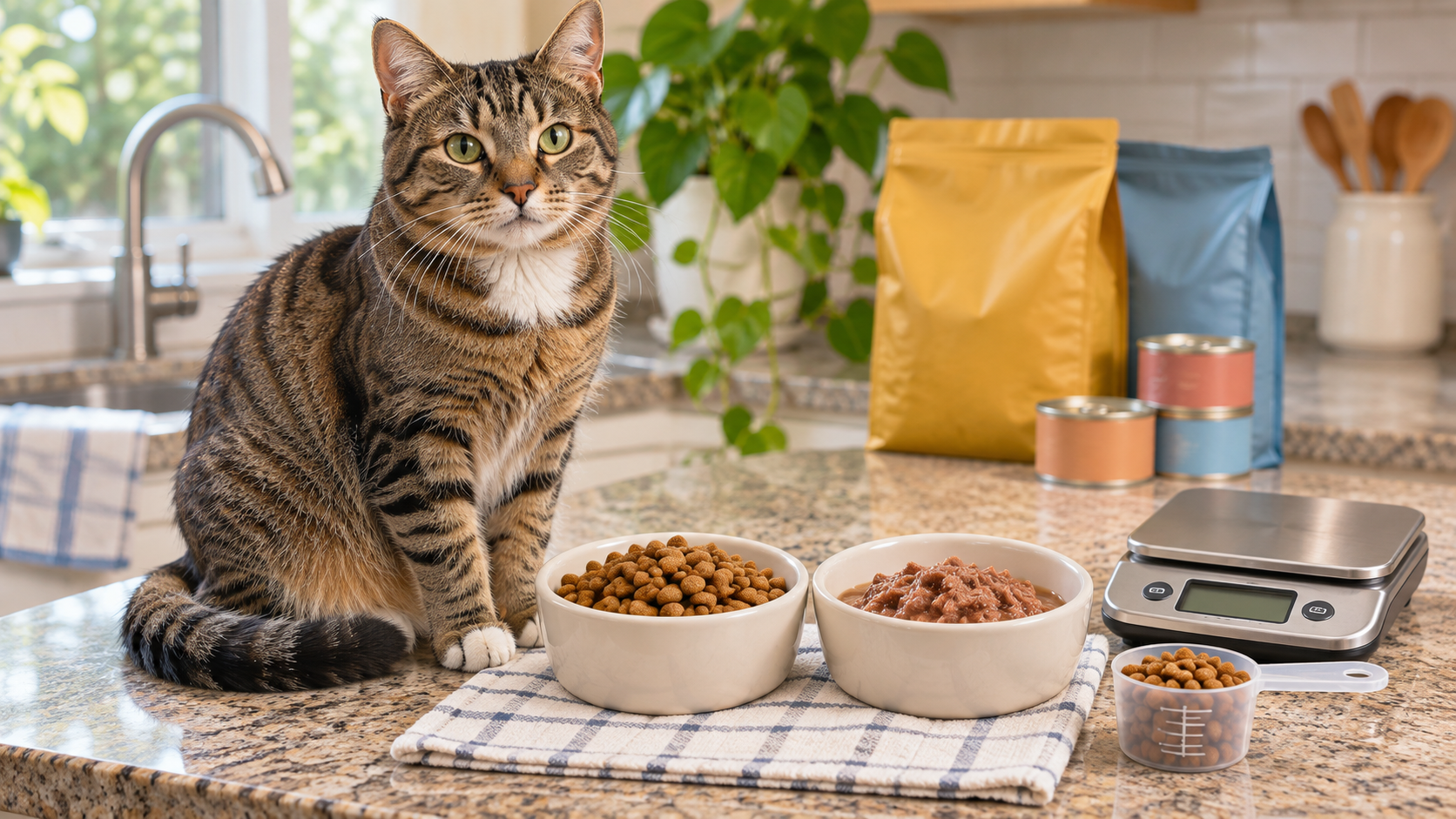
A bag of cat food can look like a bargain until you realize how quickly it disappears. A cheaper can may also cost more per meal than you expected. If you’re shopping for affordable cat food, the best place to start isn’t the front of the package. It’s the nutrition statement, calorie count, and what you’ll spend to feed your cat consistently.
Quick Answer: Choose a food labeled complete and balanced for your cat’s life stage, then compare its cost per 100 calories. In the US price examples below, dry food costs roughly $0.07 to $0.13 per 100 calories, while two common canned foods cost about $0.47 and $1.05. A measured combination can make wet food easier to afford without treating it as nutritionally superior to every dry formula.
Key Takeaways
- A lower price per bag or can does not always mean a lower feeding cost. Compare calories, not just package size.
- Check the AAFCO nutritional adequacy statement for adult maintenance, growth, or all life stages before comparing prices.
- Dry food is generally cheaper per calorie in the examples below. Canned food provides considerably more moisture.
- You can combine complete dry and wet foods if you count both toward the same daily calorie allowance.
- Kittens need a growth-appropriate diet. Don’t choose an adult-maintenance food only because it’s on sale.
- Marketing words such as premium, grain-free, and human-grade aren’t a shortcut to nutritional quality.
What Does Affordable Cat Food Actually Cost in 2026?
Let’s compare specific products rather than vague estimates. The figures below use regular one-time prices displayed on US Chewy listings reviewed on November 9, 2026, excluding sales subscriptions, tax, and shipping. Retail prices can change, and a product may be cheaper at another store. These are shopping examples, not a ranking of nutritional quality.
| Food and package | Listed package price | Calories used | Cost per 100 calories | Example 30-day cost* |
|---|---|---|---|---|
| Meow Mix Original Choice Dry, 22 lb | $24.58 (check the latest price on amazon) | 3,500 kcal/kg | $0.070 | $4.22 |
| Purina Cat Chow Complete Dry, 20 lb | $24.38 (check the latest price on amazon) | 3,688 kcal/kg | $0.073 | $4.37 |
| IAMS Proactive Health Healthy Adult Dry, 16 lb | $33.98 (check the latest price on amazon) | 3,750 kcal/kg | $0.125 | $7.49 |
| Friskies Classic Pâté Mixed Grill, 24 × 5.5 oz | $20.16 (check the latest price on amazon) | 179 kcal/can | $0.469 | $28.16 |
| Fancy Feast Classic Pâté Chicken Feast, 24 × 3 oz | $22.86 | 91 kcal/can | $1.047 | $62.80 |
The 30-day column assumes a hypothetical 200 calories per day, or 6,000 calories per month, entirely from that food. It is a price-comparison example, not a feeding recommendation. Your cat may need considerably more or less. Calculations assume all purchased food is eaten, with no waste or price changes; actual cash spent at checkout will reflect whole packages.
What the price per serving tells you
A can of Friskies in the example case costs $0.84, while a Fancy Feast can costs about $0.95. The prices per can look close, but the cans are different sizes and contain 179 versus 91 calories. That’s why their cost per 100 calories is so different.
Dry food can be compared the same way. Two bags with similar shelf prices may provide different amounts of food energy, and feeding a fixed number of cups can be misleading because calories per cup vary.
How to Calculate Cost per 100 Calories
Use the calorie statement on the bag or can. The AAFCO label guide explains where to find calories per kilogram and per familiar serving, such as a cup or can.
For canned food: Divide the case price by the number of cans to find the price per can. Then divide that price by the calories in one can and multiply by 100.
For the Friskies example: $20.16 ÷ 24 = $0.84 per can. At 179 calories per can, $0.84 ÷ 179 × 100 = about $0.47 per 100 calories.
For dry food: Convert the bag weight from pounds to kilograms (1 lb is about 0.4536 kg). Multiply the kilograms by the label’s kcal/kg to find calories in the bag. Divide the bag price by the total calories, then multiply by 100.
If math isn’t your favorite part of shopping, compare just two or three options at a time. Keep the exact formula and package size together, because a different flavor or bag size may change the answer.
Cheap Wet Cat Food vs. Affordable Dry Cat Food
Dry food usually stretches further per dollar because it contains much less water. That doesn’t make canned food a waste of money. According to Cornell’s feline feeding guidance, canned cat food contains at least 75% moisture and can contribute substantially to a cat’s water intake. Fresh drinking water should always be available regardless of the diet.
| Factor | Dry food | Wet food |
|---|---|---|
| Cost in our examples | About $0.07 to $0.13 per 100 kcal | About $0.47 to $1.05 per 100 kcal |
| Moisture | Low | High |
| Storage after opening | Keep sealed in a cool, dry place | Refrigerate unused portions promptly |
| Portion control | Weigh kibble or measure consistently | Check kcal per can or pouch |
| Best fit | Often easier for tight budgets | Useful when a higher-moisture diet is preferred or advised |
Neither format is automatically the right choice for every cat. A cat with a medical condition may need a particular diet, and a cat that struggles to chew might need a different texture. Ask your veterinarian before replacing a prescribed food solely to save money.
Three Monthly Feeding Budgets That Add Up
You don’t have to choose between all dry and all wet. Using the Cat Chow and Friskies prices above, here are three illustrative ways to supply 200 calories a day. Each plan assumes both foods are appropriate for the individual adult cat and that all food served is eaten.
| Feeding combination | Dry kcal/day | Wet kcal/day | Approximate 30-day food cost |
|---|---|---|---|
| Dry only | 200 | 0 | $4.37 |
| Mostly dry, some wet | 150 | 50 | $10.32 |
| Half dry, half wet | 100 | 100 | $16.26 |
| Wet only | 0 | 200 | $28.16 |
These are cost allocations, not preset meal plans. Fifty wet-food calories are about 28% of the example 179-calorie can, so you would need to refrigerate the unused portion safely. Waste, delivery charges, local tax, and a cat’s actual energy requirements can make the real bill higher. A smaller bag may also cost more per calorie, even though it’s easier to pay for upfront.
When combining foods, count both toward the same daily total instead of adding a full can to your cat’s normal full serving of kibble. For help planning meal times without extra calories, read our guide to feeding cats multiple times a day.
How to Tell if Budget Cat Food Is Complete and Balanced
Before comparing unit costs, look on the back or side of the package for the nutritional adequacy statement. The FDA’s guide to complete and balanced pet food explains that the statement should identify whether the food meets recognized nutrient profiles or is supported by feeding trials. These are useful minimum safeguards, not a guarantee that one food is the best choice for every cat.
Check three things:
- Life stage: Look for adult maintenance if you’re feeding a healthy adult, or growth or all life stages for a kitten.
- Feeding purpose: Make sure the food is intended as a complete diet, not labeled for intermittent or supplemental feeding only.
- Calorie content: Find kcal per cup, can, or kilogram so you can calculate appropriate portions and costs.
A food marketed as a gravy topper or a lickable treat may be fine as an occasional extra, but it shouldn’t replace a complete meal unless its adequacy statement supports that use. Ask the manufacturer for details if the label is unclear.
Affordable Kitten Food Is a Different Shopping Decision
Kittens need food formulated for growth, and their calorie needs change rapidly as they develop. A cheap adult-maintenance formula is not an appropriate substitute just because the bag is larger.
For illustration, Chewy listed Kitten Chow Year One Essentials Dry, 14 lb at $17.12, while a case of Fancy Feast Kitten Tender Ocean Whitefish, 24 × 3 oz was $23.04, or $0.96 per 90-calorie can. These products illustrate different upfront and per-serving costs, not interchangeable daily feeding amounts.
For kittens, compare growth-appropriate formulas first, then calorie density and price. Don’t use the hypothetical adult 200-calorie budget above as a kitten feeding plan. Your kitten’s age, weight, growth, and feeding schedule matter. Our wet food guide for kittens explains what to check when shopping for a growing cat.
Food Marketing Claims That Can Push Up Your Bill
Fancy packaging can make an ordinary shopping trip feel like a test of how much you love your cat. But the Tufts veterinary nutrition team cautions that a higher price doesn’t automatically mean better nutrition, and that ingredient lists alone are a poor way to judge food quality.
- “Premium” or “holistic”: Treat these as marketing descriptions, not proof of a superior nutrient profile.
- “Grain-free”: This doesn’t automatically mean better or more appropriate for cats. Grains can contribute useful nutrients in a correctly formulated food.
- “Real meat first”: Ingredient order reflects weight, including water. It doesn’t tell you whether the finished diet meets your cat’s needs.
- “By-product-free”: The absence of by-products isn’t itself proof of higher quality. Properly sourced and processed animal by-products can provide nutrients.
- “High protein”: Compare nutrient information carefully. Wet and dry protein percentages aren’t directly comparable unless moisture is accounted for.
A clear adequacy statement, transparent manufacturer information, appropriate calories, and a food your cat consistently tolerates are more useful than a slogan on the front of the package.
Eight Ways to Save Without Sacrificing Nutrition
- Compare cost per 100 calories. It reveals value that a price tag per pound or can may hide.
- Check several bag sizes. Large bags often cost less per calorie, but only if you can store the food safely and finish it while fresh.
- Compare regular prices first. Autoship and first-order promotions can make a subscription look cheaper than it will be later.
- Try a small package before buying bulk. A rejected 20-pound bag is no bargain.
- Measure daily portions. Overfilling the bowl wastes money and may contribute to weight gain.
- Use wet food strategically if appropriate. A smaller measured serving alongside a complete dry diet may fit your budget better than canned food alone.
- Store food properly. The FDA recommends keeping dry food in its original bag and promptly refrigerating or discarding unused canned food.
- Change diets gradually. Avoid unnecessary waste and digestive upset by following our safe cat food transition guide instead of switching overnight whenever a sale appears.
When the Cheapest Food Is Not the Right Food
If your cat has kidney disease, diabetes, allergies, urinary problems, or another diagnosed condition, a veterinarian may recommend a therapeutic diet. Don’t replace it with an ordinary budget formula without guidance. The cheapest bag can become an expensive decision if it doesn’t meet the cat’s medical needs.
Watch for unexplained weight loss, persistent vomiting or diarrhea, difficulty chewing, or changes in thirst and appetite. Those signs call for a veterinary assessment, not just another brand comparison. For older cats, our senior cat food guide explains why health and weight trends matter more than the word senior on a bag.
Frequently Asked Questions About Affordable Cat Food
Can cheap cat food still be healthy?
Yes. A lower-priced food can provide appropriate nutrition when it is complete and balanced for the cat’s life stage and suits the cat’s health needs. Price alone doesn’t establish nutritional quality.
Is wet or dry cat food cheaper per month?
Dry food is substantially cheaper per calorie in the US examples above. Wet food contributes more moisture, so the decision isn’t only about price. Compare the actual products and your cat’s needs rather than assuming all wet or dry foods cost the same.
What is the cheapest way to add wet food?
If your veterinarian agrees that mixed feeding is appropriate, replace some daily dry-food calories with a small amount of complete wet food. Count the calories from both foods and refrigerate leftovers promptly.
Can I feed my kitten inexpensive adult cat food?
Not if the formula is labeled only for adult maintenance. Look for a food suitable for growth or all life stages, and ask your veterinarian about feeding amounts.
Are store-brand foods automatically worse?
No. Judge the specific formula’s nutritional adequacy, life stage, calorie information, manufacturer transparency, and how your cat does on it. Avoid assuming that an unknown store brand is adequate without checking the label.
How do I budget for two cats?
Work out each cat’s calorie needs separately, then calculate the combined monthly cost. Two cats may eat different amounts, and one may require a special diet. Don’t simply double a generic feeding recommendation.
Buy the Food Your Cat Can Thrive On, Not the Label You Can Brag About
Start with two or three complete and balanced foods suitable for your cat. Compare their cost per 100 calories and estimate a full month’s feeding cost. Then choose an option you can afford consistently, that your cat will eat, and that fits any veterinary advice you’ve received.
A reliable budget plan isn’t about buying the cheapest bag once. It’s about keeping your cat fed appropriately next month, too.