
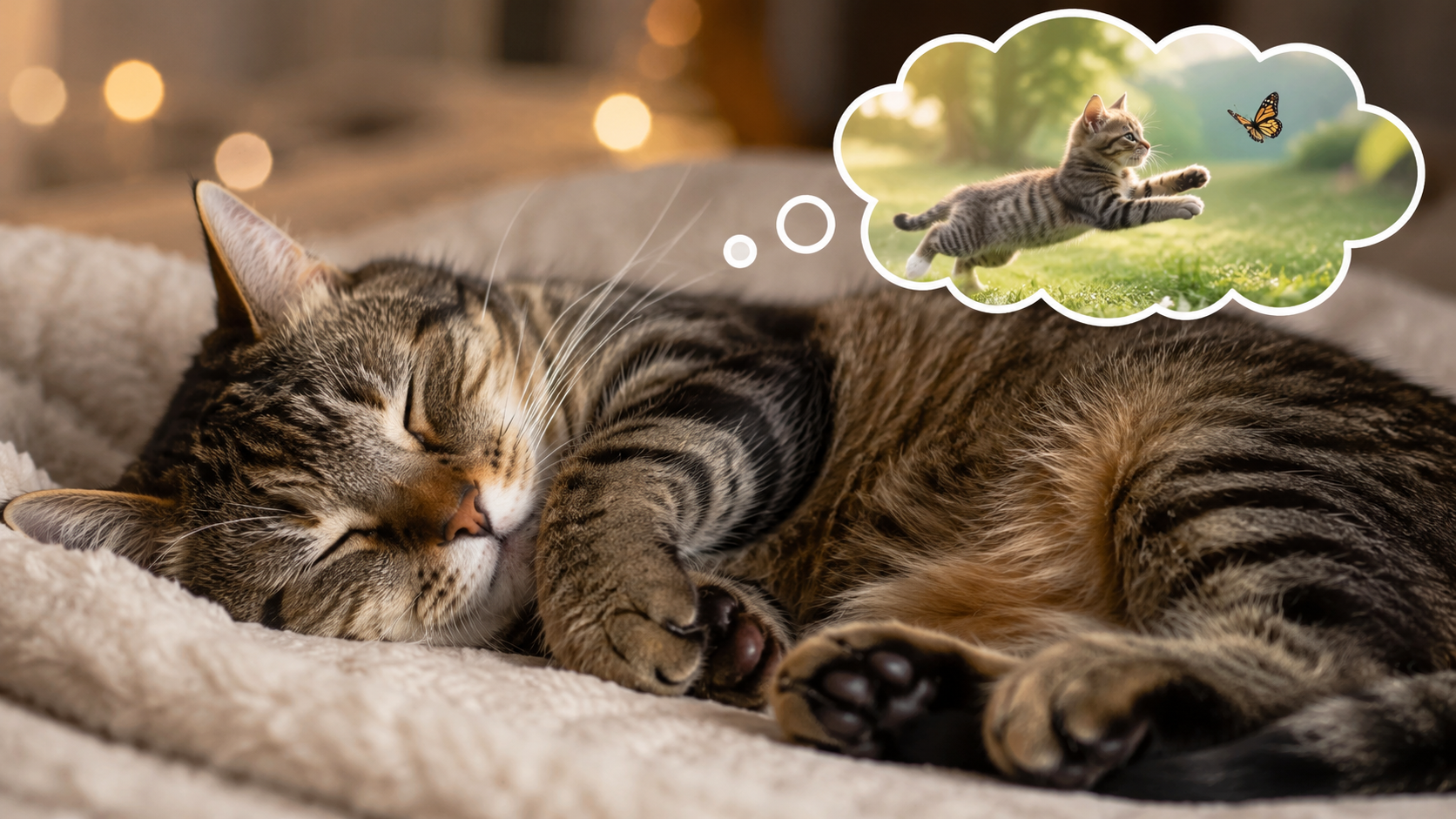
Have you ever watched your cat sleeping and noticed their paws twitching, whiskers moving, or ears flicking? You may have wondered, what do cats dream about when they twitch?
The short answer is that we cannot know exactly what a cat dreams about. Cats experience REM sleep, the stage of sleep associated with dreaming in humans, and small movements such as paw twitching or muscle twitches can occur during sleep.
Your cat may be processing experiences from its waking life, such as playing, exploring, or chasing something. However, these are reasonable possibilities, not something scientists can confirm by watching a sleeping cat.
Most gentle, occasional twitching during sleep is normal. The important thing is knowing how to distinguish ordinary sleep movements from unusual movements that may need veterinary attention.
Do Cats Dream?
Yes, cats are believed to dream.
Cats experience REM, or rapid eye movement, sleep. During this stage, cats may show small physical movements, including paw movements, muscle twitches, whisker movements, and little sounds.
Veterinary sources commonly describe these movements as part of normal sleep and associate them with dreaming. However, we cannot ask a cat what it experienced during a dream, so the exact content of feline dreams remains unknown.
Not every movement during sleep necessarily means your cat is dreaming. Cats can also move while changing sleep stages or adjusting their position.
What Do Cats Dream About?
This is the part we cannot answer with certainty.
There is no reliable way to observe the actual content of a cat’s dream. Researchers can study sleep and brain activity, but that does not allow us to determine whether a cat is dreaming about a particular person, animal, toy, or event.
It is reasonable to think that a cat’s dreams may be connected to experiences from its waking life. For example, your cat spends time playing, exploring, grooming, eating, watching birds, and interacting with people.
But saying that a cat is definitely dreaming about hunting a mouse or chasing a favorite toy goes beyond what we can prove.
Cats May Dream About Hunting
Hunting behavior is an important part of feline behavior, even for indoor cats.
A house cat may stalk toys, chase moving objects, watch birds through a window, or pounce during play. These experiences may potentially be reflected in sleep.
If your cat’s paws move as though it is running or chasing something, it is tempting to imagine a hunting dream. However, we cannot know whether that is actually what the cat is dreaming about.
Cats May Dream About Playing
Play provides cats with physical and sensory experiences throughout the day.
Your cat may spend time chasing a wand toy, batting a ball, climbing, jumping, or exploring the house. It is possible that some waking experiences are incorporated into dreams.
Still, this remains a possibility rather than a proven explanation for a particular movement.
Cats May Dream About Their Daily Life
Cats experience many familiar activities every day, including eating, grooming, exploring, resting, playing, and interacting with their owners.
Because sleep is associated with processing and consolidating experiences in many animals, it is reasonable to wonder whether waking experiences influence feline dreams.
But we cannot tell whether your cat is dreaming about its food bowl, favorite toy, or anything else specific.
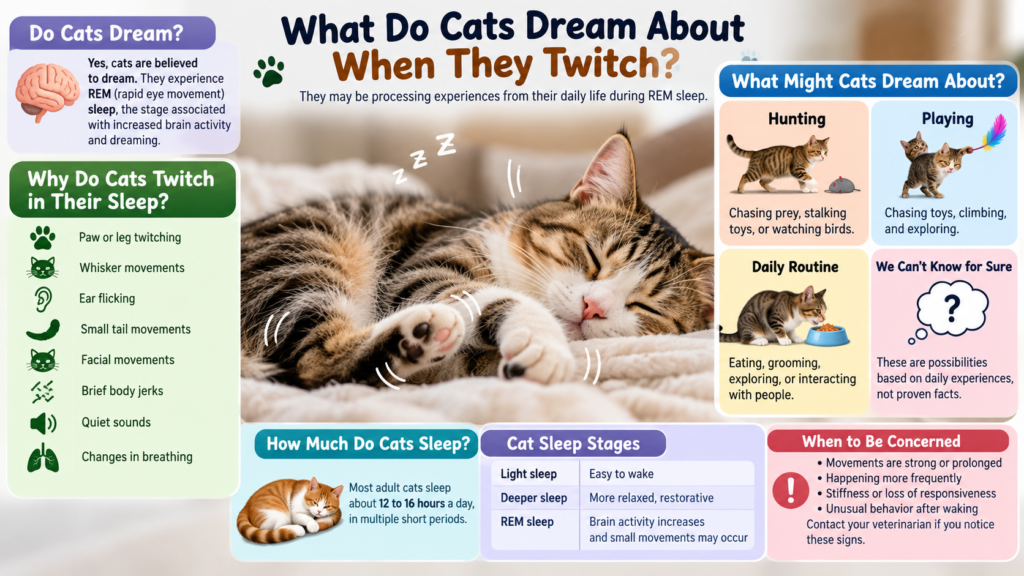
Why Do Cats Twitch in Their Sleep?
Small movements during sleep are commonly associated with REM sleep.
While your cat is sleeping, you may notice:
- Paw or leg twitching
- Whisker movements
- Ear flicking
- Small tail movements
- Facial movements
- Brief body jerks
- Quiet sounds
- Changes in breathing
These movements are usually brief and intermittent.
A sleeping cat may sometimes appear to be running, chasing, or reacting to something that is not actually present. Gentle movements like these are generally not a reason to wake your cat.
However, intense, prolonged, or unusual movements are different and should not automatically be assumed to be dreaming.
How Much Do Cats Sleep?
Cats are naturally big sleepers.
Many cats sleep around 12 to 16 hours a day, although the amount varies between individual cats. Cats also tend to sleep in multiple periods rather than one long uninterrupted stretch.
Their sleep includes lighter sleep as well as deeper and REM sleep. The amount and pattern of sleep can also change with age, health, activity, and individual personality.
Cat Sleep Stages
| Sleep stage | What you may notice |
|---|---|
| Light sleep | The cat may remain relatively easy to wake |
| Deeper sleep | The body becomes more relaxed |
| REM sleep | Brain activity increases and small movements may occur |
The twitching owners notice is often associated with REM sleep.
Do Kittens Twitch More in Their Sleep?
Kittens spend a great deal of time sleeping because their bodies and brains are developing.
You may notice small paw movements, whisker twitches, facial movements, or other brief motions while a kitten sleeps. These movements can be normal.
As with adult cats, however, unusually intense or prolonged movements should not simply be assumed to be normal dreaming.
The most useful comparison is your kitten’s normal behavior. A sudden change is more important than whether your kitten moves more or less than another kitten.
Should You Wake a Twitching Cat?
Usually, no.
If your cat is sleeping comfortably and making small, occasional movements, there is generally no need to wake them. Letting your cat sleep undisturbed is usually the best approach.
Suddenly touching or grabbing a sleeping cat can startle them. A startled cat may jump, swat, or bite as a defensive reaction.
If you are concerned about your cat, observe from a safe distance rather than shaking or restraining them.
When Is Cat Twitching During Sleep Abnormal?
Most gentle sleep twitching is harmless, but not every type of movement should automatically be attributed to dreaming.
Contact your veterinarian if your cat has movements that are:
- Strong or violent
- Repeated or prolonged
- Becoming more frequent
- Associated with stiffness
- Associated with loss of responsiveness
- Followed by unusual confusion or behavior
- Accompanied by other concerning symptoms
Seizures can sometimes involve abnormal movements or twitching and may occur as a cat is falling asleep or waking up. Some focal seizures can cause twitching in part of the body without obvious loss of consciousness.
If you are unsure whether an episode is normal sleep movement or something more serious, record a short video if it is safe to do so. A video can give your veterinarian useful information about what you observed.
Normal Sleep Movement vs. Concerning Movement
| Usually normal | Worth discussing with a veterinarian |
|---|---|
| Small paw twitches | Violent or prolonged movements |
| Occasional whisker movement | Repeated whole-body shaking |
| Brief ear flicks | Stiff or rigid movements |
| Small facial movements | Loss of responsiveness |
| Short episodes during sleep | Confusion or unusual behavior afterward |
The pattern, duration, and other symptoms matter more than any single movement.
How to Help Your Cat Sleep Well
You cannot control what your cat dreams about, but you can provide an environment that supports comfortable sleep.
Provide a Comfortable Sleeping Area
Give your cat access to a quiet, comfortable place where they can rest without being repeatedly disturbed.
A bed, blanket, elevated perch, or other safe resting area can work well.
Keep a Predictable Routine
Cats often benefit from predictable daily routines.
Try to keep regular activities such as feeding and play reasonably consistent.
Provide Appropriate Play
Interactive play gives cats opportunities for physical activity and mental stimulation.
Wand toys and other appropriate toys can encourage stalking, chasing, and pouncing behaviors.
Give Your Cat Safe Places to Retreat
Cats should have access to quiet areas where they can rest and feel secure.
Hiding places and elevated resting spots can give cats options when they want to sleep without being disturbed.
When Should You Call the Vet About Sleep Movements?
Occasional twitching while your cat sleeps is usually not a reason for concern.
However, veterinary advice is appropriate if the movements are new, unusually strong, prolonged, increasingly frequent, or accompanied by other changes in behavior or responsiveness.
It is especially useful to record an episode if you can do so safely. Your veterinarian can use the video, along with your cat’s medical history and examination, to determine whether further evaluation is needed.
Frequently Asked Questions
What do cats dream about when they twitch?
We cannot know exactly what cats dream about. Their dreams may involve experiences from daily life, such as playing or exploring, but this cannot be confirmed.
Do cats dream like humans?
Cats experience REM sleep, which is strongly associated with dreaming in humans. This suggests that cats likely experience some form of dreaming, although we cannot know exactly what their dreams are like.
Why does my cat twitch while sleeping?
Small twitches are commonly associated with sleep, particularly REM sleep. Paw movements, whisker twitches, and brief body movements can be normal.
Should I wake my cat if it is twitching?
Usually, no. If the movements are mild and your cat appears comfortable, let them continue sleeping.
Do kittens twitch more in their sleep?
Kittens spend a lot of time sleeping and may show noticeable movements while asleep. Small twitches can be normal, but unusual or intense movements should be discussed with a veterinarian.
When should I worry about my cat twitching in its sleep?
Contact your veterinarian if the movements are unusually strong, prolonged, frequent, or accompanied by stiffness, loss of responsiveness, or unusual behavior afterward. Recording an episode can help your veterinarian assess what happened.
The Bottom Line
So, what do cats dream about when they twitch?
We simply do not know for sure. Cats experience REM sleep and can show small movements such as paw twitching, whisker movements, and muscle twitches while sleeping.
Your cat may be dreaming about experiences from its daily life, such as playing, exploring, or other familiar activities, but these are possibilities rather than proven facts.
The next time you see your cat’s paws twitching during a nap, there is usually no reason to panic. Let your cat sleep and enjoy the moment from a distance.
If the movements become violent, prolonged, unusually frequent, or are accompanied by other concerning signs, contact your veterinarian.