
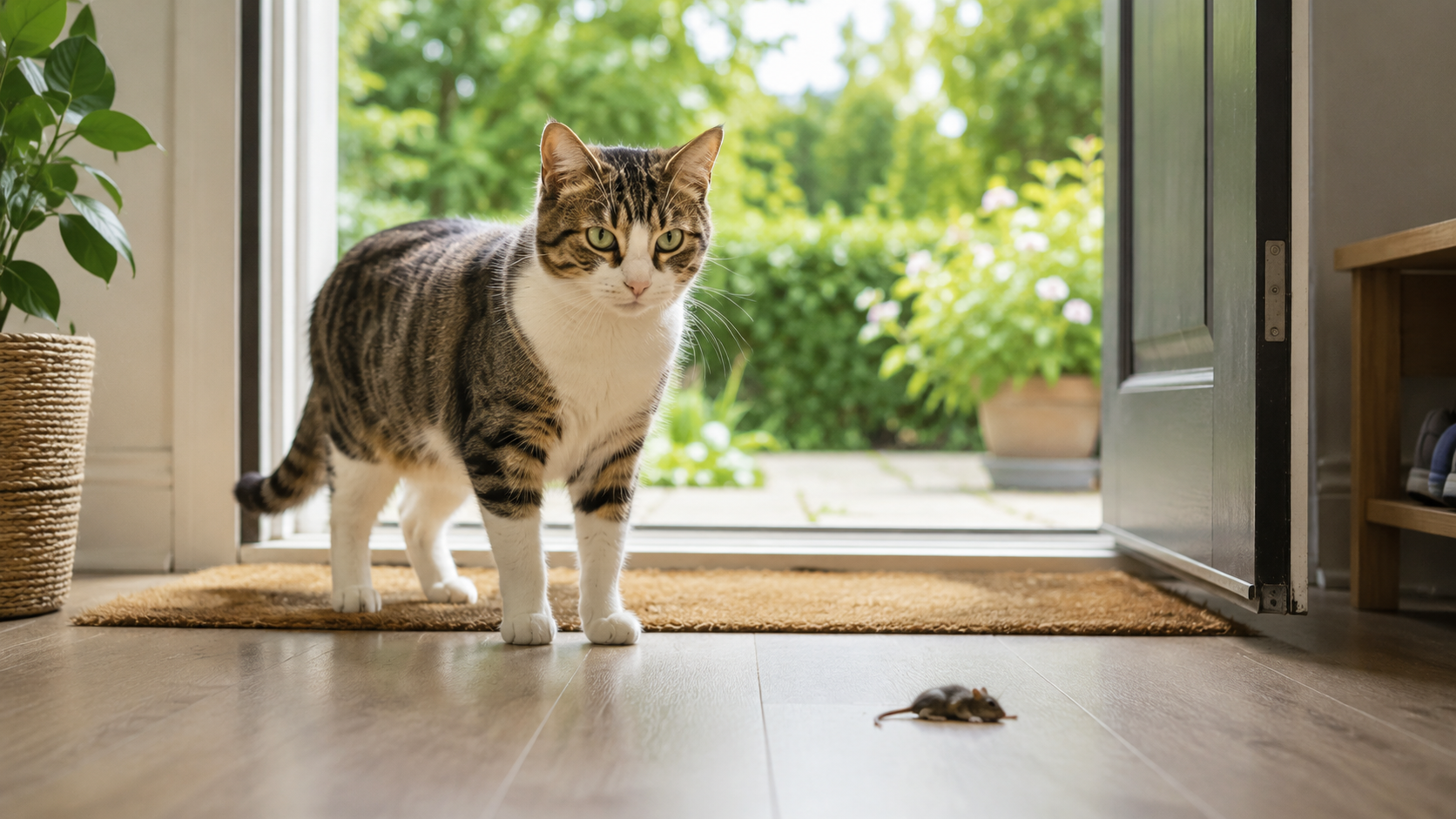
A dead mouse on the kitchen floor can look very much like a present. It probably isn’t a gift, at least not in the way humans think of a cat picking out something special for you.
Cats bring dead animals home primarily because hunting is part of normal feline behavior, and home provides a familiar place to carry, manipulate, eat, or leave captured prey. The popular stories that cats are “feeding their family” or teaching incompetent humans to hunt are appealing explanations, but they aren’t facts about what an individual cat intends. Animal-welfare guidance instead emphasizes predatory instinct and the tendency to bring prey back into a familiar core area.
A full food bowl doesn’t necessarily prevent it, either. Hunting behavior is not simply an emergency response to hunger. Cats can remain strongly motivated to search for, stalk, chase, and capture moving prey even when their nutritional needs are being met.
So yes: for a cat with outdoor access, bringing prey home can be normal behavior.
But just because it’s normal doesn’t mean it’s harmless. There are three things to consider: your cat’s natural hunting instincts, the impact on local wildlife, and the risk of your cat or household being exposed to parasites or diseases from the animals they catch.
Start With What We Know—and What We Don’t
Cat behavior becomes much easier to understand when certainty is kept in proportion to the evidence.
Well supported: Domestic cats retain strong predatory behavior. Hunting can involve searching, approaching or stalking, capturing, killing, and manipulating prey. International Cat Care describes these behaviors as a recognizable hunting sequence rather than a single action triggered only by hunger.
Reasonable interpretation: A cat may carry captured prey into the house because the home functions as a familiar, secure part of its territory where the animal can be handled, consumed, or left with less interference. Cats Protection uses this explanation in its current behavior guidance.
Not established: We cannot confidently say that every cat delivering a mouse is giving its human an affectionate present, proudly displaying hunting talent, or deliberately teaching a person how to hunt. Those stories assign a specific intention to behavior when the cat cannot tell us why it made that particular decision.
This difference is important.
Your cat can have a positive relationship with you and bring a mouse home without the mouse itself being a symbolic declaration of love.
A Full Food Bowl Doesn’t Turn Off the Hunter
One of the first things owners ask is: “Why is my cat killing animals when I feed them perfectly well?”
Because eating and hunting aren’t identical motivations.
International Cat Care notes that hunger can influence parts of the predatory sequence, particularly whether caught prey is killed, but hunting behavior itself is not limited to a hungry cat.
That helps explain something owners see frequently: a cat eats dinner, goes outside, and later catches a mouse anyway.
From the cat’s perspective, a small animal moving through grass presents sensory cues that can trigger attention and predatory behavior. Evolution has equipped cats to notice, stalk, chase, seize, and manipulate small prey. Scientific reviews of domestic-cat hunting describe evolutionary background, diet, individual characteristics, and environment as interacting influences on how much a particular cat hunts.
Individual variation is substantial, too. Research on pet cats has found that some individuals return prey frequently while many others rarely do so.
That’s why two cats in the same home can act very differently when they go outside.
One may spend an afternoon sleeping under a shrub.
The other seems to have a busy schedule.
Why Bring the Animal Through the Door?
Catching something and carrying it into your bedroom are two different decisions, which is why the “why bring it to me?” part feels so personal.
It may not be.
Cats Protection explains prey return as a movement back toward the cat’s core territory—a familiar area where the cat may feel more secure handling or consuming what it caught.
That interpretation fits an important observation: cats don’t necessarily deposit prey directly in a person’s hands. An animal may appear beside the cat flap, under a table, in a hallway, behind furniture, or in another familiar indoor location.
In other words, your house may be the destination even when you are not.
Researchers are still studying why cats bring prey home. For example, a 2025 study looked at how often pet cats bring prey back and what influences this. The findings show that bringing prey home is just one part of hunting, not clear proof of a social message to humans.
We can’t know exactly what a cat is thinking when it brings something home. It’s better to admit we don’t know for sure than to turn a fun story into a scientific fact.
What Your Cat Brings Home Changes the Practical Problem
Not every hunting episode requires the same response.
| What arrives | What matters most | Your immediate priority |
| Dead mouse or rat | Possible contamination, parasites, fleas | Keep cat and children away; clean up safely |
| Dead wild bird | Wildlife disease exposure, including current avian influenza concerns | Avoid bare-hand contact and follow current public-health guidance |
| Live uninjured animal | Cat may catch it again; handling wildlife can injure you or the animal | Separate the cat and contact wildlife professionals if help is needed |
| Injured animal | Wildlife welfare and species-specific handling rules | Contact a licensed wildlife rehabilitator |
| Partly eaten prey | Greater exposure through ingestion | Monitor the cat and discuss concerning symptoms with a veterinarian |
| Toy repeatedly carried to you | Predatory/play behavior without wildlife exposure | Use it as an opportunity for interactive play |
The U.S. Fish and Wildlife Service advises contacting a professional when wildlife is genuinely injured; most states require permits or licenses for wildlife rehabilitation, and many birds are also protected under federal rules.
That means a wounded bird your cat catches isn’t a good candidate for improvised home rehabilitation.
If There’s a Dead Mouse on the Floor, Deal With the Mouse First
Behavior analysis can wait until after cleanup.
For a dead rodent, CDC guidance recommends wearing rubber or plastic gloves, wetting the carcass and contaminated area thoroughly with an appropriate disinfectant, allowing the disinfectant to remain for the specified contact time, placing the rodent in a plastic bag, sealing that bag inside a second bag, and disposing of it in a covered garbage container. Hands should be washed thoroughly after gloves are removed.
If you also find rodent urine or droppings, don’t immediately sweep or vacuum them. CDC warns that disturbing contaminated material can put infectious particles into the air; its guidance calls for wet disinfection before removal.
Keep your cat away while you clean.
And don’t punish the cat afterward. The connection between being yelled at now and successfully hunting earlier isn’t a useful lesson to expect a cat to make. Behavior organizations instead recommend redirecting natural predatory activity toward acceptable outlets such as interactive toys.
A dead wild bird deserves extra caution.
This issue has become more important because of highly pathogenic avian influenza.
CDC’s current guidance identifies A(H5) bird flu as widespread among wild birds and advises people to avoid unprotected exposure to sick or dead wild birds and other potentially infected animals. When direct contact cannot be avoided, CDC recommends appropriate personal protective equipment rather than bare-hand handling.
Cats themselves are susceptible to H5N1. Cornell’s Feline Health Center identifies exposure to wild birds among known or suspected routes of feline infection and recommends keeping cats away from sick or dead birds.
If your cat has caught or eaten a bird and subsequently develops fever, loss of appetite, marked lethargy, respiratory problems, discharge from the eyes or nose, poor coordination, tremors, seizures, or sudden vision problems, call your veterinarian promptly and explain that there was wild-bird exposure before arriving at the clinic.
For disposal of a wild bird, follow current CDC and local wildlife or public-health guidance because recommendations can change with disease activity in your area.
Eating the Catch Adds Another Layer of Risk
A cat carrying a mouse is one thing. A cat consuming wild prey has additional exposure.
Cornell explains that cats can acquire Toxoplasma gondii after eating infected prey. Most infected cats don’t develop clinical toxoplasmosis, but infection can cause illness in some animals, particularly those with weakened immune systems.
Rodents can also carry parasites that infect cats. For example, Cornell notes that cats can get some types of roundworms by eating rodents with larvae. Keeping cats from hunting is one way to lower this risk.
This does not mean every cat that catches a mouse will become sick.
It means outdoor predation creates exposure opportunities that don’t exist to the same degree for a cat kept away from prey.
Routine veterinary preventive care therefore matters particularly for cats that hunt. Your veterinarian can recommend parasite prevention, vaccination, and screening based on your cat’s location, lifestyle, age, and health rather than assuming every outdoor cat has identical risks.
Bringing Home Wildlife Isn’t Just a Household Nuisance
There’s also the animal on the other end of the hunt.
Free-ranging domestic cats can have substantial effects on wildlife. A major U.S. systematic assessment published in Nature Communications concluded that free-ranging cats kill very large numbers of birds and mammals, with unowned cats responsible for most of the estimated mortality.
The precise effect of one individual owned cat depends on where that cat lives, what species are present, how frequently it hunts, and many other ecological factors.
Still, once a pet regularly brings wildlife home, you no longer have to guess whether that particular cat is hunting.
You now have clear proof.
For owners who want to protect both their cat and local wildlife, preventing unsupervised hunting is more reliable than trying to change the cat’s underlying predatory nature.
The Most Reliable Prevention Changes Access, Not Instinct
A cat cannot bring home a wild mouse that it cannot reach.
Keeping a cat indoors or providing controlled outdoor access through a secure catio or other enclosed arrangement prevents free hunting during that period. Cornell also identifies indoor living or controlled environments as a way to reduce contact with other animals and disease exposure.
That doesn’t mean moving an outdoor cat inside should consist of locking the door and removing everything interesting.
Cats still need opportunities to perform normal predatory behaviors.
The Feline Veterinary Medical Association recommends interactive toys that mimic prey movement, food puzzles, toy rotation, and play in which the cat is periodically allowed to capture the toy.
A useful play session therefore looks less like waving a toy randomly in the cat’s face and more like a small hunting sequence:
- move the toy away from the cat rather than directly at them
- let it disappear briefly behind furniture
- alternate fast movement with pauses
- allow stalking and pouncing
- let the cat successfully catch the toy
- finish before your cat completely loses interest
The goal isn’t to stop hunting completely.
It is to provide an appropriate outlet for behavior the cat is already strongly motivated to perform. FelineVMA specifically describes play and predatory behavior as an important environmental need.
Can More Play Actually Reduce Real Hunting?
There is evidence that it can help.
In a 12-week trial involving 355 cats in 219 households, University of Exeter researchers tested several approaches designed to reduce prey returned home. Owners who added five to ten minutes of daily object play saw a 25% reduction in prey brought home during the study. The play involved prey-like movement that allowed stalking, chasing, pouncing, and an eventual toy “kill.”
The same study found fewer prey returns among cats switched to a commercial food in which protein came from meat. However, the researchers explicitly stated that they did not yet know which property of the diet produced the effect.
This limitation matters.
It would be inappropriate to conclude that every hunting cat needs a particular “high-meat” product, a grain-free diet, or a diet change made solely to stop hunting. The study tested a specific intervention under specific conditions; it did not establish a universal prescription for feline nutrition.
Interactive play is the easier low-risk lesson to apply: give your cat consistent opportunities to stalk, chase, pounce, and capture appropriate toys.
What About a Bell on the Collar?
Collars are commonly suggested as wildlife-warning devices, but the evidence isn’t perfectly straightforward.
In the same Exeter trial, cat bells did not produce a detectable overall reduction in prey brought home, although results varied among individual cats. A colorful bird-warning collar cover reduced bird captures in that study but did not reduce mammal captures.
An earlier review also found mixed results across studies of belled cats.
If your cat wears any collar outdoors, safety matters. A properly fitted breakaway-style collar is preferable to a collar that can remain caught on vegetation or structures.
Don’t let a collar accessory give you a false sense of security.
Restricting unsupervised access to wildlife is much more direct than hoping potential prey hear or see the cat soon enough.
Feeding the Cat More Isn’t a Reliable Solution
If hunting were simply a calorie problem, filling the bowl would solve it.
It doesn’t.
International Cat Care describes most of the hunting sequence as behavior that can occur separately from immediate hunger, while scientific reviews identify multiple influences on hunting beyond food availability alone.
Overfeeding a cat in an attempt to suppress hunting may create a different health problem without eliminating predatory behavior.
Feed according to your cat’s nutritional needs and body condition, not according to how many mice appear on the doorstep.
Don’t Punish the Delivery
A dead animal can produce a strong human reaction. From the cat’s perspective, though, hunting is normal behavior.
Shouting, chasing the cat, spraying water, or otherwise punishing the animal after a prey delivery doesn’t remove the underlying motivation to hunt. Animal-behavior guidance instead favors preventing access to prey and providing acceptable outlets for predatory behavior.
There is also no need to praise the delivery.
Stay neutral. Secure the cat. Remove the prey safely. Clean the area. Then adjust whatever part of the routine gives the cat access to wildlife.
This approach lets you focus on what you can actually control.
When Does This Become a Veterinary Question?
A cat that has hunted for years and occasionally returns with prey is presenting a different situation from a cat whose behavior suddenly changes along with signs of illness.
The act of bringing home a mouse doesn’t diagnose a medical condition.
Veterinary attention becomes more relevant when physical or behavioral abnormalities follow hunting or prey consumption.
Contact your veterinarian if your cat develops symptoms such as:
- persistent vomiting or diarrhea
- significant loss of appetite
- unusual lethargy
- coughing or breathing difficulty
- weakness or poor coordination
- tremors or seizures
- sudden changes in vision
- visible wounds, swelling, or pain after a hunt
- marked changes in normal behavior
Wild prey can expose cats to parasites, and certain infections associated with prey consumption can cause gastrointestinal, respiratory, neurological, or systemic illness.
Wild-bird exposure deserves particular attention while H5N1 remains a concern. Cornell advises contacting a veterinarian immediately if a potentially exposed cat develops compatible signs and recommends calling the clinic before bringing the animal inside so staff can prepare appropriate precautions.
If your cat has been bitten or scratched by a wild mammal, contact your veterinarian even when the wound initially looks minor. What happens next can depend on the species involved, your cat’s vaccination status, and local disease risks.
Questions That Usually Come Right After the First Mouse
Does my cat think I’m a bad hunter?
There is no solid evidence that your cat has assessed your hunting performance and decided remedial education is necessary.
Female cats can expose kittens to prey as part of the development of hunting behavior, but extending that observation into “pet cats bring prey to humans because they think humans can’t hunt” is an interpretation, not an established explanation for prey deliveries to owners.
Is my cat bringing me dead animals because they love me?
The behavior can occur in a cat that has a close relationship with you, but the dead animal itself isn’t reliable evidence of a particular emotion.
A more defensible interpretation is that your cat hunted successfully and returned the prey to a familiar environment.
Why does my cat sometimes bring the animal home alive?
Capturing prey does not always end immediately in killing it. International Cat Care describes hunting as a sequence containing separate capture, kill, and manipulation stages, so a cat can transport or continue interacting with prey that remains alive.
If live wildlife enters your home, separate your cat first. If the animal is injured or cannot leave safely, contact a licensed wildlife rehabilitator rather than attempting extended care yourself.
Why does my cat leave dead animals by the door?
The doorway may be where the cat enters the familiar home area while carrying prey.
There is no need to assume that precise placement is ceremonial unless you have evidence of a learned routine associated with that location.
Why does my cat bring me toys instead of animals?
Toy carrying can recruit some of the same behavioral components used during hunting, such as chasing, grasping, carrying, and manipulating an object. FelineVMA specifically recommends prey-mimicking interactive toys as an outlet for predatory behavior.
A toy mouse on the pillow is the version of this problem most owners can live with.
Will getting another cat stop the hunting?
There is no reliable reason to expect it to.
Domestic cats are capable solitary hunters, and hunting tendency varies substantially among individuals. Adding another cat also introduces social, space, resource, and compatibility considerations unrelated to predation. Research shows meaningful individual variation in how frequently pet cats hunt and return prey.
Do female cats bring home more prey because mothers teach kittens to hunt?
Maternal behavior is often used to support the “teaching humans” explanation, but that doesn’t establish that adult female cats regard owners as kittens.
Multiple interacting factors influence hunting frequency, and individual variation makes simple sex-based explanations unreliable.
If You Want Fewer Surprises on the Floor, Change the Opportunity
You don’t need to convince your cat that mice are unacceptable gifts.
You need to make wild prey harder to access while keeping legitimate predatory behavior possible in safer forms.
For a cat that regularly hunts, the most practical plan is:
- Reduce unsupervised outdoor access. Indoor living, secure outdoor enclosures, or other controlled access directly limits encounters with wildlife.
- Add daily prey-style play. Let your cat stalk, chase, pounce, and successfully capture a toy. Both current feline-environment guidance and controlled research support this approach.
- Use food puzzles and rotate enrichment. These provide additional opportunities for active investigation and food-seeking behavior.
- Don’t punish hunting after the fact. Prevent access and redirect the behavior instead.
- Handle real prey as a health issue, not a souvenir. Use CDC-safe cleanup practices for rodents and extra caution with sick or dead wild birds.
The main idea is simple.
Your cat doesn’t have to stop acting like a hunter. They just need safer ways to do it.
A mouse on the rug may feel like a message addressed personally to you. Still, the evidence points toward a much more feline explanation: hunting happened, prey was captured, and your cat carried the result into familiar territory.
Understand the instinct. Then manage the opportunity.
Refferences
Feline Behavior & Environmental Enrichment
- International Cat Care: Understanding the Hunting Behaviour of Cats
- Feline Veterinary Medical Association (FVMA / AAFP): Your Cat’s Environmental Needs (Five Environmental Pillars Guide)
Controlled Research on Predation & Hunting Interventions
- Cecchetti et al. — Current Biology (2021): Provision of High Meat Content Food and Object Play Reduce Predation of Wild Animals by Domestic Cats Felis catus
- Cecchetti et al. — Mammal Review (2021): Drivers and Facilitators of Hunting Behaviour in Domestic Cats and Options for Management
- Loss, Will & Marra — Nature Communications (2013): The Impact of Free-Ranging Domestic Cats on Wildlife of the United States
Veterinary Health Resources (Cornell Feline Health Center)
- Toxoplasmosis in Cats: Cornell Feline Health Center – Toxoplasmosis
- Gastrointestinal Parasites of Cats: Cornell Feline Health Center – Gastrointestinal Parasites
- H5N1 Avian Influenza & Cats: Cornell Feline Health Center – Feline Avian Influenza Update
Public Health & Disease Prevention Guidelines (CDC)
- CDC Rodent Cleanup: CDC – How to Clean Up After Rodents
- CDC H5N1 Prevention: CDC – Bird Flu (H5N1) Prevention and Treatment