
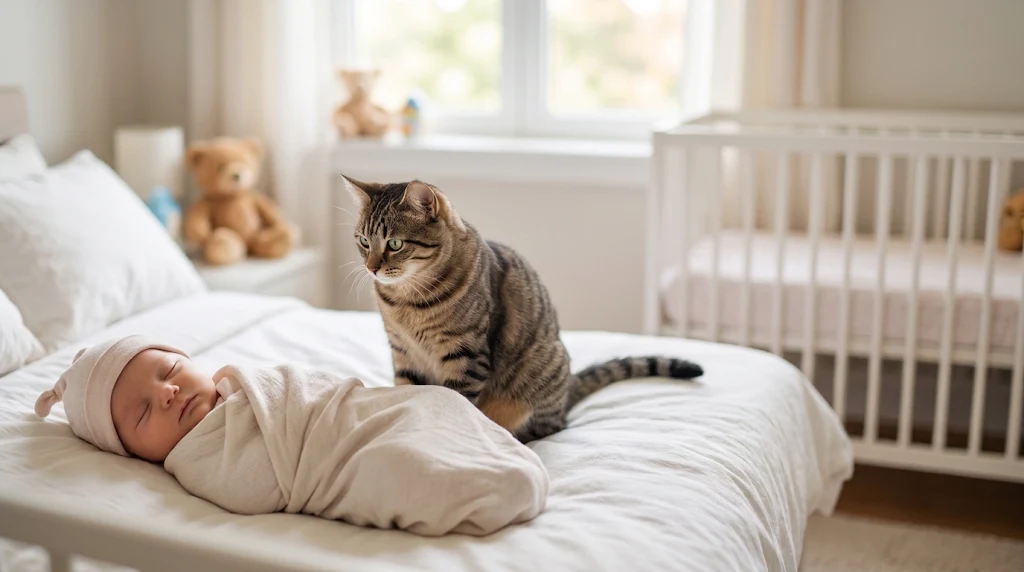
Is it safe for cats to be around newborns? In many homes, yes. A healthy, well-cared-for cat can live with a new baby, but the adults must manage every interaction. The most important rules are to supervise contact, keep the cat out of the baby’s sleep space, and give the cat somewhere quiet to retreat.
Quick Answer: Cats and newborn babies can usually share a home safely when their contact is closely supervised. Never leave them alone together, even for a moment. Keep cats out of cribs and bassinets, follow safe-sleep guidance, wash your hands after handling litter or pet supplies, and introduce your cat to the baby gradually. Talk to your pediatrician or veterinarian if either needs extra precautions.
You may have spent years sharing your couch with your cat. Then you bring home a tiny baby, and suddenly every jump, meow, or curious sniff feels like a possible risk. You don’t necessarily need to rehome your cat. You do need a practical plan that protects the baby without making your cat feel trapped or pushed aside.
Key Takeaways
- Never leave a cat and newborn alone together, including during a nap.
- Your baby’s crib or bassinet must stay cat-free. A separate, firm, flat sleep surface is essential.
- Let your cat choose whether to approach during short, calm introductions. Do not force contact.
- Maintain veterinary care, parasite prevention, handwashing, and a litter box that is inaccessible to children.
- Watch for a change in your cat’s behavior and take infant scratches, bites, or illness seriously.
Are Cats Safe Around Newborns? What Is and Isn’t Safe
Being in the same household is different from sharing a sleep surface or having unrestricted physical contact. A quiet cat resting across the room while an alert adult holds the baby is a different situation from a cat climbing into an unattended bassinet.
| Situation | Safer approach |
|---|---|
| Cat watches the baby from across the room | Usually fine when an alert adult is supervising |
| Cat approaches while an adult holds the baby | Allow a brief, voluntary investigation only if the cat stays relaxed |
| Baby is sleeping in a crib or bassinet | Keep the cat completely out of the sleep space |
| Adult needs to leave the room | Separate the cat and baby first |
| Cat hisses, freezes, swats, or tries to escape | End the interaction calmly and give the cat space |
| Baby has a bite, scratch, or concerning symptoms | Contact the child’s healthcare professional promptly |
The Texas A&M veterinary team stresses that familiar, gentle pets still need supervision around babies. A cat may be startled by sudden crying or movement even if it has never scratched anyone before.
Why Cats Must Stay Out of Cribs and Bassinets
A newborn cannot reliably move away if something blocks the nose or mouth. A cat settling close to the baby’s face could obstruct breathing, even without aggressive behavior. That is why a sleeping baby must have a dedicated, cat-free space.
The American Academy of Pediatrics’ safe-sleep guidance recommends placing babies on their backs on a firm, flat mattress in a safety-approved crib or bassinet, with only a fitted sheet. Keep pillows, blankets, toys, and pets out. Room-sharing with a parent is recommended, but the baby should not share an adult bed.
If the bassinet is in your bedroom, manage your cat’s access to that room whenever the baby sleeps. A closed door or another reliable separation plan is safer than expecting a cat to obey a verbal command at night. Offer your cat an appealing bed or perch elsewhere.
Don’t drape a net over a crib or add an improvised cover to keep the cat away. Cats Protection warns that so-called cat nets can fail or become an entanglement hazard. A cat may also climb on them. Avoid putting deterrent objects inside the baby’s crib, too.
How to Introduce Your Cat to a Newborn Step by Step
The first meeting doesn’t need to become a photo opportunity. If your cat is unsure, watching from a distance is enough.
Before the baby comes home
Gradually introduce new furniture, sounds, and routines. Practice keeping sleeping areas off-limits before the baby arrives. If you play a recording of a baby crying, start quietly, reward relaxed behavior, and stop if your cat becomes frightened. Keep feeding and play schedules reasonably predictable.
Prepare a quiet retreat with the cat’s familiar bed, water, scratching surface, and access to litter. A secure elevated resting spot can help your cat observe the household without being approached. Battersea’s introduction guide recommends preparing for changes in smells, noises, and household routines ahead of time.
On the first day at home
- Have one adult care for the baby while another calmly greets the cat.
- Choose a quiet room away from the cat’s feeding and sleeping areas.
- Hold the baby securely while the cat remains free to stay back or leave.
- If the cat approaches calmly, allow a brief look or sniff from a safe distance. Keep the baby’s face and hands away from the cat’s mouth and claws.
- Praise or reward relaxed behavior. If the cat seems tense, end the meeting without scolding.
The Cats Protection baby-introduction guidance emphasizes letting cats investigate voluntarily and keeping their routines as stable as possible. Some cats are curious immediately. Others need much longer, and that’s okay.
During the first few weeks
Keep interactions short and supervised. Give the cat attention when the baby is awake as well as when the baby sleeps, so the baby’s presence doesn’t always mean the cat loses access to you. Use treats or play at a comfortable distance when the cat remains calm.
Don’t encourage the cat to lick the newborn, climb into the baby’s lap, or settle beside a sleeping infant. As your baby becomes mobile, keep the same supervision rule and teach gentle handling when the child is old enough to understand.
How to Tell When Your Cat Is Stressed by the Baby
Some cats hide when visitors arrive or a baby cries. A brief retreat isn’t necessarily a problem. More concerning is a sudden, persistent change in appetite, litter-box habits, grooming, or social behavior.
Look for flattened or sideways ears, stiff posture, a rapidly moving tail, wide pupils, hissing, growling, swatting, or attempts to escape. The AAHA feline behavior guidelines describe these as possible fear or distress signals. One sign alone doesn’t tell the whole story, so consider the situation and your cat’s normal behavior.
Give your cat space before its discomfort escalates. Don’t punish hissing or force the cat back toward the baby. If your cat starts hiding much more than usual, our guide to why cats hide and when to worry can help you look for other warning signs. Persistent aggression or behavior changes deserve a veterinary assessment and, when appropriate, support from a qualified feline behavior professional.
Can Cats Pass Infections to Newborn Babies?
Cats can carry germs even when they appear healthy. That doesn’t mean every cat is infected or that normal household ownership is inherently unsafe. The practical goal is to reduce unnecessary contact with saliva, feces, parasites, and broken skin.
The CDC’s cat health guidance recommends washing hands after handling cats, litter, and pet supplies, supervising children around animals, and providing routine veterinary care. Keep litter boxes away from baby items and areas used to prepare food. Wash your hands before handling bottles, pacifiers, or the baby’s food.
Scratches, bites, fleas, and ringworm
Even playful scratches can break the skin, and cat bites can introduce bacteria. The CDC also explains that cat scratch disease can spread when a scratch is contaminated with bacteria associated with fleas. Ringworm, a fungal skin infection, can spread between pets and people.
Use veterinarian-recommended flea prevention, keep routine checkups current, and trim nails safely if your cat tolerates it. Nail trimming reduces sharp tips but does not replace supervision. Our cat nail-trimming guide covers a low-stress approach. Never declaw a cat as a substitute for child-safety planning.
What about toxoplasmosis?
Toxoplasmosis doesn’t spread simply because a cat sits beside a baby or someone touches clean fur. Infection can occur after swallowing the parasite from contaminated feces, soil, water, or food. Infection during pregnancy is a particular concern because it can harm the developing baby.
The CDC’s prevention guidance recommends changing litter daily, washing hands, avoiding raw meat for cats, and having someone else handle litter during pregnancy when possible. People who are pregnant or immunocompromised should speak with their healthcare professional about extra precautions. Rehoming a healthy family cat is not a routine requirement for preventing toxoplasmosis.
What to Do if Your Cat Scratches or Bites Your Newborn
Separate the cat and baby immediately, without shouting or grabbing a frightened animal. Gently wash the affected skin with soap and running water. Contact the baby’s pediatrician promptly for any bite or scratch that breaks the skin, even if the wound looks small. Let the clinician decide whether additional evaluation is necessary.
Seek emergency care if the baby has trouble breathing, becomes unusually hard to wake, has major bleeding, or appears seriously unwell. The American Academy of Pediatrics advises urgent evaluation for fever in babies younger than three months, including a rectal temperature of 100.4°F (38°C) or higher. A wound near the eye or a deep bite also needs immediate medical assessment.
Don’t assume a scratch happened because your cat is jealous. Fear, surprise, pain, or unwanted handling may be involved. Once the baby has received appropriate care, review how the animals and children were separated and speak with your veterinarian about preventing another incident.
Do Cats Cause Allergies in Newborns?
Cat allergens are proteins found in sources such as dander and saliva, not simply visible fur. Some children develop allergies; many do not. Studies on early pet exposure and later allergy risk have produced mixed results, so having a cat isn’t a reliable way to prevent allergies, and automatically removing a cat isn’t necessary for every newborn.
A 2026 review of cat allergy research describes the evidence as inconsistent. If your baby has persistent rash, coughing, wheezing, or nasal symptoms, ask the pediatrician to assess possible causes. Never assume a cat allergy is the diagnosis based on symptoms alone. Breathing difficulty needs emergency care.
A Newborn Safety Routine That Works for the Whole Home
Make the safe choice the easy choice. Put cat food, litter, and medication in areas where the baby and baby-care supplies won’t come into contact with them. Keep diaper creams, pacifiers, and small toys away from pets, too.
| Daily moment | Practical safety habit |
|---|---|
| Baby naps or sleeps overnight | Baby alone in an approved sleep space; cat physically excluded |
| Parent is holding the awake baby | Cat may observe from a distance while an alert adult supervises |
| Feeding or preparing bottles | Wash hands and keep pet dishes away from preparation surfaces |
| Cleaning the litter box | Keep baby away, scoop daily, wash hands thoroughly |
| Cat hides during crying | Let the cat retreat; don’t pull it into the room |
| Adult leaves, even briefly | Separate the baby and cat before stepping away |
If you’re thinking about bringing a new cat home while caring for a newborn, that’s a different challenge from living with a healthy, established pet. Consider delaying an optional adoption until your family has a workable routine. For an unfamiliar outdoor cat, our guide to bringing a stray cat inside safely covers health checks and isolation precautions.
Frequently Asked Questions
Can my cat be in the same room as my newborn?
Yes, during supervised awake time, if the cat is relaxed and a responsible adult can manage the interaction. The baby still needs a cat-free crib or bassinet whenever sleeping. Arrange physical separation if you might fall asleep or leave the room.
Can a cat sleep next to a newborn?
No. Do not let a cat share a newborn’s crib, bassinet, bed, or other sleep surface. A newborn needs a separate, clear sleep space, and a cat near the baby’s face could obstruct breathing.
Is it safe for my cat to sniff my baby?
A calm, brief investigation from a safe distance may be acceptable while an adult holds the baby securely. Don’t force the cat closer, and prevent licking or contact with the baby’s face, hands, and broken skin.
Should I get rid of my cat before the baby arrives?
Usually, no. Many families safely keep their cats by following supervision, hygiene, and safe-sleep rules. Discuss special concerns, such as a cat with repeated aggression or a medically vulnerable infant, with your pediatrician and veterinarian.
Can cat hair suffocate a baby?
Loose cat hair by itself is not the same as a cat covering a baby’s airway. The important preventable danger is an animal entering the baby’s sleep space or resting against the baby’s face. Keep the crib clear and cat-free.
What if my cat hisses whenever the baby cries?
Hissing signals discomfort or a need for distance. Move the cat to a quiet area with access to its essentials, and avoid forced introductions. If the response continues, intensifies, or includes swatting or other behavior changes, contact your veterinarian.
You Can Care for Your Baby and Your Cat
A new baby changes the house, but that doesn’t automatically mean your cat no longer belongs in it. Keep the rules simple: a cat-free sleep space, close supervision during awake contact, good hygiene, and a reliable place for your cat to relax. If your baby is injured or becomes ill, contact the pediatrician. If your cat struggles with the change, get veterinary or behavior guidance before the problem grows.
The best relationship doesn’t have to begin with cuddling. It can begin with a quiet cat resting comfortably on the other side of the room while your baby is safe in your arms.