
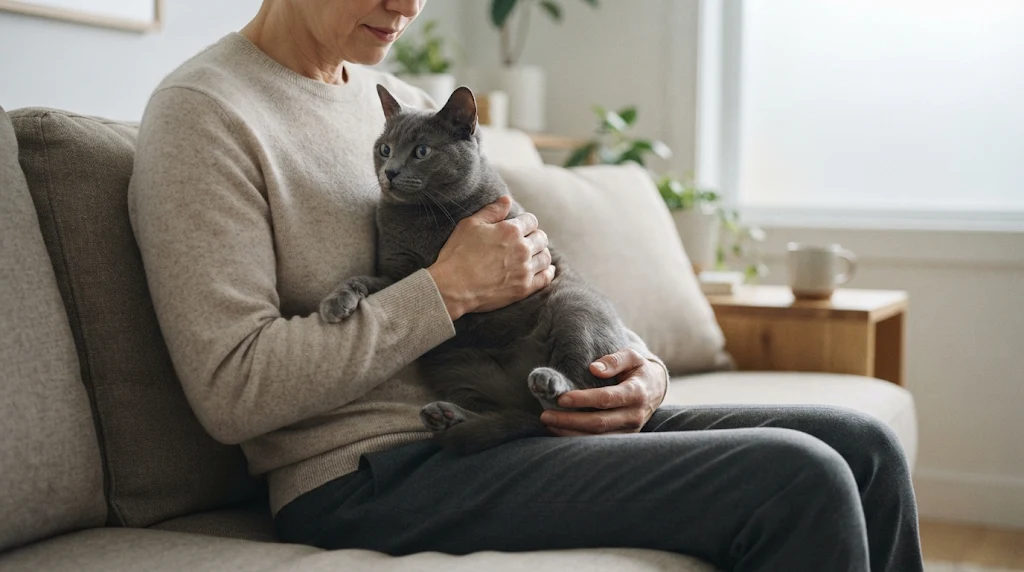
Some cats stretch out across their owner’s arms as if they’re enjoying a nap. Others twist away the moment they are lifted. Is holding a cat like a baby safe? It depends on whether the cat chooses the position, how its body is supported, and how easily it can get down. A cute pose isn’t worth making your cat feel trapped.
Quick Answer: Briefly cradling a relaxed cat may be tolerated if its chest, back, and hindquarters are securely supported and it can breathe freely. Don’t force a cat onto its back or restrain it when it wants to leave. The safer everyday option is to hold the cat upright against your body with both hands supporting its weight.
What Does Holding a Cat Like a Baby Mean?
People use that phrase for several different positions. A cat may be lying belly-up across both forearms, sitting upright against someone’s chest, or resting sideways on a person’s lap. These aren’t equally comfortable for every animal.
A healthy cat that voluntarily rolls onto its back on a lap may feel relaxed. That isn’t an invitation to lift it into the air or rub its stomach. A cat that cannot turn away might become still because it feels frightened, not because it enjoys the position.
There isn’t good evidence that simply lying on its back briefly always harms a healthy cat. There also isn’t a universal rule that holding every cat belly-up is safe. The cat-friendly veterinary interaction guidelines emphasize reducing restraint, respecting the cat’s preferred position, and allowing it choices. These principles apply to ordinary handling at home as well.
How to Pick Up a Cat Safely
If your cat is comfortable being lifted, approach slowly and get close to its level. The goal is steady support rather than a perfect pose. PetMD’s guide to picking up cats recommends using both hands rather than lifting by the scruff or letting the back legs hang.
- Let the cat see you and approach if it wants to. If it moves away, wait for another opportunity.
- Crouch beside the cat and gently place one hand beneath the chest just behind the front legs.
- Bring the other hand or forearm under the hindquarters to carry the back end.
- Lift smoothly, keeping the cat near your body. Support its rear and avoid squeezing the chest or belly.
- Keep the hold brief. Lower the cat gently to a solid surface, supporting it until the paws are down.
Practice while seated or low to the floor if you are unfamiliar with handling. This lowers the distance the cat might fall if it becomes startled. Never lift a cat by the tail, front legs, armpits alone, or loose skin at the neck.
Which Holding Positions Are Better?
| Holding position | Practical guidance |
|---|---|
| Upright against your chest | Support the chest and rear; a sensible everyday option for a willing cat |
| Across both arms, body supported | May suit a relaxed cat that chooses the position |
| Belly-up cradle | Avoid forcing the position; stop at any resistance |
| Sitting on the lap | Lets the cat control contact and easily move away |
| Dangling by front legs or held by scruff | Don’t do this; use full-body support instead |
A large cat may need more forearm support than a small one. Adjust how you hold the cat instead of trying to fit it inside a particular pose. You can also place a folded blanket on your lap for a cat that prefers to lie down rather than be lifted.
How to Tell Whether Your Cat Is Comfortable Being Held
Look at the whole animal, not just one behavior. A cat with a loose body, normal ear position, and no attempts to escape may be comfortable. A stiff cat with wide pupils, ears turned back, or tense feet may be frightened. Purring on its own doesn’t prove enjoyment; cats may also purr when stressed or unwell.
Stop holding your cat if it twists, pushes with its paws, flicks its tail repeatedly, growls, hisses, or turns toward your hand as if to bite. Lower it securely rather than tightening your grip. Cats Protection’s handling guide explains how to recognize when a cat wants to be put down and why supporting the rear matters.
If your cat tends to nibble and lick during interactions, our guide to why cats bite then lick can help you consider the context. A cat doesn’t have to bite before you’re allowed to stop the interaction.
When Should You Avoid Cradling a Cat?
Some cats have conditions that make lifting uncomfortable or unsafe. Cats with breathing difficulties, recent surgery, injuries, painful joints, or an unusual abdomen may need tailored handling instructions. Don’t press on surgical sites or force a position that seems painful. If your cat is breathing with an open mouth, struggling for air, or collapsing, stop handling and seek emergency veterinary care immediately.
A cat that used to enjoy being picked up but suddenly cries or growls when lifted may be in pain. Arrange a veterinary examination rather than assuming it has become unfriendly. The same applies if it has new stiffness, reluctance to jump, or reacts when you touch a particular area.
Don’t attempt to pick up a frightened stray or an unfamiliar cat that isn’t willing to approach. Instead, allow it space and ask an experienced rescuer for help when necessary. See our guide to bringing a stray cat inside for safe first steps.
Can You Teach a Cat to Enjoy Being Held?
You can sometimes help a cat become more comfortable with necessary handling, but you can’t guarantee that it will enjoy cuddling in your arms. Begin with a gentle touch while the cat is relaxed. If it stays comfortable, briefly support its chest and hindquarters without lifting far. Return it to the floor before it becomes distressed and reward relaxed behavior if it enjoys treats.
Keep future sessions short and increase difficulty only when the cat voluntarily remains comfortable. Stop if the cat avoids you afterward. Never hold it until it stops fighting; stillness may indicate fear, not acceptance.
A cat that prefers sitting next to you can still form a close relationship. Pet the areas it welcomes, offer interactive play, and let it choose whether to climb into your lap. If it becomes rough during play, our guide to safe play and overstimulation explains when to give it a break.
Helping Children Handle Cats Safely
Young children may want to carry a cat the way they carry a doll. Teach them to sit on the floor and let the cat come to them instead. An adult should supervise contact and handle lifting when necessary. A cat that jumps out of a child’s arms can injure itself or scratch the child.
Avoid holding the cat close to a child’s face. Never allow hugging that pins the animal’s legs or neck. Give the cat a retreat area where children are not allowed to follow.
Frequently Asked Questions
Does holding a cat on its back hurt its spine?
A brief, voluntarily relaxed position with full support is not automatically a spinal injury. But forced or unsupported positions can cause distress or injury, especially in a cat with an existing medical condition. Use an upright supported hold if unsure.
Is it safe to hold a kitten like a baby?
Kittens are fragile and can wriggle suddenly. Support the entire body, stay close to a safe surface, and avoid forcing a belly-up position. Very young newborns need specialized care and limited handling.
Why does my cat go completely still in my arms?
Stillness could reflect relaxation or fear. Check posture, ears, eyes, and whether the cat tries to leave. Put it down gently if you are unsure.
Can I carry my cat over my shoulder?
Some cats choose to place their front paws near a person’s shoulder. Keep the rear supported and prevent falls. Don’t use that position if the cat is struggling or you cannot see and control the situation safely.
What should I do if my cat scratches me when I pick it up?
Set it down safely, wash any wound promptly with soap and water, and seek medical advice if the injury is serious or concerning. Learn what happened just before the scratch rather than punishing the cat.
Let the Cat Choose the Cuddle
The next time your cat approaches, see whether it wants to sit beside you, climb onto your lap, or be lifted. If you do pick it up, support both ends of its body and set it down before it becomes uncomfortable. A calm, voluntary interaction is a better sign of trust than how long you can keep a cat in your arms.