
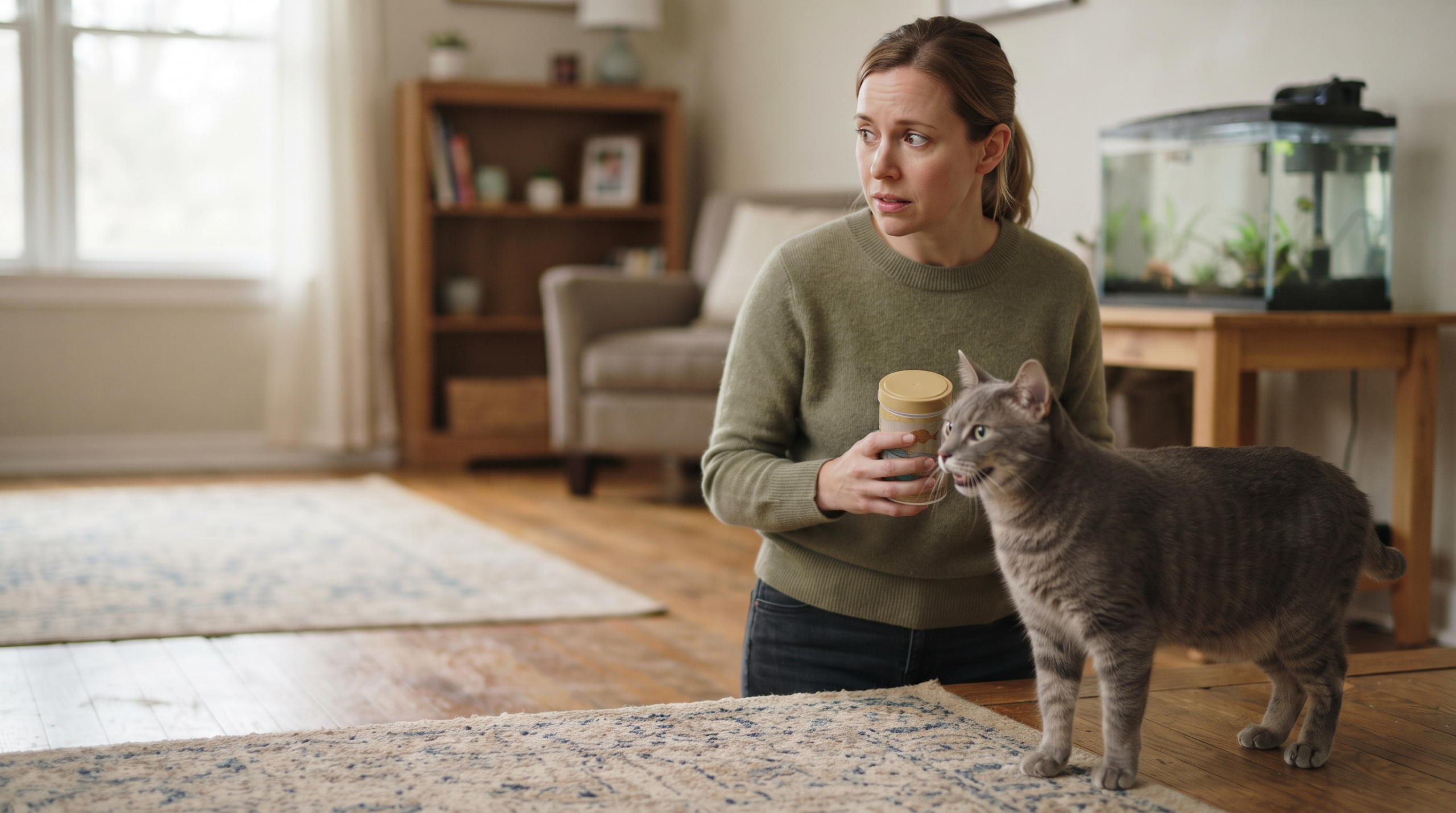
You find an open fish food container on the floor, a few pellets scattered nearby, and your cat sitting beside the mess. Is betta fish food poisonous to cats? The answer cannot be determined from the words “betta food” alone. The exact ingredients, any added medication, the amount swallowed, and your cat’s condition determine how urgently you need help.
Quick Answer: Betta fish food isn’t automatically poisonous, but not every formula is safe for cats. Some contain garlic, and aquarium feed may be mixed with medication. Remove access, keep the packaging, and call your veterinarian or an animal poison-control service if the ingredients or amount are concerning or unknown. Breathing difficulty, collapse, or seizures require emergency care now.
First, check whether your cat needs emergency care
If your cat is struggling to breathe, choking, collapsing, having seizures, or showing severe weakness, go to an emergency veterinary hospital immediately. Call ahead if possible, but don’t delay the trip to count pellets or search for ingredients.
If your cat appears normal, put away the food and collect the details needed for professional advice. Many exposures can be assessed over the phone before a visit is required, but a normal appearance immediately afterward does not rule out toxicity.
Which betta food exposures are most concerning?
| Exposure | What to do |
|---|---|
| Small taste of a known nonmedicated formula with no identified hazards | Remove access; ask your vet whether observation is appropriate |
| Garlic or onion listed on the label | Call your vet or poison-control service promptly for a dose-specific assessment |
| Medicated or home-treated feed | Get professional advice immediately, even without symptoms |
| Unknown amount, unknown product, or possible chemical contamination | Contact a veterinarian or poison-control service promptly |
| Chewed plastic, foil, or missing lid pieces | Contact a vet about possible swallowed packaging |
| Severe symptoms | Emergency veterinary care now |
There is no validated universal number of betta pellets that is safe for every cat. A count of ten pellets says little about the concentration of a particular ingredient or whether those pellets had been soaked in medication.
Can garlic in betta fish food poison a cat?
Garlic is not just a theoretical concern. The manufacturer’s ingredient list for Hikari Betta Bio-Gold includes garlic. The product is sold as fish food, and its label doesn’t establish a safe feline exposure level.
Garlic and onions belong to the Allium group of plants. The Merck Veterinary Manual explains that sufficient exposure can damage red blood cells and cause anemia. Anemia means the blood has a reduced ability to carry oxygen. Signs can include weakness, pale gums, rapid breathing, dark urine, or collapse, and may appear several days after ingestion.
This does not mean that a single pellet containing garlic will necessarily poison a cat. The actual dose matters, and an ingredient list generally doesn’t tell you how much garlic is in each pellet. Ask a veterinary professional to assess the product and amount rather than trying to calculate a safe threshold at home.
Medicated fish food can look like ordinary food
Some fish owners add treatments directly to pellets or frozen aquarium meals. The original fish food label might therefore be accurate but incomplete as a record of what the cat ate.
For example, Seachem’s MetroPlex product instructions describe mixing an aquarium medication into food. This is an example of how ordinary feed may be altered, not a recommendation to use the product around cats or a claim that every exposure is toxic.
If someone else feeds the fish, ask whether anything was mixed into the container. Keep the labels for the original food and any treatments. Tell the veterinary professional if you don’t know how the food was prepared. Do not assume a medication is safe because veterinarians sometimes use a similar substance in other situations. Dose and formulation matter.
Five things to do when your cat ate fish food
- Secure the cat away from the aquarium supplies. Collect spilled pellets without forcing your cat to open its mouth.
- Save the container and photograph the front, ingredients, lot number, and any treatment bottles.
- Estimate the time and amount eaten. If the quantity is uncertain, give a range or explain what you know.
- Note your cat’s weight, age, health conditions, current medications, and symptoms. Mention any missing packaging.
- Call the veterinarian or animal poison-control service for an individual plan, then follow that plan exactly.
In the United States, you can contact your own veterinarian, an emergency clinic, or ASPCA Poison Control at 888-426-4435. Consultation fees may apply. Cornell’s guide to common cat hazards explains why the product information is important when seeking help for an exposure.
Symptoms to watch for after exposure
The timing and type of symptoms depend on what was swallowed. Vomiting, diarrhea, drooling, poor appetite, unusual hiding, unsteady movement, and tiredness can occur for a variety of reasons, not just poisoning.
If these changes occur after eating aquarium food, report the exposure and symptoms to your veterinarian promptly. Pale or abnormal gum color, difficulty breathing, collapse, seizures, and severe weakness are emergency signs.
A cat may seem fine at first even when the exposure deserves treatment. In particular, symptoms of red blood cell damage from Allium ingredients can be delayed. Do not treat one symptom-free day as proof that any product was safe. Follow the exact monitoring period your veterinary professional recommends.
If you are already following a veterinarian’s home-care plan for another illness, mention that too. Our guide to why cats hide explains why a change in hiding can be meaningful but isn’t by itself a diagnosis.
What you should never do at home
Do not give your cat hydrogen peroxide, salt, oil, milk, activated charcoal, or human medications as an attempt to treat the ingestion. Never try to make your cat vomit at home. The ASPCA’s guidance on inducing vomiting explains that there is no safe home method for making a cat vomit and that peroxide can injure cats.
Don’t force water into the cat’s mouth or try to pull a swallowed piece of packaging out of the throat. If your cat is choking, seek emergency care instead. Bring the product information along if it is available without delaying treatment.
After the immediate risk has been assessed, return to the normal feeding routine only as your vet directs. For more on daily feeding and prevention, read our guide to betta food and feline nutrition. For longer-term nutrition, fish food should never replace a complete feline diet.
Frequently asked questions
Can one betta pellet kill a cat?
A tiny taste of an identified nonmedicated formula without a concerning ingredient is generally a lower-risk exposure than a large or unknown amount. But no reliable universal pellet limit exists. A veterinary professional can help assess the specific product, especially if garlic or medication is involved.
How soon will a cat show signs of poisoning?
There is no single timeline. Some reactions develop quickly, while others may take days. Do not delay contacting a professional about a concerning exposure until symptoms appear.
What if my cat ate betta food yesterday and seems fine?
Check the product and contact your veterinarian if the ingredients, quantity, medication status, or packaging are uncertain. Delayed effects are possible with certain substances.
Is aquarium medication in fish food always fatal to cats?
No. Risk depends on the substance, concentration, amount consumed, and the cat’s health. A dose-specific professional assessment is needed.
Can I prevent poisoning by using a garlic-free fish food?
Removing one potential hazard doesn’t make aquarium food appropriate for cats. Keep every fish food and treatment secured away from pets.
The safest decision depends on the label
Don’t let a small pellet size or a normal-looking cat convince you that an unknown exposure is harmless. Gather the ingredients and amount, get appropriate advice, and use emergency care if severe signs are present. Once the immediate risk is addressed, keep aquarium products out of reach so this doesn’t become a repeated incident.