
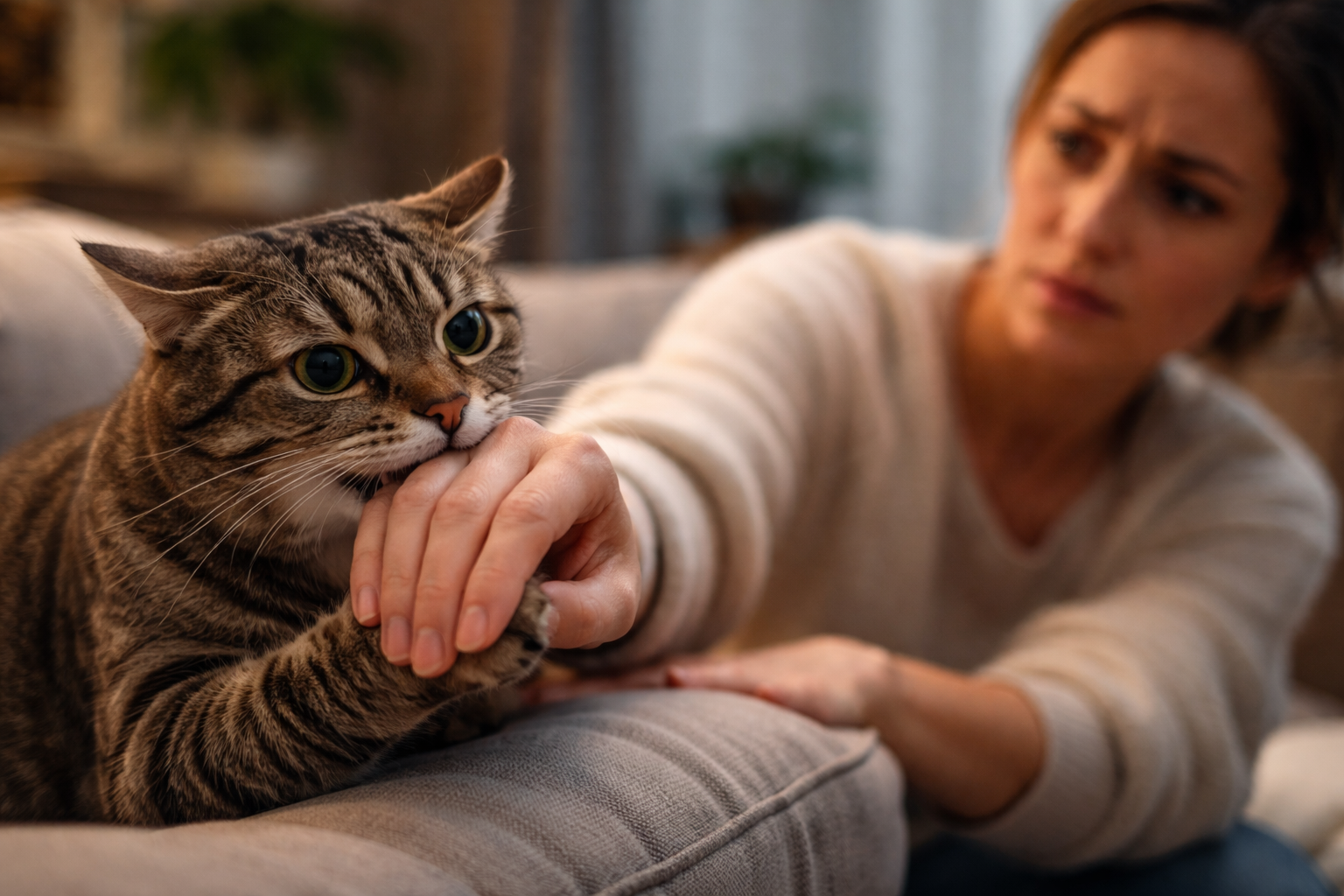
It often starts with something so minor; most people don’t think twice about it.
A soft nip during play. A gentle bite when petting goes on too long. A sudden chomp on the ankle when walking past the couch. These moments seem innocent sometimes even amusing. Cat owners shrug it off, calling it quirky or saying, “He’s just playful.” No harm, no foul. Until things change.
The nips become harder. The warning signs disappear. One day, a bite breaks skin. It happens during an otherwise calm interaction. There’s no hissing, no growl just sudden pain and confusion. The owner pulls back in shock, not recognizing the animal they thought they understood. This is the point when most people realize they’ve missed something crucial.
Many assume cat biting is a phase, something the animal will outgrow. Others believe it’s simply a part of a cat’s personality nothing to worry about. These assumptions are dangerously wrong.
What begins as mild play biting can evolve into a serious behavioral pattern if left unaddressed. Biting is not just a physical action; it’s a form of communication. And when a cat learns that biting gets results attention, space, or control it doesn’t stop. It escalates.
At its root, biting is shaped by a cat’s nervous system and environment. It’s a learned behavior, reinforced by how humans respond. Every time a cat bites and gets what it wants, that behavior becomes more efficient and more automatic.
Unfortunately, many cat owners unintentionally encourage this. They mistake early warning signs for affection. They play with their hands. They ignore subtle stress signals. And over time, they condition their cat to skip subtlety and go straight to using teeth.
The consequences of this miscommunication aren’t just physical. A biting cat damages trust within the household. Family members may become afraid. Children might get hurt. Guests avoid visiting. In worst-case scenarios, owners feel forced to rehome or euthanize their cat not because the cat is broken, but because the relationship has been.
This isn’t about labeling a cat as “aggressive.” It’s about recognizing a breakdown in understanding. One that can be repaired if addressed early, and seriously. Because this is not just about stopping bites. It’s about rebuilding communication, repairing trust, and protecting both the cat and the people around it.
This must be taken seriously and it must begin now.
Understanding the Issue Deeply
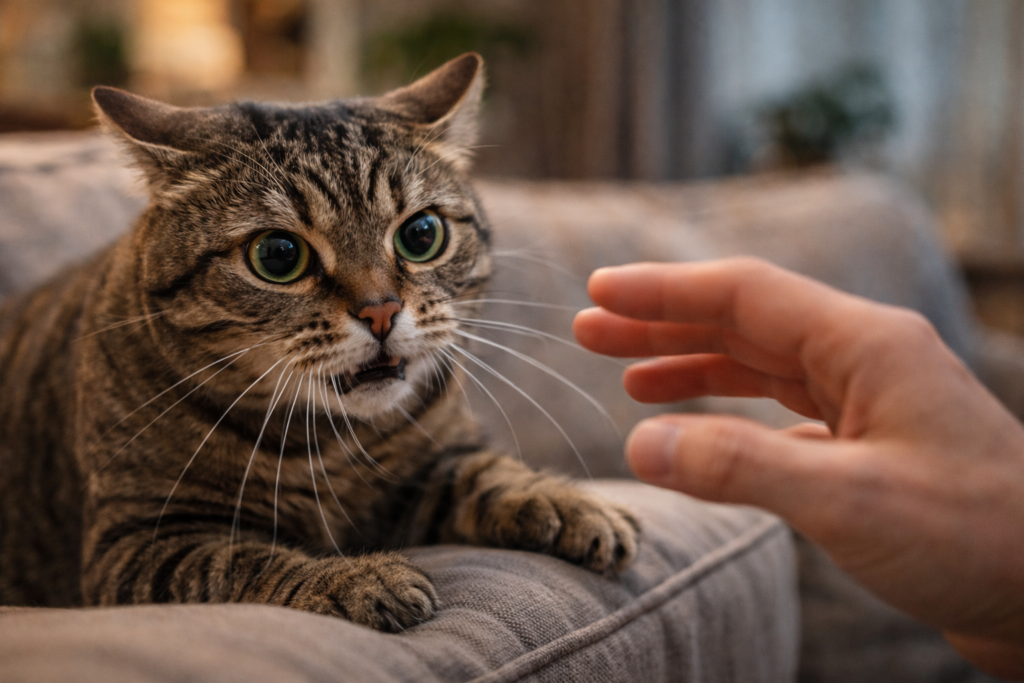
When a cat bites, it’s not acting out of malice, spite, or dominance. These human projections distort the real issue and delay meaningful intervention. You must understand: biting is not a personalityflaw it’s a behavioral output. It’s the end result of a process the cat has learned over time, usually in response to overstimulation, fear, frustration, or unmet needs.
Biting Is Communication Not Defiance
Cats are not subtle out of choice; they are subtle by design. Their primary communication is body language and behavior, not vocal expression. When a cat bites, it is communicating in the only language it knows will be understood immediately pain. It is a signal that something has gone too far. That something might be physical touch, emotional stress, or environmental discomfort.
This is why the question “why does my cat bite me?” must be asked not with blame, but with clarity. The answer is rarely singular. A bite can be triggered by:
- Overstimulation: A petting session that exceeds the cat’s tolerance window
- Frustration: Play attempts being ignored or under-stimulating environments
- Fear or anxiety: A new person, sudden movement, or past trauma
- Pain: Hidden injury, dental issues, arthritis, or illness
Each bite is an output of the nervous system attempting to regulate discomfort or regain control of a situation that feels unsafe or overwhelming.
Reflexive vs. Conditioned Biting
Not all bites are the same. Some are reflexive an automatic, unthinking reaction to sudden pain or extreme fear. These are fast, defensive, and often surprising even to the cat itself.
Other bites are conditionedbehaviors deliberate, repeatable actions the cat has learned through reinforcement. These typically develop over time and follow a pattern. For instance, if a cat nips during play and the person withdraws their hand or responds excitedly, the cat learns: biting equals stimulation or relief.
This is where many owners make a critical mistake.
They respond inconsistently sometimes laughing, sometimes jerking away, sometimes scolding. This inconsistency doesn’t discourage the behavior; it strengthens it. The cat receives mixed signals but sees one constant: biting gets a result.
The Role of Neurological Reinforcement
The nervous system adapts to whatever works. Every time a cat bites and achieves a desired outcome be it ending discomfort or initiating excitement neural pathways fire and are reinforced. Over time, this becomes a go-to behavior. The cat doesn’t think it through; the response is fast, efficient, and increasingly automatic.
This process is called operant conditioning, and it’s not exclusive to cats. But with felines, the reinforcement can happen even with minor feedback. A flinch. A shout. A retreat. All of these can teach the cat: my bite controls the environment.
And once that pattern is locked in, it doesn’t just stay static. It escalates.
The Silent Influence of Trauma and Poor Socialization
In many cases, especially with rescue cats or those taken in from unknown backgrounds, early trauma or improper socialization plays a foundational role.
Kittens removed too early from their mother and siblings miss critical bite inhibition lessons. Normally, when one kitten bites too hard, the other yelps and stops playing this teaches limits. Without that natural feedback, young cats often fail to develop control over jaw pressure and emotional regulation.
Cats that experienced fear, hunger, abuse, or environmental chaos in early life often live with a heightened stress response. Their brains are wired for survival, not trust. In these cases, biting is not aggression it is preemptive defense. The cat assumes danger and acts first.
The long-term consequences of such trauma can be mistaken for “bad temperament,” but the reality is more complex. These cats are often desperate for safety but lack the tools to ask for it properly.
In short:
When asking “why does my cat bite me?”, the real answer lies in layers:
- Environmental mismatches
- Missed signals
- Conditioned reinforcement
- Unresolved fear or pain
- And sometimes, the echoes of early trauma
Understanding this is not just about identifying a problem. It’s the first step toward undoing it by changing how we interpret, interact, and respond.
Early Warning Signs Explained
What many describe as “sudden” cat bites are rarely sudden at all. They’re the final act in a sequence of ignored or misread signals a chain of physiological stress that builds quietly until the cat has no choice but to act decisively. Cats do not bite without warning. Humans simply fail to see the warning in time.
Understanding the early signs of tension is not optional. It is the only way to prevent escalation and avoid situations where a bite feels like it came out of nowhere.
The Subtle Language of a Cat in Discomfort
Cats communicate discomfort with precision but not with words. Their warning system is entirely visual and physical. When a cat is approaching its tolerance limit, its body begins sending out signals. These are not aggressive gestures; they are requests for space, for the interaction to pause or end. When these signals are ignored, the next logical step is the bite.
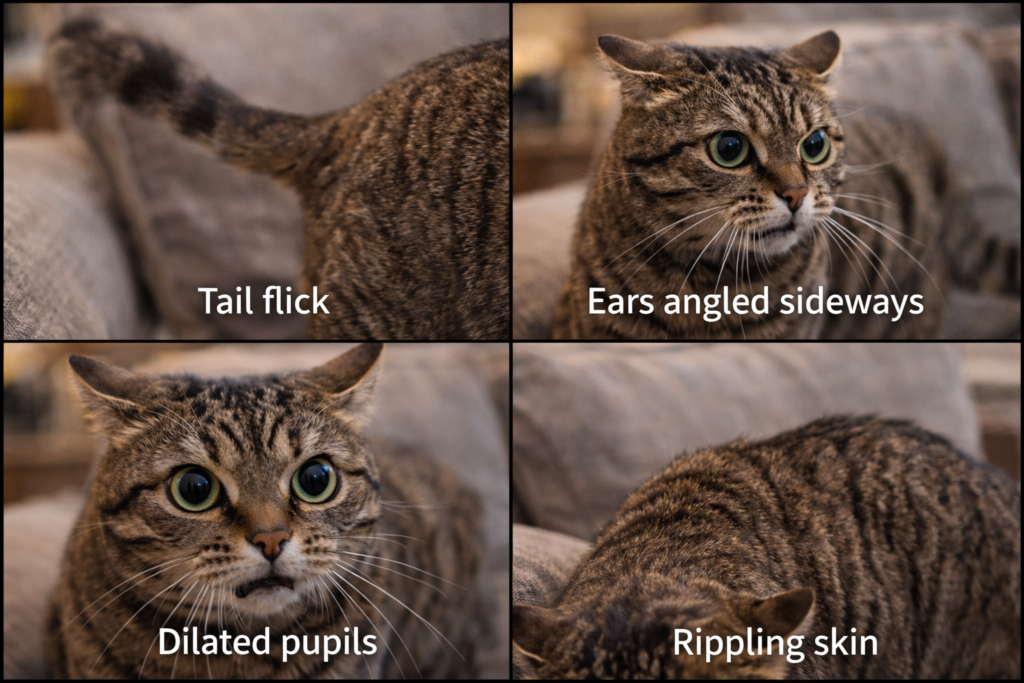
Here are the most common pre-bite cues you must learn to recognize:
- Tail Twitching or Lashing: A tail that begins to flick sharply, especially while the rest of the body remains still, signals agitation. The faster and more erratic the movement, the closer the cat is to acting out.
- Ear Movement: Ears that rotate sideways (“airplane ears”) or flatten back against the head indicate rising stress. Even a single-ear rotation can be an early clue the cat is processing discomfort.
- Pupil Dilation: Wide, dilated pupils are a physiological sign of increased arousal whether from excitement or anxiety. Context matters: if the body is tense and the pupils are large, the cat is not enjoying itself.
- Skin Rippling: A shiver-like movement along the spine, particularly during petting, is one of the most misunderstood signs of overstimulation. This is not a pleasurable reaction it’s a warning.
- Sudden Stillness or Freezing: Sometimes, right before a bite, a cat will go completely still. This “freeze” response is the final internal checkpoint before the cat acts.
These signs are not random. They are the body’s way of saying: I’ve had enough.
Why Humans Miss the Warnings
This is where many people make a serious mistake. Cats are subtle communicators. Most humans are not trained to interpret feline body language and often project human emotions onto animal behavior. What appears as tolerance or affection such as a cat remaining on your lap while being petted may actually be resignation or quiet distress.
In high-stimulation environments such as during play or when guests are present these signals become even harder to notice. A fast-moving hand, a loud sound, or an overwhelming scent can push a cat to its limit more quickly than expected. When that limit is reached, the bite is not spontaneous rage it’s the only method left that guarantees a human response.
This miscommunication is at the heart of “cat bites suddenly” complaints. The biting was predictable. It just wasn’t understood.
Overstimulation Is Not Moodiness
To truly prevent biting, we must change how we view overstimulation. It is not an emotional quirk or “mood swing.” It is a biological ceiling a hard limit set by the cat’s nervous system.
Petting-induced aggression is a classic example. A cat may enjoy touch for 20 seconds, then reach a point where further input overwhelms its sensory system. Continuing beyond this threshold triggers discomfort, then panic, then defensive action.
Different cats have different ceilings. Some tolerate long petting sessions. Others can only handle short bursts. The key is not how long you want to touch your cat it’s how long your cat wants to be touched.
When that window closes, ignoring it turns affection into a threat. This is especially true in multi-pet homes or loud environments, where baseline stress is already high.
The Solution Begins with Observation
Before anything else can change, observation must come first. You must become a student of your cat’s body language. Every interaction especially physical ones must be watched for subtle signs of tension.
Once you learn the pre-bite cues, you can intervene before the bite happens:
- Pause the petting
- Redirect with a toy
- Give space
- Let the cat disengage first
This is how escalation is prevented, and how trust is rebuilt.
Because at its core, “cat overstimulation: signs and solutions” is not about eliminating the cat’s reaction it’s about eliminating the conditions that provoke it in the first place.
Normal Behavior vs Dangerous Behavior
One of the most damaging misunderstandings in feline care is the belief that all biting is the same. It isn’t. Some forms of biting are part of normal development. Others signal a behavioral problem already in motion. Failing to tell the difference allows a manageable situation to quietly evolve into a dangerous one.
Understanding this distinction is essential not only for safety, but for shaping a cat’s behavior before it hardens into habit.
Play Biting Is Natural but Only at the Right Stage
When kittens play, biting is unavoidable. It is how they learn coordination, hunting technique, and social boundaries. During early development, kittens wrestle, pounce, and bite one another constantly. This is normal, expected behavior. What keeps it healthy is feedback.
When a kitten bites too hard, the other kitten disengages. Play stops. That pause teaches bite inhibition. Over time, kittens learn pressure control and restraint.
The problem begins when humans replace that system. When people use their hands as toys, they unknowingly teach the kitten that human skin is acceptable prey. There is no feedback loop that says “too hard.” There is no natural correction. The behavior continues unchecked.
This is why so many owners later report that their cat bites during play but “never used to hurt before.” The behavior didn’t change the cat’s strength did. Play biting that is not redirected early does not disappear with age. It matures.
When Play Turns into a Pattern
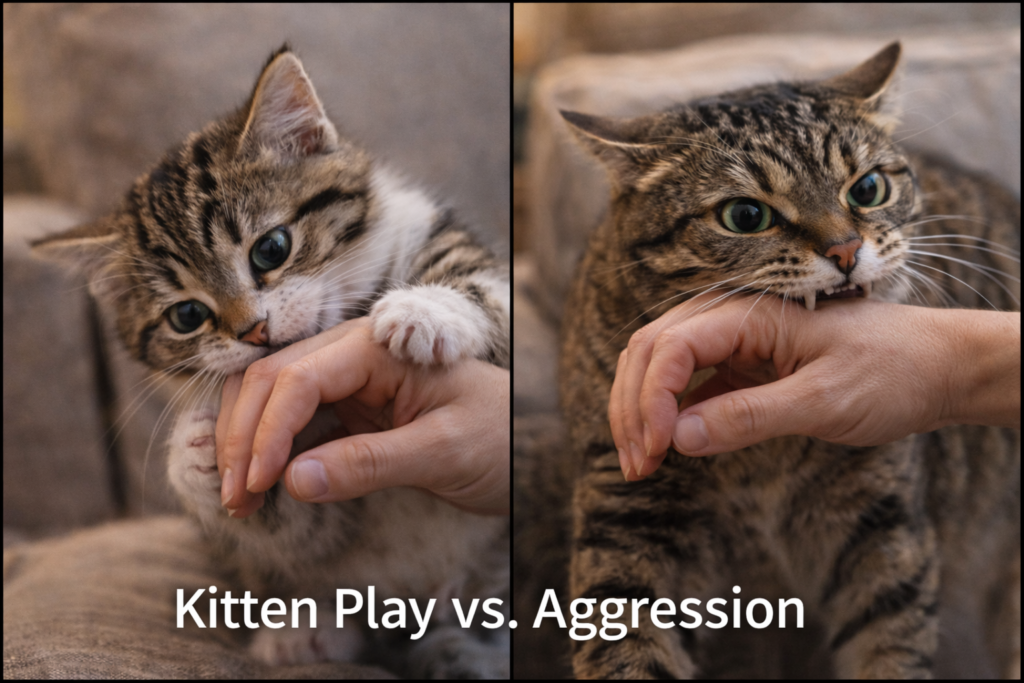
Playful nipping has specific characteristics:
- Light pressure
- No skin puncture
- Loose, bouncy movement
- Pauses between interactions
These behaviors occur in bursts and stop when stimulation ends.
Dangerous biting looks very different. Targeted biting involves focus and intent. The cat may stalk hands or feet. The bite may clamp rather than release. Pressure increases. The behavior may repeat even after the person withdraws. This is no longer play it is conditioned predatory behavior.
At this point, the cat is not “being rough.” It is executing a learned hunting response that has been reinforced repeatedly over time.
What Is Not Normal and Must Not Be Ignored
Certain behaviors should never be dismissed as typical feline behavior, regardless of age or personality.
These include:
- Bites that break skin
- Bites that occur during calm interactions, such as gentle petting
- Repeated attacks without clear provocation
- Biting that happens alongside stiff posture or silent intensity
- Escalating frequency or severity over time
When these signs appear, the issue has moved beyond normal play. Ignoring them allows neurological reinforcement to continue unchecked.
This is where many people make a mistake: they assume the cat is “just energetic” or “a little aggressive by nature.” In reality, the environment and interaction style have taught the cat exactly how to behave.
The Role of Age and Environment
Age plays a critical role in how biting manifests. Kittens are impulsive but flexible. Adult cats are neurologically efficient. A behavior practiced repeatedly in youth becomes automatic in maturity. At the same time, modern living environments intensify the problem.
Indoor cats especially those in apartments or small homes common across the USA, Canada, Europe, Australia, and New Zealand often lack appropriate outlets for hunting and movement. Without enrichment, energy accumulates.
When stimulation finally occurs, it erupts. Hands move. Feet walk by. The cat responds instinctively.
Without structured play and mental engagement, biting becomes the substitute outlet.
How to Play Without Creating Aggression
Understanding how to play with a cat without encouraging aggression is one of the most important responsibilities of ownership.
Cats must chase objects not people. Interactive toys that create distance between human skin and feline teeth are essential. Wand toys, kicker toys, and puzzle feeders allow the cat to express natural hunting behavior safely.
Equally important is how play ends. Abruptly stopping play leaves adrenaline unresolved. Proper play should follow a natural cycle: chase, capture, release, and rest. When that cycle is respected, frustration decreases and so does biting.
Normal behavior becomes dangerous only when guidance is absent. When play is misdirected, enrichment is lacking, and boundaries are unclear, a cat does not become aggressive by nature. It becomes aggressive by design.
Recognizing this difference early is what determines whether biting remains a temporary behavior or becomes a permanent problem.
Root Causes
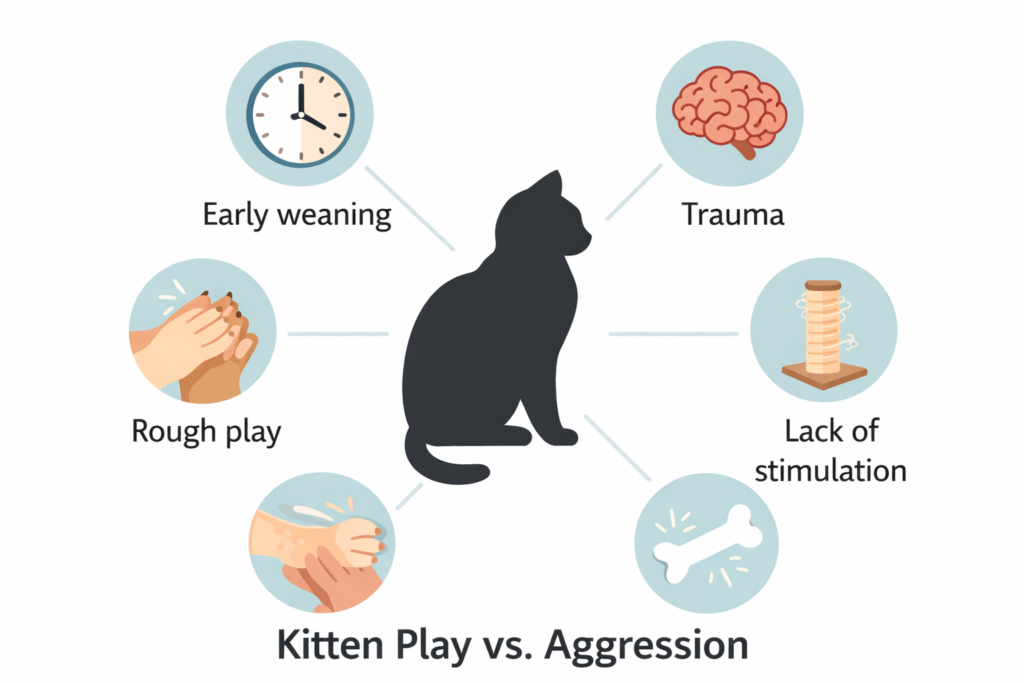
When cat biting becomes frequent, unpredictable, or aggressive, it’s not enough to simply manage the behavior you must understand why it developed in the first place. Without this foundational clarity, any attempt at correction will be superficial at best, and counterproductive at worst.
Cat biting behavior, when explained thoroughly, is not caused by a single issue. It emerges from a complex mix of behavioral development, neurological reinforcement, and environmental influence. Each contributing factor can exist independently, but more often, these causes build on each other creating a layered behavioral pattern that intensifies over time.
Early Weaning and the Bite Inhibition Gap
Cats learn bite control from their mothers and littermates during a crucial developmental window typically between 3 to 9 weeks of age. If a kitten is weaned or separated too early, that natural process is interrupted. For more on early socialization timing, see Cornell’s guide to the developmental stages of kittens.
When a kitten bites too hard during play, the others yelp or walk away. That immediate consequence teaches the kitten to moderate pressure. This is called bite inhibition. Without it, the cat grows up without understanding how much force is too much.
Early-weaned kittens may seem friendly or playful, but they often bite harder and more frequently than those who had full socialization. Over time, this lack of inhibition becomes hardwired, especially if the behavior is unintentionally encouraged through hand play.
Boredom and Lack of Stimulation
Cats are apex predators. Even domestic indoor cats retain strong hunting instincts, and if these drives go unmet, boredom quickly turns into frustration. This is especially common in apartments and smaller homes, where the space is limited and natural hunting behaviors are suppressed.
In the USA, UK, Canada, and most of Europe, cats are increasingly kept as strictly indoor pets. While this protects them from cars and predators, it also limits their opportunities for mental and physical engagement.
Without outlets like interactive toys, climbing structures, or regular play routines, a cat’s energy builds up until it has nowhere else to go. That tension often erupts as redirected aggression biting feet, stalking hands, or attacking at random moments.
In contrast, parts of Australia and New Zealand have a higher rate of semi-outdoor cat access. While this reduces boredom-related aggression in some cases, it introduces other risks: territorial stress, injuries, and overstimulation from unpredictable outdoor stimuli all of which can also lead to biting.
The point is this: a cat without a healthy outlet will find one often at the expense of human skin.
Learned Behavior Through Hand Play
Many cat owners unwittingly create the very behavior they later try to stop.
Play sessions that involve hands tickling, poking, or roughhousing blur the line between fun and aggression. These interactions train the cat that human skin is fair game. Every time the cat bites and the person laugh, reacts, or pulls away, the behavior is reinforced.
This becomes especially dangerous as the cat ages. What felt like harmless kitten play becomes painful adult biting, and the habit is already deeply embedded.
You must understand: this behavior isn’t instinct it’s training. And the trainer was often you.
Hidden Pain and Medical Discomfort
Biting is not always behavioral. In many cases, it is the only way a cat can express underlying physical pain.
Common medical causes of pain-induced aggression include:
- Dental disease (very common in adult cats)
- Arthritis (especially in older or overweight cats)
- Gastrointestinal discomfort
- Skin sensitivities or wounds
- Neurological conditions
Cats instinctively hide pain it’s a survival mechanism. But when touched in a painful area or handled too roughly, they may bite reflexively. This is not aggression; it’s defensive pain avoidance.
This is why any sudden change in behavior must trigger a veterinary evaluation first. Treating a medical issue as a behavior problem is not only ineffective it’s cruel.
Fear, Anxiety, and Early Trauma
Some cats bite not out of overstimulation or boredom, but out of fear. And when fear has been present since kittenhood due to abuse, neglect, or chaotic environments the behavior becomes deeply rooted. This is where early trauma affects cat behavior in profound ways.
Cats who were:
- Abandoned young
- Mishandled in shelters
- Exposed to violence or neglect
- Raised in unpredictable environments
…often carry that fear into every new interaction.
For these cats, biting is not a response to a trigger it is the baseline. Touch is suspicious. Approach is threatening. Even calm interactions may provoke defensive behavior because the cat has been conditioned to expect pain or betrayal.
These animals are not “mean” or “unfriendly.” They are survivors. And until safety is re-established over time, biting will remain part of their defense strategy.
Cumulative Effects and Behavioral Complexity
Each of these root causes early weaning, poor socialization, boredom, hand play, medical pain, trauma can lead to biting on its own. But in most real-world cases, they combine.
A cat that was weaned early, kept indoors without enrichment, and played with hands is already at high risk. Add hidden dental pain or past trauma, and the behavior becomes more intense and more difficult to untangle.
This is why a superficial fix like spraying with water or yelling doesn’t work. It doesn’t address the why. And unless the “why” is uncovered and resolved, the biting will continue or worsen.
Cat biting behavior explained properly always leads back to cause not character.
You’re not dealing with a “bad” cat. You’re dealing with an intelligent animal whose experiences have shaped a problematic but reversible response pattern.
Correction begins with truth. And the truth is: most biting isn’t random. It’s earned, learned, and reinforced often without anyone realizing it.
Escalation Over Time
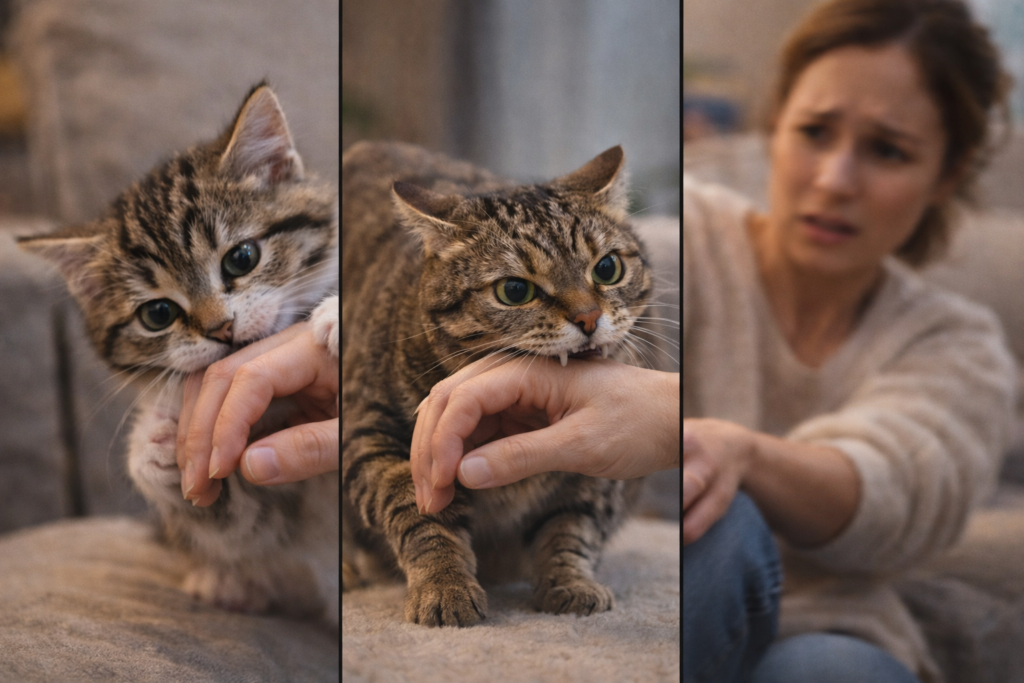
Cat aggression does not appear overnight. It unfolds quietly over weeks, months, or even years often unnoticed until the situation feels unmanageable. What begins as a playful nip becomes a conditioned response, then eventually a default behavior. By the time a cat is biting hard, fast, and without warning, the groundwork has already been laid through long-term reinforcement and miscommunication.
The Timeline of Escalation
Understanding how this process evolves is essential if you’re trying to reverse it. The shift from innocent behavior to aggression happens in stages each shaped by how humans respond.
- Play Biting
This starts in kittenhood. It looks harmless and often feels endearing. A light nip during play, a little mouthing of fingers. If the behavior is not redirected early especially if hands are used as toys, it becomes normalized. - Reactive Nipping
As the cat grows and its nervous system matures, the bite gains force. Nipping now occurs during overstimulation, minor frustration, or when the cat wants to end interaction. At this point, many owners start noticing discomfort but may still excuse the behavior as “quirky.” - Conditioned Attack Behavior
If left unchecked, the cat begins to use biting deliberately and efficiently to control its environment. The behavior is no longer playful or reactive it is preemptive and practiced. This is when owners report that their cat bites suddenly without any clear cause.
But that “sudden” moment is the endpoint of a long behavioral arc that has gone unaddressed.
Reinforced by Results
This is where many owners unintentionally lock in the behavior: they respond in ways that reward the bite.
- If the cat bites and the hand withdraw: it worked.
- If the cat bites and the play stops: it worked.
- If the cat bites and the person react emotionally (yells, jumps, or runs): it worked.
The cat learns that biting gets results faster and more reliably than any other communication. The nervous system adapts. The threshold for biting lowers. Over time, the cat bites sooner, with greater intensity, and with fewer signals leading up to it.
This is how a once-playful cat becomes one that seems unpredictable and aggressive.
Speed, Pressure, and Loss of Warnings
As the pattern deepens, several dangerous changes occur:
- Increased speed: The cat moves from stimulus to bite in seconds.
- Greater pressure: The bite breaks skin, not just startles.
- Reduced warnings: Ears, tail, posture these signs disappear. Why? Because the cat learned humans don’t respond to subtle cues, so it skips straight to what works.
By now, the behavior is not only a habit it’s neurologically efficient. The brain has created a shortcut: frustration = bite.
Reversing this at this stage is still possible, but much more difficult. It will require unlearning a response that has been repeatedly reinforced over months or years.
What Biting Does to the Human–Cat Relationship
As aggression escalates, something deeper begins to break: trust.
- People stop initiating contact with the cat.
- Visitors are warned or kept away.
- The cat is confined, isolated, or avoided.
Fear begins to replace affection. This emotional erosion changes how the cat is treated. Interactions become tense. The home becomes a stressor. And in response, the cat becomes more defensive, more anxious, and more prone to biting. It becomes a feedback loop: fear drives behavior, behavior fuels more fear.
Isolation, Rehoming, or Worse
If intervention doesn’t happen, the long-term outcome is rarely good.
- Some cats are banished to a back room or garage, denied affection or stimulation.
- Others are surrendered to shelters, labeled “aggressive” or “unpredictable” which makes adoption unlikely.
- In severe cases, euthanasia is considered. Not because the cat is beyond saving, but because the relationship has been damaged beyond repair.
The tragedy is that nearly all of these outcomes are preventable if the biting had been taken seriously early on.
Why Timely Action Matters
If you’re wondering how to stop cat aggression, this is where the answer becomes clear:
Stop waiting.
Every bite teaches the cat that aggression is functional. Every delay in correction makes that behavior harder to undo. Escalation is not an accident it is the result of inaction, misunderstanding, or inconsistency. You don’t stop biting by reacting to the bite. You stop it by preventing the need to bite in the first place.
That means:
- Addressing the environment
- Changing how you play
- Learning to recognize signals
- Stopping reinforcement loops
- And rebuilding trust before it breaks completely
By understanding escalation as a process not a personality you give your cat a chance to change and you give the relationship a chance to heal.
What Must Be Done Immediately
When a cat begins to bite frequently, especially without clear warning, many owners fall into one of two unhelpful patterns: they either ignore it, hoping it resolves on its own, or they try to assert dominance through punishment. Both approaches make the problem worse.
If you’re serious about learning how to stop cat aggression, you must act immediately and you must do it with purpose, clarity, and calm. This is not about control. It is about intervening before damage becomes irreversible to the cat’s behavior, to your relationship, and to your household’s safety.
1. End All Hand-Based Play Immediately
This cannot be overstated: your hands must never be part of the game. When cats are allowed to chase, bite, or swat at fingers, they learn one core lesson: human skin equals prey. That pattern reinforces every time you move your hand, laugh at the interaction, or allow it to continue “just this once.”
To stop the reinforcement loop:
- No more finger wrestling
- No tickling the belly
- No teasing with feet under blankets
The message must be consistent: hands are for affection, not for hunting. This single step can reduce a significant portion of biting behavior within weeks if practiced without exception.
2. Replace With Targeted Enrichment
Stopping the behavior is only half of the equation. The other half is redirecting the energy somewhere appropriate. Cats bite because they need stimulation. If you remove the biting without providing an outlet, frustration will escalate and may return in more dangerous forms.
What you must do instead is provide structured enrichment, including:
- Wand toys that keep distance between your hand and the toy (e.g., feather wands, fishing pole-style toys)
- Kicker toys for full-body engagement and safe biting
- Vertical climbing structures like cat trees, window shelves, or wall-mounted perches
- Interactive puzzle feeders to activate hunting instincts during mealtime
This is how you fulfill their natural behavioral needs without inviting aggression. If you’re unsure how to play with a cat without encouraging aggression, this is the blueprint. You can explore more enrichment ideas for indoor cats that align with feline instincts.
Think “chase and capture,” not “grab and wrestle.”
3. Learn and Respect the Body’s Signals
Your cat is not unpredictable. You just haven’t learned its language yet.
Start watching for:
- Tail flicking
- Ear rotation or flattening
- Pupils widening
- Skin twitching
- Sudden stillness
At the first sign of agitation, stop what you’re doing. Back off calmly. Let the cat walk away or settle down.
This teaches the cat two critical lessons:
- You respect its boundaries
- It doesn’t need to bite to end interaction
Respecting body language is the most powerful way to re-establish trust and safety.
4. Eliminate Punishment Completely
Many owners respond to biting with yelling, tapping the nose, or worse spray bottles or forced isolation. This is a critical mistake.
Punishment teaches fear, not boundaries. A punished cat doesn’t learn what not to do. It learns that you are unpredictable, and potentially dangerous. This increases anxiety-based aggression, especially in already fearful or under socialized cats.
What works instead:
- Calm withdrawal of attention
- Redirecting energy with toys
- Predictable routines
You’re not trying to dominate your cat. You’re trying to create a safer emotional environment one where biting is no longer necessary or functional.
5. Rule Out Medical Causes Immediately
Before assuming the behavior is purely emotional or environmental, you must eliminate physical pain as a factor.
Schedule a veterinary checkup and request a full physical exam with attention to:
- Dental disease
- Joint or spinal discomfort
- Gastrointestinal pain
- Skin conditions (especially around grooming-sensitive areas)
- Neurological triggers
A cat in pain will often bite reflexively when touched even by someone it trusts. If biting behavior appears suddenly or increases rapidly, a hidden medical issue is a high probability.
Treating behavioral symptoms while ignoring pain is not just ineffective it is inhumane.
6. Frame This as Trauma Prevention
You are not just managing a behavioral quirk. You are interrupting a pattern that, if left unchecked, can lead to:
- Escalated aggression
- Permanent fear response
- Surrender to a shelter
- Euthanasia due to liability
By acting now, you are preventing future trauma for your cat, and for everyone in your home. The goal is not control. It’s correction, healing, and rebuilding safety on both sides of the relationship.
Aggression in cats does not “burn out.” It builds. But so does trust if you begin the repair process immediately and stay consistent.
The next move is yours. And it needs to happen today.
Long-Term Management

Stopping cat aggression isn’t about quick fixes or clever tricks. It’s about rewiring behavior over time through stability, structure, and a renewed relationship based on clarity and trust. Once immediate changes are in place, the next phase is long-term behavioral management. This is where meaningful transformation happens but only if you commit to consistency.
You must understand: aggressive behavior doesn’t vanish. It’s replaced. What you build over the next weeks and months determines whether your cat learns peace or sharpens survival instincts.
The Importance of Structure and Consistency
Feline behavior thrives on predictability. Randomness creates stress, and stress creates aggression. Cats that bite are often living in a world they don’t fully understand where affection turns into overstimulation, where rules change daily, and where their cues are ignored or misread.
The solution? Daily structure.
- Feed your cat at the same times each day.
- Play at consistent intervals.
- Don’t allow chaotic bursts of interaction or rough handling at unpredictable times.
A reliable rhythm reduces anxiety. And with less anxiety, the likelihood of aggressive behavior drops dramatically.
Play Should Follow the Natural Sequence
In the wild, cats hunt, catch, kill, eat, groom, and sleep. This isn’t just a survival routine it’s a neurochemical sequence that regulates their emotional state.
Use this model to guide your play sessions:
- Hunt – Use wand toys that simulate prey (move them erratically, not directly at the cat).
- Catch/Kill – Let the cat win. Don’t snatch the toy away every time.
- Eat – Offer a treat or small meal immediately after.
- Groom/Sleep – Let the cat rest without stimulation.
Following this hunt-catch-kill-eat-groom-sleep cycle not only satisfies instinct but also teaches the cat how to wind down safely.
Many aggressive cats never reach the “groom/sleep” stage because play ends abruptly or without closure. That unresolved arousal? It often resurfaces as biting later in the day.
Let the Cat Take the Lead in Rebuilding Trust
Trust must be rebuilt on the cat’s terms. That means:
- Don’t initiate petting sessions without invitation.
- Let your cat approach you, not the other way around.
- Don’t hover or attempt forced affection.
- Stop interacting the moment signs of discomfort appear.
Every time you respect a boundary, the cat learns: you are safe. And when safety becomes predictable, biting becomes unnecessary. This isn’t just about stopping attacks. It’s about removing the emotional triggers that made biting necessary in the first place.
Tools for Long-Term Behavioral Enrichment
Cats with a history of aggression need an environment designed to regulate not provoke their nervous system. This includes:
Puzzle Feeders
Stimulate hunting behavior and reduce food-boredom aggression. Scatter feeding, treat-dispensing balls, and slow feeders work well.
Scent-Based Calming Aids
Synthetic feline pheromone diffusers (like Feliway) can help reduce territorial stress and anxiety. These are especially useful in multi-cat homes or apartments.
Vertical Territory & Safe Spaces
Give your cat the option to retreat. High shelves, enclosed cat beds, or hidden corners let them self-regulate without confrontation.
Long-term management isn’t just about “correcting” behavior. It’s about creating an environment that doesn’t give aggression a reason to exist.
Access to Professional
In North America, the UK, and much of Europe, certified feline behaviorists are increasingly accessible both in-person and online. These professionals specialize in non-coercive, species-appropriate intervention plans.
- In the United States and Canada, look for Certified Applied Animal Behaviorists (CAABs) or veterinarians with behavior specialization (DACVBs).
- In the UK and EU, organizations like the International Cat Care (ICC) or the Association of Pet Behavior Counsellors (APBC) offer qualified referrals.
- In Australia and New Zealand, feline behavior support is more limited regionally, but tele-consults through international services (Fear Free Pets, PetCoach, Vetster) are viable alternatives.
If your cat’s aggression has escalated despite your efforts, professional support is not a luxury it is a necessity.
Long-Term Success Comes from the Ground Up
You must resist the urge to look for a single turning point.
Behavioral change is layered:
- First the triggers are removed.
- Then the routine is rebuilt.
- Then trust is earned slowly, interaction by interaction.
Cat biting behavior, when explained accurately, is not just about what happens in the moment. It’s about everything that came before and everything that comes after.
The aggression you see today may be a product of months or years of confusion, frustration, or fear. But if you begin replacing that history with consistent safety, daily structure, and proper outlets, the pattern can be rewritten.
Not instantly. Not without setbacks.
But permanently if you stay the course.
Common Mistakes and False Beliefs
When dealing with feline aggression especially biting many owners operate under deeply flawed assumptions. These aren’t just harmless myths; they actively delay intervention, reinforce the wrong behaviors, and make recovery more difficult. If you want to truly understand cat biting behavior, you must confront these beliefs head-on. Because most long-term damage doesn’t come from the cat it comes from what the human does wrong, especially in the early months.
“He’s Doing It to Get Back at Me”
The myth of spite
Cats are not vindictive. They do not operate with human concepts of revenge or emotional manipulation. When a cat bites, it’s reacting to a stimulus, stressor, or pattern not plotting payback.
Thinking your cat is biting “because he’s madded at you” anthropomorphizes complex behavior and often leads to punishment or resentment. In reality, the cat is responding to:
- Overstimulation
- Fear
- Lack of outlet
- Prior reinforcement
Assigning moral intent to animal behavior is one of the fastest ways to misdiagnose the real issue and to respond in ways that make it worse.
“He’s Dominant”
Dominance theory does not apply to cats
Dominance-based behavior models, long discredited in dog training, are completely irrelevant for feline behavior. Cats are solitary hunters by nature, not pack animals with hierarchical structures.
Aggressive behavior is not an attempt to dominate you. It’s an attempt to:
- Create space
- Regain control
- Communicate discomfort
If you respond with “dominance tactics” like physical restraint, forced petting, or verbal intimidation you escalate the cat’s fear response. This leads to more defensive aggression, not less.
You don’t earn trust by asserting control. You earn it by respecting signals and creating safety.
“It’s Just His Personality”
Behavior is not identity
Many owners label their cat’s behavior as inherent: “He’s just spicy”, “She’s always been that way”, or “That’s just how he plays.”
But aggression isn’t a fixed trait it’s a learned response to unmet needs. This belief becomes dangerous because it:
- Justifies inaction
- Stops people from seeking help
- Turns a treatable issue into a lifelong excuse
You must separate the cat’s behavior from its identity. One can change. The other is being misunderstood.
“I’ll Wait and See if It Gets Better”
Waiting equals deeper reinforcement
This is perhaps the costliest mistake. Every day you allow biting to continue, you allow the cat’s nervous system to solidify the behavior. Neural pathways become more efficient. The response becomes more automatic. Waiting doesn’t freeze the problem. It fuels it.
What begins as a minor behavioral concern becomes a permanent feature of the cat’s interaction style. At that point, correction is possible but far harder and slower.
Aggression is not a phase. It is a feedback loop. And the longer it’s allowed, the stronger it becomes.
Yelling, Spraying, or Physical Correction
All of these backfires neurologically
Punishment doesn’t discourage aggression it feeds it. Whether you yell, use a water spray, hiss at the cat, or tap them physically, the outcome is the same:
- Increased cortisol (stress hormone)
- Deeper mistrust
- Stronger defensive behavior
In essence, you teach the cat that you are unsafe, and that aggression is necessary for self-protection. The next bite comes faster and harder.
Even verbal punishment (raising your voice or tone) can increase arousal and anxiety in sensitive cats.
The correct response is calm disengagement, redirection, and environmental adjustment not confrontation.
Human Behavior in the Early Months
When we talk about cat biting behavior explained, the real cause often lies in what humans did or failed to do early on:
- Using hands for play
- Ignoring overstimulation signals
- Failing to provide enrichment
- Delaying vet checks for pain
- Punishing out of frustration
- Mislabeling trauma as “personality”
Cats learn through repetition and consequence. And when their first months in a home are filled with mixed signals, unmet needs, or fear-based responses, the long-term impact is almost guaranteed.
Aggression is rarely a mystery. It’s almost always the outcome of a misaligned environment paired with poor human interpretation.
You don’t need to be perfect. But you do need to be honest and willing to correct the real source of the problem: your own behavior first.
When Professional Intervention Is Required
There’s a point where personal effort and environmental tweaks aren’t enough. When a cat’s aggressive behavior persists or worsens despite consistent changes at home, the issue moves beyond basic management. This is when professional intervention becomes not just advisable, but necessary.
And if you’re hesitating because you believe asking for help is an admission of failure, you’re making a dangerous mistake. In reality, seeking expert support is an act of responsibility, not surrender.
Signs That You Need Expert Help
Many owners push through escalating behavior for months or even years, hoping things will improve. But there are clear indicators that DIY correction won’t be enough:
- Bites that draw blood
This is not playful or accidental. Once a cat is biting with enough force to break skin, it signals a breakdown in inhibition and control. - Lack of visible warning signs
If the cat bites without the usual cues tail flicking, ear flattening, posture changes this often means the signals have been ignored so often that the cat no longer gives them. This is a critical stage. - Aggression escalates despite structured changes
If you’ve removed hand play, introduced enrichment, respected signals, ruled out pain and the aggression still increase then the behavior is no longer situational. It’s entrenched. - Other pets or people are at risk
When aggression expands beyond one target when the cat starts attacking other animals or multiple people in the household intervention is no longer optional. Someone is going to get hurt. - The cat is creating fear in the home
If children are afraid to walk by, if guests are warned not to interact, or if you avoid petting your own cat out of anxiety, the damage is not just behavioral it’s relational.
At this stage, you’re not just trying to correct behavior. You’re trying to salvage the relationship before it becomes unrepairable. If you’re unsure where to start, this cat behavior consultation guide offers qualified help.
Not All “Trainers” Are Qualified
One of the biggest missteps owners make is hiring the wrong kind of help. Most pet trainers are not equipped to handle feline aggression. Cats are neurologically and behaviorally different from dogs, and many generalist trainers apply techniques that do more harm than good.
Here’s what you need to look for:
- Certified Feline Behaviorists
These specialists understand species-specific behavior, trauma history, environmental triggers, and non-coercive behavior modification. Depending on your region, look for:- CAAB (Certified Applied Animal Behaviorist)
- CCBC (Certified Cat Behavior Consultant)
- Veterinary Behaviorists (DVM with behavior specialty)
- Veterinary Behaviorists
For cases involving fear aggression, trauma, or suspected neurological issues, board-certified veterinary behaviorists can provide both behavioral plans and medical intervention when needed.
Localized Help for Cat Owners
If you live in an area where feline behavior experts are scarce, you’re not out of options. Many high-quality services now offer remote consultations, especially in underserved areas like:
- Australia & New Zealand
While feline behaviorists are relatively rare outside of major cities, online consults are available through platforms like VetBehaviourTeam.com.au and international behavior services that accept remote clients. - Rural Canada & UK Countryside
If you’re hours from a major center, seek virtual sessions through:- Pet Coach
- Vetster
- International Association of Animal Behavior Consultants (IAABC)
- USA (Urban or Remote)
The US has better access overall, but even here, many owners are unaware they can book behavior consults entirely online. Use Fear Free Certified directories or search for DACVB-certified specialists.
Don’t wait until things get critical. Remote doesn’t mean less effective. Many cats respond faster to virtual plans because stress is lower in the home environment.
Seeking Help Is a Step Toward Repair, Not Defeat
Too many people delay professional help out of pride, denial, or fear of judgment. But by the time biting becomes frequent or severe, the problem is rarely something you can fix alone.
Asking for help:
- Doesn’t mean you’re a bad owner
- Doesn’t mean your cat is beyond saving
- Does mean you’ve chosen to protect your cat and everyone around it
When people search “how to stop cat aggression”, they often expect a single trick or tactic. But as this article has shown, cat biting behavior is shaped by many overlapping factors neurological, emotional, environmental, and learned. Some of these go deeper than what household routines alone can resolve.
The longer you delay, the more damage is done. And not just to your skin but to trust, safety, and your bond with the animal.
If the warning signs are there, stop hoping it will fade.
Pick up the phone. Book the consult.
Start the repair process before the damage becomes permanent.
Conclusion
Cat biting is not a defect. It’s not a sign that your cat is broken, or mean, or unlovable. It is a form of communication often the only one the cat feels it has left.
Every bite is a message. Every escalation is a signal that something in the cat’s world has been misunderstood, ignored, or mishandled. And if you’ve come this far in the article, then you already know: this isn’t about “fixing” your cat.
It’s about taking a long, honest look at the role you play in shaping the behavior you now want to change.
This is where many owners falter because facing that responsibility can feel overwhelming. But that responsibility is the most powerful tool you have.
When a cat bites, it is responding to its environment, its past, and above all, your behavior.
- Were you using your hands as toys?
- Did you ignore early signs of stress or overstimulation?
- Did you punish the behavior instead of understanding its root?
- Did you delay taking action, hoping it would “get better on its own”?
These are hard questions. But answering them honestly is what separates those who lose the bond and those who rebuild it stronger than before.
Cat biting behavior, explained fully, is rarely about the cat alone. It is the outcome of thousands of micro-interactions, patterns, reinforcements, and missed opportunities for clarity. If you want to stop aggression, you must first stop misunderstanding.
Behavior does not form in a vacuum. And it doesn’t correct itself, either. You are not powerless, you are not late.
But you are accountable.
You either address the pattern now clearly, consistently, and compassionately or you pay the price later.
That price may be a broken bond. It may be physical injury, it may be the heartbreak of surrendering a cat that could have been saved had the effort been made earlier.
Biting is not a moral failure. It is a consequence of unmet needs, unspoken fear, or unresolved confusion.
And every one of those things is something you, as the human, have the power to change.
Start now. Start right.
Because behavioral problems are not permanent. But neither is trust and the longer you wait, the harder it is to get it back.
Frequently Asked Questions (FAQ)
1. Why does my cat bite me out of nowhere?
Cats rarely bite without warning what appears sudden is usually a missed buildup of stress signals. Tail flicking, ear rotation, or skin twitching are often present before the bite. Ignoring these cues leads to escalation.
2. How do I stop my cat from biting me during play?
Stop using your hands or feet as toys. Instead, redirect energy using wand toys, kicker toys, and structured play sessions. Always allow your cat to “catch” the toy and end play calmly to avoid frustration-driven biting.
3. Is cat biting a sign of aggression or just overstimulation?
It can be either. Overstimulation leads to biting when a cat’s sensory threshold is exceeded especially during petting. True aggression often develops from stress, fear, trauma, or past reinforcement of biting behavior.
4. Can early trauma cause a cat to become aggressive?
Yes. Cats that experienced early trauma such as abuse, abandonment, or improper socialization are more prone to fear-based biting. These cats often bite defensively and need time, structure, and professional support to recover.
5. Should I punish my cat for biting me?
No. Punishment increases fear and can make aggression worse. Cats do not respond to punishment like dogs or humans. The correct response is calm disengagement, environmental adjustment, and positive redirection.