
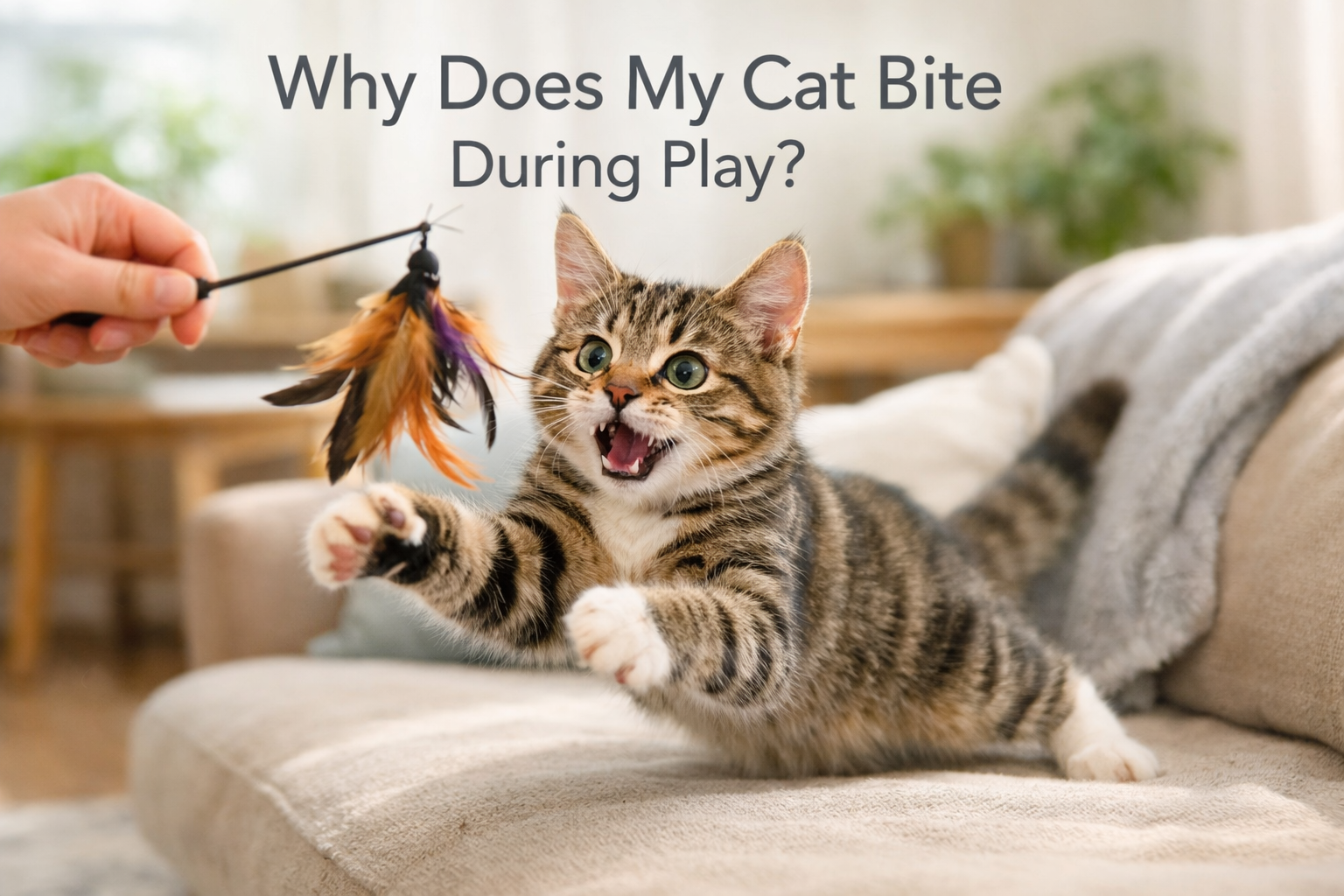
One second you’re tossing a toy mouse, the next your cat clamps down on your hand like it’s prey. You flinch, confused why does my cat bite during play when we were just having fun? You’re not alone. This throws off a lot of first-time cat owners.
Here’s the truth: this biting isn’t about anger, and it’s definitely not personal. Cats aren’t being mean, they’re acting on instinct. Even the sweetest indoor kitty has a wild little hunter built in. What feels like an ambush to you might just be “target practice” to them.
Understanding what triggers this behavior is the first step toward changing it. And once you do, playtime becomes fun again for both of you. In this guide, we’ll unpack the hidden reasons behind those surprise chomps, help you read the warning signs, and show you exactly how to stop biting the right way. Let’s fix it.
Is It Normal When a Cat Bites During Play?
Yes, it’s totally normal and no, it doesn’t mean your cat is broken or aggressive.
Play biting is especially common in kittens and young cats under two years old. Think of it like a toddler who hasn’t learned personal space yet. They’re full of energy, running on instinct, and still figuring out the rules of what’s okay and what’s not. Biting is simply part of how they explore the world and interact especially when they’re hyped up.
That said, normal doesn’t mean harmless. Just because it’s natural doesn’t mean you should let it slide. A quick nip may seem cute at first, but if it turns into a habit, it gets harder to break later and your hands will pay the price. Even playful bites can hurt, especially as cats grow stronger and more confident. So yes, it’s normal but it still needs to be redirected.
Age plays a huge role. Kittens bite because they’re learning boundaries. Teenagers (6–12 months) bite because they’re overstimulated and bored. Adult cats? If they’re still biting during play, it’s usually because they were never taught the right way to interact or they’re not getting enough physical and mental stimulation.
The living environment matters too. Indoor cats often bite more during play because they have fewer natural outlets for their energy. Outdoor cats burn energy chasing bugs or climbing trees. A cat in a single-pet home is also more likely to fixate on you as their main playmate, which means more pouncing, more chasing, and yes more biting. In multi-cat homes, rough play gets spread around.
So don’t panic. You’re not alone, and your cat isn’t turning into a mini serial killer. This is just part of the learning curve for both of you. The key is knowing when to step in, how to read the signs, and how to guide your cat toward healthier, safer play. That’s what we’ll cover next.
The Natural Instinct Behind Play Biting
Playtime for cats isn’t just fun, it’s training for survival. When your cat pounces, bites, or grabs, they’re not being moody or mean. They’re running through a built-in sequence that every feline, wild or tame, follows. It starts with stalking, builds into a chase, leads to a grab, and ends with a bite, sometimes even a “kill bite.”
The problem? We often interrupt this instinctual pattern halfway through. And when a cat doesn’t get to finish the job, that tension builds up fast. That’s when the bites show up. Understanding this natural drive is the first step to changing how you play with fewer scratches and a lot more harmony.
Cats Are Practicing Hunting Not Playing “For Fun”
When your cat pounces on your hand like it’s a wounded bird, it’s not trying to be dramatic, it’s following a survival script millions of years old. What looks like a quirky play session to us is, to your cat, a serious hunting rehearsal. And that changes everything.
Here’s the sequence hardwired into every cat: stalk → chase → grab → bite → kill bite. Even tiny kittens know this drill. It’s not personal, it’s primal. That playful leap off the couch? Stalking. The wiggle before the lunge? Pure predator mode. The sudden chomp on your wrist? That’s the bite-to-kill reflex kicking in. It’s the moment in the wild when the prey stops moving.
Now here’s where it gets messy: humans interrupt the process. We squeal, yank our hands back, or stop the game right at the climax. Imagine playing a sport where you’re never allowed to score frustratingly, right? That’s how your cat feels when they’re chasing but never get to “finish” the hunt. The result? A bite thrown in out of pure instinctual overflow.
This is where most cat advice online misses the point. They treat biting as misbehavior, when it’s actually the natural end to a cycle that we accidentally trigger. Your cat isn’t trying to hurt you, they’re just doing what their wild ancestors did to survive. The trick is to give them a way to complete the cycle safely, without using your skin as the practice dummy. We’ll get to that part soon.
Why Cats Bite During Play
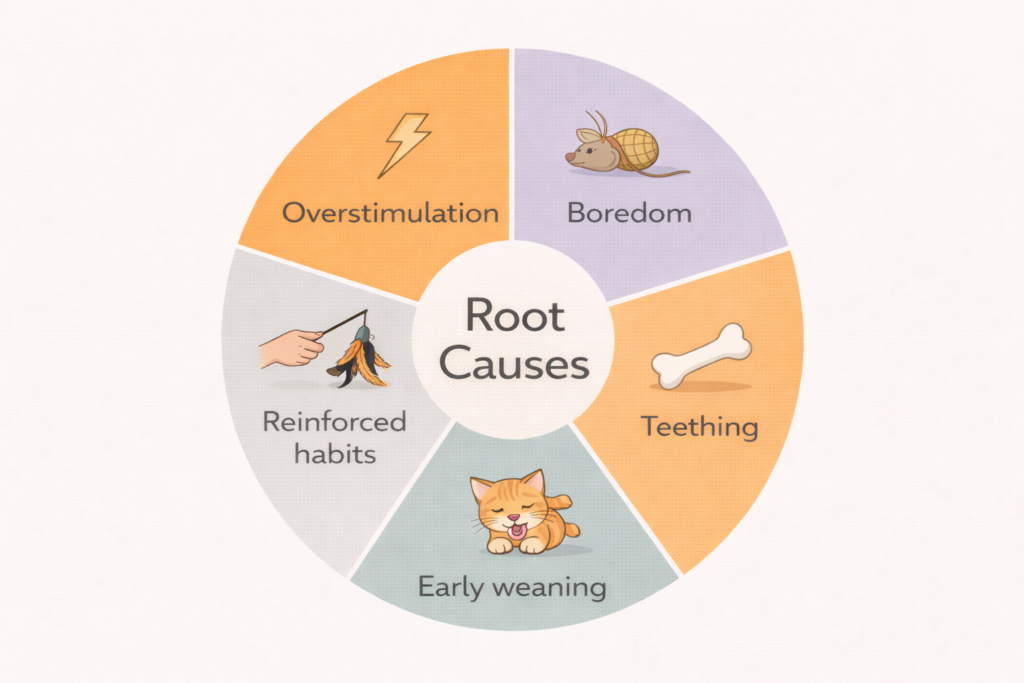
There’s no single reason your cat bites during play; it’s a mix of instinct, emotion, and learned habits. Once you know the “why” behind each bite, it’s way easier to stop it without ruining the bond you’re building. In this section, we’ll break down the most common causes of play biting, especially the ones most new cat owners miss.
Some reasons are rooted in your cat’s wiring. Others come from how we interact with them often without realizing we’re encouraging the very behavior we’re trying to stop. Let’s take a closer look at each one so you can spot what’s really going on when your cat suddenly turns playful into painful.
1. Overstimulation During Play
Cats have a hidden line between “this is fun” and “I’ve had enough.” Cross it too fast, and they snap. This is called the threshold, and once your cat hits it, they may bite as a way to dump that built-up tension. You’ll often see a sudden pause mid-play, a frozen body, or a low tail twitch right before it happens.
Look out for the subtle signals: dilated pupils, ears turning sideways, skin rippling across the back. These aren’t random, they’re warnings. Too much excitement, too fast, can flip your cat from playful to reactive in seconds. Knowing when to slow down or stop is key to keeping playtime safe.
2. Hands Used as Toys (Major Mistake)
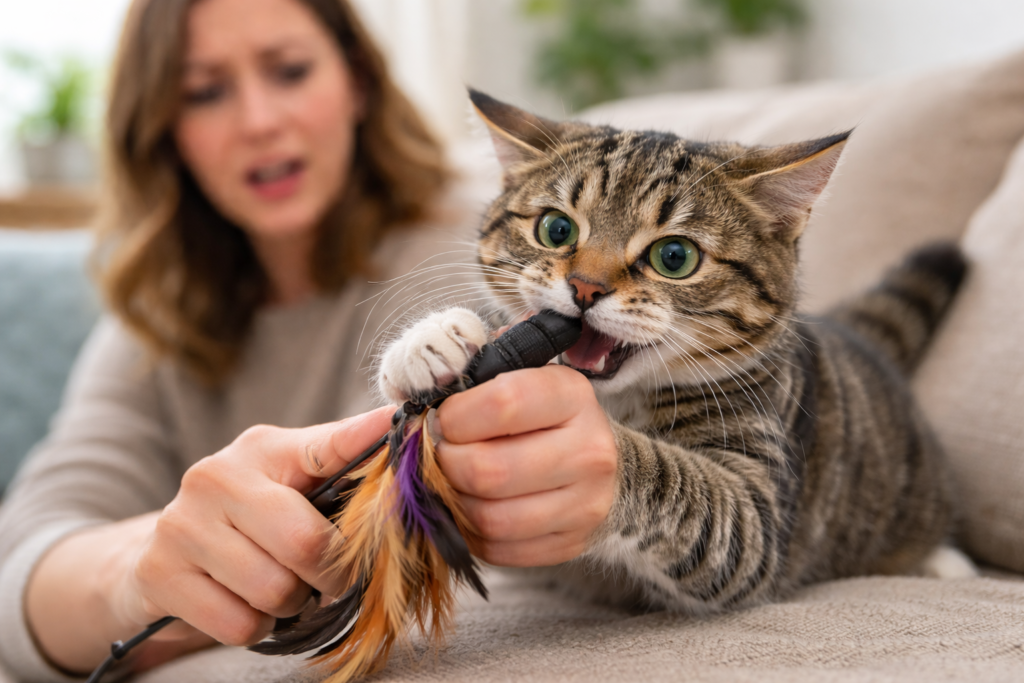
Let’s be blunt: if you play with your hands, you’re training your cat to attack you. Full stop. It might seem cute when they’re tiny, but that same behavior with adult teeth? Not so funny anymore.
Cats don’t get the difference between “gentle nibbles” and real hunting. To them, movement equals prey. Fingers that wiggle look like mice trying to escape. When you let your cat chase or grab your hands, you’re basically saying, “Go ahead, bite this.” Stop doing it. Use a toy. Always.
3. Excess Energy and Boredom
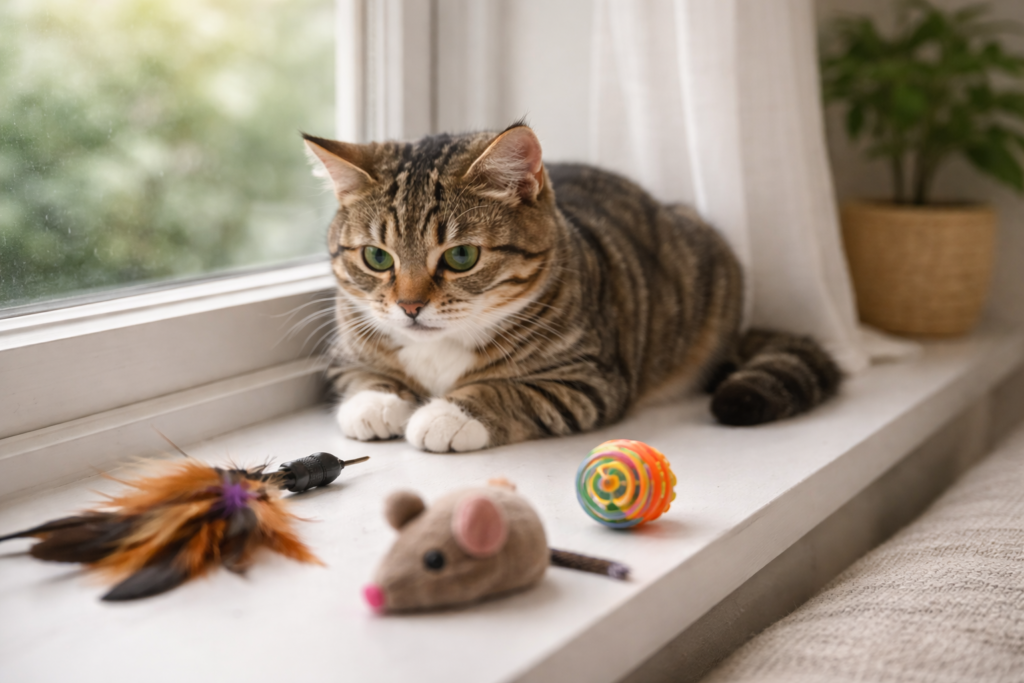
Cats are wired to move. Indoor cats? Not so much. When there’s no outlet for their natural energy, it builds up and bursts out in random attacks during play.
You might notice it most in the evenings. This is called the “cat zoomies” for a reason. If your cat starts biting or lunging during play, it could just be stored-up energy looking for release. Regular, structured play sessions help a lot here. A tired cat is a calmer cat.
4. Early Separation From Mother or Littermates
If your cat was adopted young or rescued as a kitten, this might be a hidden cause. Kittens learn bite control from playing with their siblings. They bite, get bitten back, and figure out when it hurts.
When that feedback loop is cut short like in early-weaned or bottle-fed kittens they miss a key part of social development. These cats often bite harder and more unpredictably. It’s not their fault. They just didn’t get the chance to learn what “too rough” feels like.
5. Teething (3–6 Months)
If your kitten is biting everything from your toes to your phone charger, teething is likely the reason. Around 3 to 6 months, adult teeth start pushing in, and their gums get sore just like human babies.
Chewing eases the discomfort, so they bite anything in reach. This is normal, temporary, and manageable. Offer soft, kitten-safe chew toys. Don’t scold redirect. They’re not being bad. They’re just uncomfortable and doing what their instincts tell them.
6. Learned Behavior Reinforced by Humans
Here’s the part most people miss: you might be accidentally rewarding the biting. If your cat bites and you react loudly, yank your hand, or laugh, it’s attention. And attention, to a cat, means do that again.
Even worse, if you keep playing after a bite, your cat thinks biting is part of the game. They learn that nipping gets a reaction and that sticks. The fix? Stay calm. End play immediately when a bite happens. No yelling. No drama. Just a clear signal that biting = game over.
Play Biting vs Aggression: How to Tell the Difference
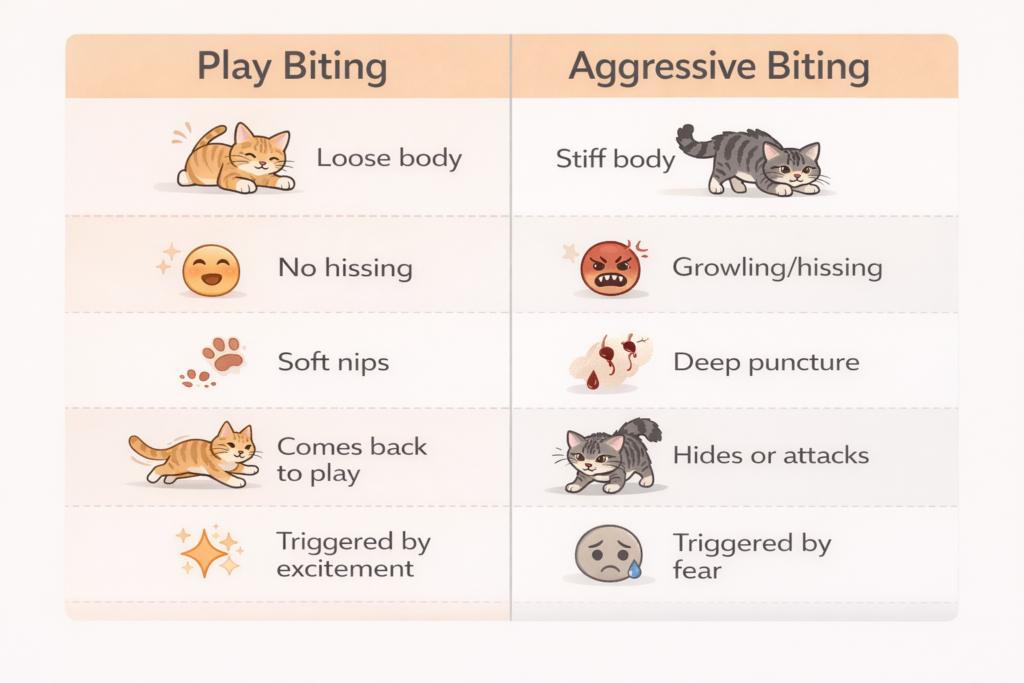
Not all bites are created equal. Some are playful warnings; others are serious signs of stress or fear. If you’ve ever pulled your hand back mid-bite wondering “was that fun or fury?” you’re not alone. This is one of the most confusing parts of living with a cat, especially for new owners.
The good news? Once you learn to read the signals, the difference becomes crystal clear. Your cat’s body language gives everything away. You just need to know what to look for.
Here’s a quick cheat sheet to help you tell playful nips from aggressive strikes:
| Play Biting | Aggressive Biting |
| Loose, wiggly body | Stiff, tense posture |
| No hissing or growling | Growling, hissing, or spitting |
| Gentle nips, no injury | Deep puncture wounds |
| Returns for more play | Hides or escalates to attack |
| Triggered by excitement | Triggered by fear or pain |
If your cat bites but then runs off to hide, flattens their ears, or stares at you with huge, panicked eyes it’s not play. That’s defensive aggression, and it needs a calm, cautious response. On the flip side, if your cat bites and then immediately bounces back into pounce mode with their tail up and ears forward, it’s probably just them getting a bit too excited.
The key is pattern and context. Play biting has a rhythm to it. Aggression feels sudden and sharp, like a lightning strike. Learn to spot the difference, and you’ll handle each moment with the right reaction, no second guessing, no scratches, no stress.
Warning Signs Before Your Cat Bites
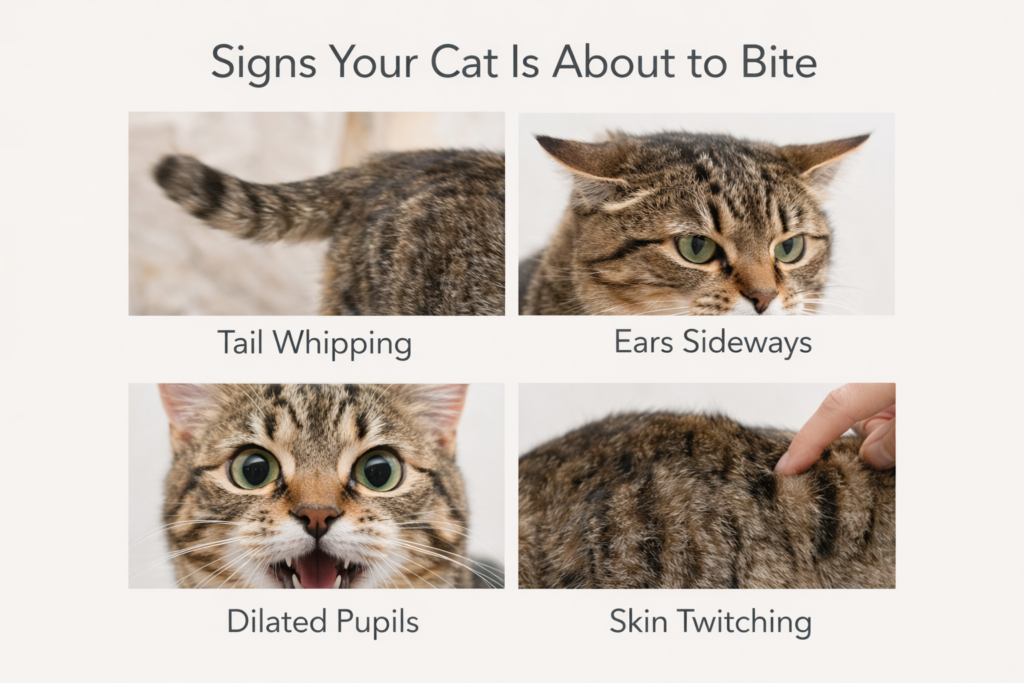
Here’s something most new cat parents don’t realize: cats almost always give a warning before they bite. It might not be loud like a dog’s growl, but the signs are there. Once you know what to watch for, you can avoid most bites altogether.
Think of these signs as your cat’s way of saying, “I’m getting overwhelmed,” or “Back off, I’ve had enough.” If you miss them, the bite that follows isn’t random, it’s a last resort. Here are the most common red flags:
- Tail whipping – A slow wag is fine. But if the tail starts thumping or lashing side to side, your cat is irritated and on edge.
- Sudden stillness – They freeze, pupils wide, body tense. This is the moment right before action, usually a bite or pounce.
- Ears rotating sideways – When the ears start turning outward or flattening, it’s not a cute look it’s a sign of overstimulation or discomfort.
- Eyes fully dilated – Big, black pupils mean high arousal. They could be excited or about to snap. Read it in context.
- Skin rippling – You’ll see the fur along their back twitch or ripple, especially when petting. That’s a sign they’re nearing their limit.
Every cat has their own threshold. Some give you lots of warning, others just a few seconds. The key is to stay alert and respectful. Recognize the buildup, and you can stop playtime before things turn painful. It’s not about walking on eggshells, it’s about learning the rhythm of your cat’s mood, like reading beats in a song.
How to Stop a Cat From Biting During Play (Without Punishment)
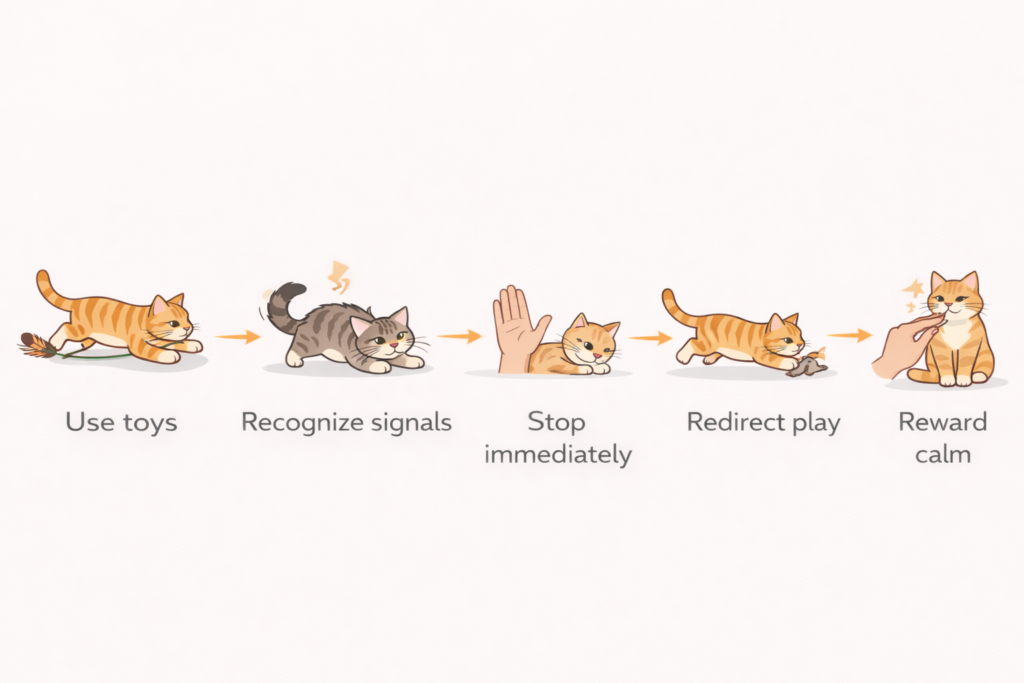
Stopping play biting isn’t about scolding or punishment, it’s about guiding your cat toward better habits. They’re not being “bad”; they’re reacting to instinct, energy, and the way we interact with them. The goal is to channel that energy in safer, healthier ways without damaging trust. Here’s how.
Use Toys Never Hands
This is rule number one: your hands are not toys. Ever. If you let your cat chase or bite your fingers, you’re teaching them that attacking skin is part of the game. It starts out harmless with a tiny kitten… until those baby teeth turn into adult fangs.
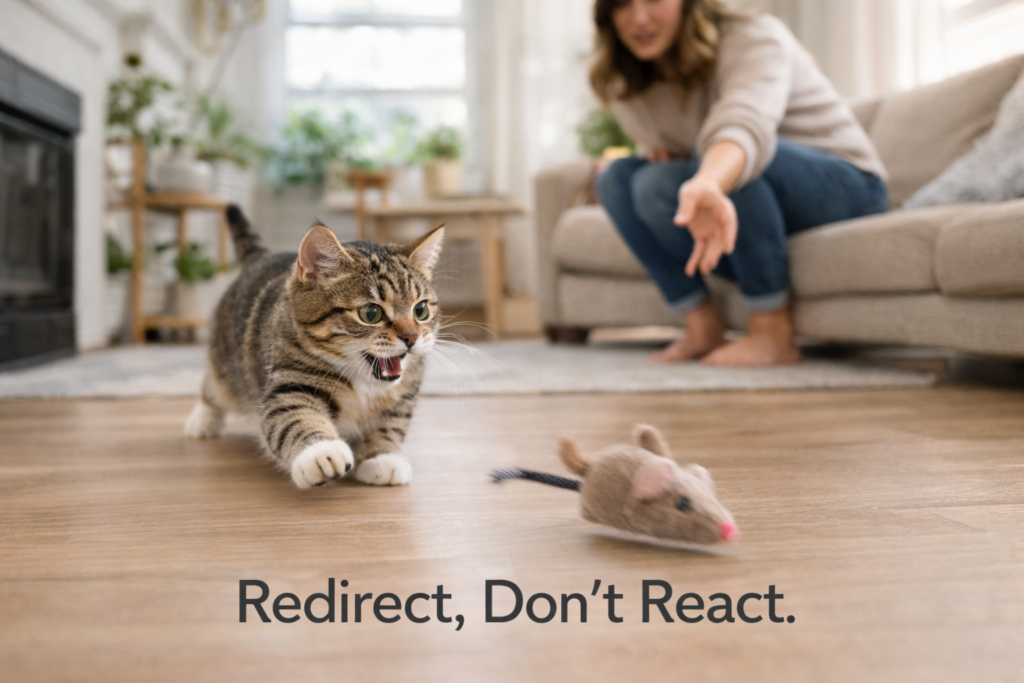
Instead, always put a toy between you and your cat during play. Wand toys, string chasers, feather sticks, anything that keeps your hands out of the danger zone. The more distance you create, the safer and more satisfying the play becomes for both of you.
End Play Immediately After a Bite
If your cat bites, stop the game immediately. No talking, no scolding, no dramatic exit. Just stand up, walk away, and give them a minute to cool down. This teaches a clear rule: “Bite = Game Over.”
It might feel harsh, but it’s actually kind. You’re giving your cat consistent feedback in a way they understand. Over time, they’ll start to connect the dots and learn that being gentle keeps the fun going.
Schedule 2–3 Structured Play Sessions Daily
Random bursts of play are fine, but cats thrive on routine. Plan two or three short sessions a day where you engage your cat fully with toys, movement, and energy. Think of it like scheduled “hunt time.”
Just 10–15 minutes per session is enough to burn off energy and give your cat the stimulation they crave. It also helps reduce those surprise attacks when your cat gets bored and starts using your ankles as prey.
Mimic Natural Hunt Sequence
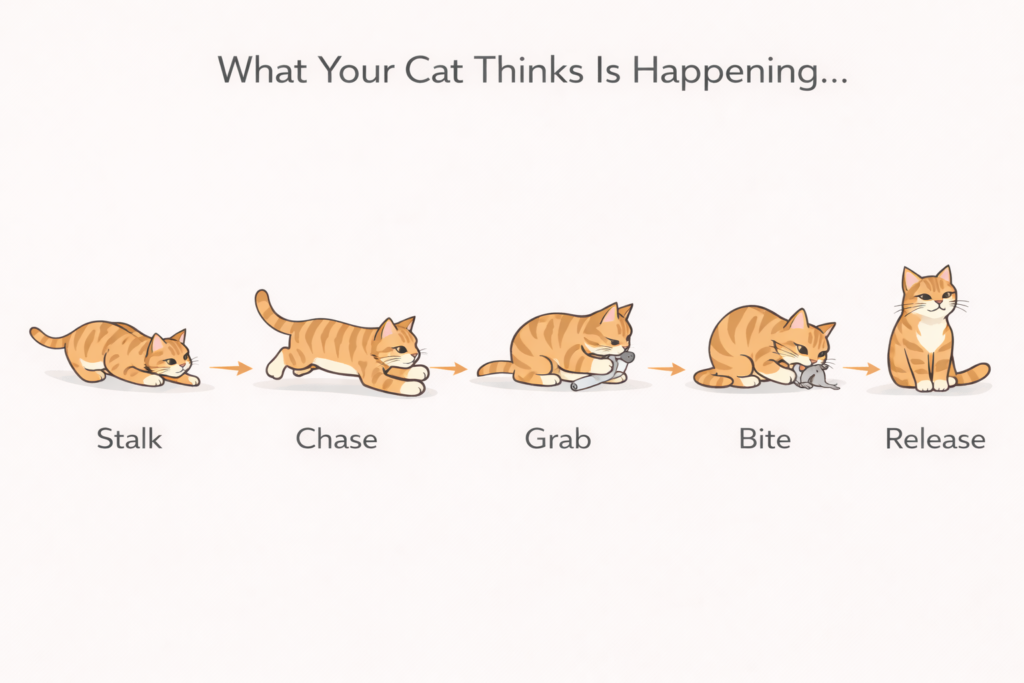
To make play satisfying, it needs to feel like a hunt. Start slowly dragging the toy as if it’s sneaking around. Let your cat stalk it. Then speed it up into a chase. Finally, let them catch it and “kill” it. End with a few calm seconds and maybe even a small treat.
This sequence matches what your cat would do in the wild: stalk → chase → grab → kill → eat → groom → sleep. When play follows that rhythm, your cat finishes the cycle relaxed and fulfilled, not frustrated and bitey.
Rotate Toys Weekly
Imagine if someone handed you the same exact toy every single day. You’d get bored too. Cats are no different. They get used to toys fast, and what once triggered excitement can become background noise.
Keep a few toys hidden and rotate them weekly. You don’t need 50, you just need to make them feel new again. A simple switch-up can reignite interest and prevent boredom biting.
Reward Calm Play
Cats learn fast when there’s something in it for them. When your cat plays gently, no biting, no claws reward that behavior. Use a calm voice, gentle petting, or a small treat to show them, “Hey, that was great.”
Don’t just focus on stopping the bad. Reinforce the good. Over time, your cat learns not just what not to do, but what you do want from them. That’s how real behavioral change sticks.
What NOT to Do
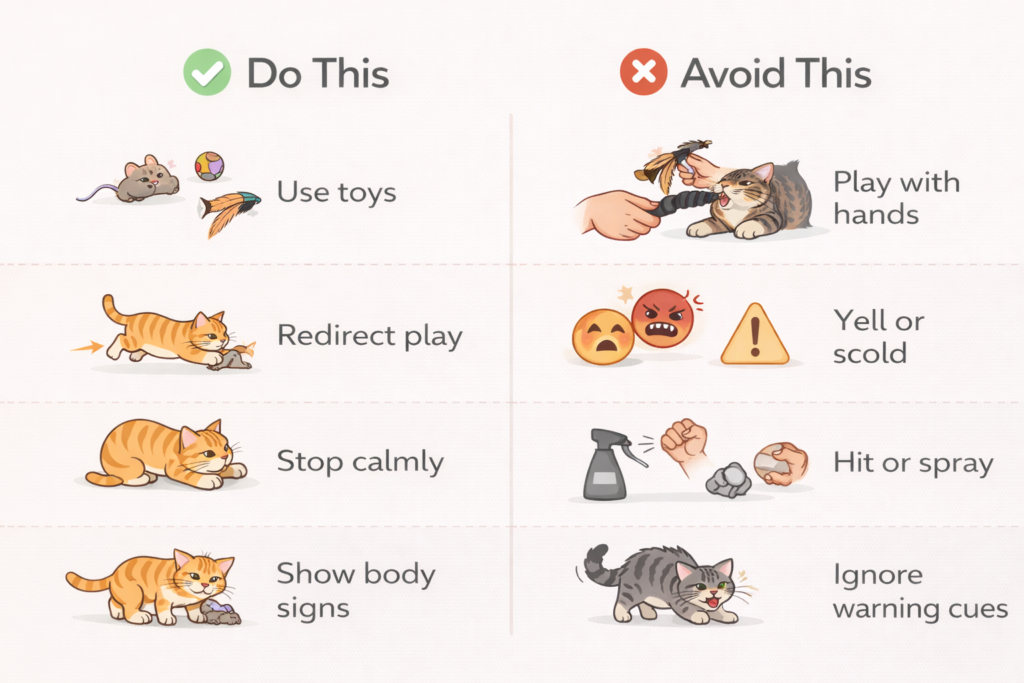
It’s easy to get frustrated when your cat bites you out of nowhere. But how you respond in that moment will either build trust or break it. Cats don’t understand punishment the way people do. Harsh reactions often make the behavior worse, not better. Let’s walk through what not to do and why.
Don’t hit
Even a light tap can deeply damage your bond. Cats are sensitive creatures. What feels like a “gentle smack” to you feels like violence to them. It breaks their trust and can make them fearful or worse, defensive. Some cats may stop biting… but only because they’re scared of you. That’s not the relationship you want.
Don’t yell
A loud “NO!” or raised voice might feel natural in the heat of the moment, but it doesn’t work. Cats don’t connect your volume with their actions. They only hear threat and chaos. This can heighten their arousal, making them more reactive or anxious. Think of it like trying to teach someone during an earthquake it’s noise, not learning.
Don’t spray water
Water bottles are often suggested online, but they do more harm than good. Spraying your cat might stop the behavior once, but it creates stress and confusion. Instead of learning “don’t bite,” your cat learns “don’t trust humans with spray bottles.” It’s a shortcut with long-term damage.
Don’t shake your hands away
The instinct to yank your hand when bitten is strong. But fast, jerky movements activate your cat’s hunting instincts even more. Pulling away teaches them to grab tighter next time. Instead, freeze your hand briefly, then calmly move it away. Stillness interrupts the prey signal.
Don’t continue play after biting
If you keep playing after a bite, you’re accidentally saying, “Biting is part of the game.” Your cat learns that nipping = more fun, not less. Always end play the moment a bite happens. No drama. Just a clear boundary. Over time, that message sinks in quietly but powerfully.Your cat isn’t trying to be bad. They’re trying to communicate in the only way they know. It’s your job to listen and teach in a way they understand. That starts with respect, not punishment. And it builds a relationship that’s rooted in trust, not fear.
When Play Biting Becomes a Problem
Most play biting is harmless and easy to fix with patience and structure. But sometimes, those little nips cross a line and that’s when you need to step back and ask, “Is this still normal?” Not all biting is playful. When it starts to feel intense, unpredictable, or painful, that’s a red flag.
Let’s talk about signs that the biting may be more serious than just roughhousing.
Skin-breaking bites
If your cat’s bite draws blood or leaves deep punctures, that’s not play, that’s aggression or fear. Play bites are controlled. Hard, painful bites are a sign your cat isn’t regulating their behavior. This needs to be addressed quickly, because it can turn into a habit that damages both your bond and your body.
Sudden personality change
If your sweet, calm cat suddenly starts biting during normal interactions especially if it happens out of nowhere it’s time to pay attention. This kind of shift could be stress-related, or a sign something deeper is going on emotionally or physically.
Fear-based behavior
Biting that comes with hiding, hissing, growling, or flinching means your cat isn’t playing they’re defending themselves. This often happens when cats feel cornered or unsafe. It may stem from past trauma, overstimulation, or even something as simple as being picked up when they weren’t in the mood.
Redirected aggression
Sometimes your cat gets worked up by something else: a bird outside, a strange smell, another pet and they suddenly turn that energy on you. This is called redirected aggression. It looks random, but it has a trigger. It’s confusing, especially when you weren’t even involved in the first place.
Pain-related biting
Pain changes everything. If your cat has arthritis, dental issues, or an injury, they may lash out when touched especially in sensitive areas. Biting could be their way of saying, “That hurts, stop.” Always notice if the biting happens in the same context or spot.
When to See a Vet or Behaviorist
If biting gets worse, becomes unpredictable, or is paired with any of the signs above, don’t just Google it and book a vet visit. Rule out pain or illness first. If your cat checks out physically, a certified feline behaviorist can help rebuild trust and redirect the behavior in a healthy way.
Remember: your cat isn’t being “bad” , they’re trying to communicate. Your job is to listen closely and respond with care.
Frequently Asked Questions
Why does my cat bite me and then lick me?
It’s a mix of affection and overstimulation. They might be grooming you, then suddenly feel overwhelmed or irritated.
Why does my cat grab my hand and bunny kick?
That’s a hunting reflex. They’re treating your hand like prey. Use toys instead to redirect the behavior safely.
Why does my cat bite only me?
You’re probably their main playmate. It could also be that your reactions (pulling away, laughing) are reinforcing the behavior.
Should I let my cat play bite?
No. It teaches them bad habits and can lead to harder bites later. Always use toys, not hands.
Can play biting turn aggressive?
Yes. If left unchecked, it can escalate into fear-based or frustration-driven biting. Redirect it early to prevent this.
Conclusion
If your cat bites during play, take a deep breath, it’s not bad behavior. It’s not dominance, rebellion, or hatred. This isn’t your cat turning on you. It’s instinct, pure and simple mixed with excitement, energy, and a bit of learned habit.
Cats don’t play by human rules. They play like predators. When we step into their world often without meaning to, we trigger that primal wiring. The biting that follows isn’t personal. It’s a message. And once you learn how to read it, everything changes.
What your cat needs isn’t punishment, it’s guidance. Boundaries. Structure. Better play routines. They need to know that you’re not prey, and that there are safer, more satisfying ways to let out all that wild energy.
So instead of pulling away in frustration, step in with understanding. You’re not just fixing a behavior, you’re building trust, one play session at a time. And that bond? That’s what makes all the scratch marks and learning curves worth it.
Scientific / Expert-Based References
- ASPCA — Cat Aggression
- Cornell University College of Veterinary Medicine
- International Cat Care
- VCA Hospitals — Aggression in Cats
- American Association of Feline Practitioners (AAFP) — Feline Behavior Guidelines
- PetMD — Why Cats Bite When Playing